Logo of Panjab University

Panjab University

Chandigarh, India • Founded 1882 • World Rank #1356

Updated May 2026

Overview

Local Name: पंजाब यूनिवर्सिटी
Acronyms: PU
Founded: 1882
Institution Type: University
Control Type: Public
Entity Type: Non-profit
World Rank: #1356
Rank in India: #24
Motto: Lead us unto the Light from Darkness
Colours: Red
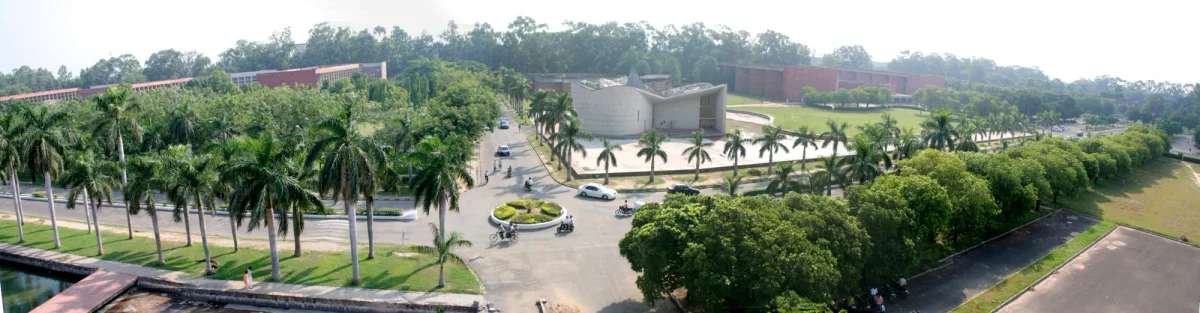
Panjab University institutional setting
1 / 6

Established in 1882, the Panjab University is a non-profit public higher education institution located in the urban setting of the metropolis of Chandigarh (population range of 1,000,000-5,000,000 inhabitants).

Officially recognized by the University Grants Commission of India, Panjab University (PU) is a large-sized coeducational Indian higher education institution. Panjab University (PU) offers courses and programs leading to officially recognized higher education degrees such as bachelor's degrees, master's degrees and doctorate degrees in several areas of study.

This 142-year-old Indian higher-education institution has a selective admission policy based on entrance examinations and students' past academic records and grades. The acceptance rate range is 40-49% making this Indian higher education organization an averagely selective institution.

International applicants are eligible to apply for enrollment.

PU also provides several academic and non-academic facilities and services to students including a library, housing, sports facilities, financial aids and/or scholarships, study abroad and exchange programs, online courses and distance learning opportunities, as well as administrative services.

Location & Contact

For visits or applications to Panjab University, location and primary contact details are below. Open days are typically announced via social channels — follow them to receive event notifications.

Address: Sector 14
Postal Code: 160 014
Phone: +91 (172) 541 945
Fax: +91 (172) 541 022
Social Media:

Academic Details

Panjab University's academic structure, enrolment numbers, and accreditation context are gathered below. Together they describe how the institution operates beyond the surface-level overview.

Recognition: University Grants Commission of India
Student Enrollment: 15
Academic Staff Range: 1,000-1,499
Campus Setting: Urban
Memberships & Networks
Association of Commonwealth Universities (ACU)

Academic Structures

The colleges, schools, and faculties that house Panjab University's degrees are below. Clinical units and teaching hospitals are often part of medical schools, with separate governance arrangements.

Unit 11 items
  • Faculty of Arts
  • Faculty of Business Management and Commerce
  • Faculty of Dairying, Animal Husbandry and Agriculture
  • Faculty of Design and Fine Arts
  • Faculty of Education
  • Faculty of Engineering and Technology
  • Faculty of Languages
  • Faculty of Law
  • Faculty of Medical Sciences
  • Faculty of Pharmaceutical Sciences
  • Faculty of Science

Programs Offered

Every programme Panjab University offers, searchable by name and grouped by level. Pathway programmes leading from foundation to bachelor entry are sometimes listed separately from full degree programmes.

91 programmes on record. Each level below shows a sample. Compare these on the programs page All programs in India

Bachelor's Degree 18 programmes

Bachelor of Arts
Liberal Arts

Programme website (opens in a new tab)

Bachelor of Commerce
Business & Management

Programme website (opens in a new tab)

Bachelor of Education
Education & Teaching

Programme website (opens in a new tab)

Bachelor of Engineering (Biotechnology)
Biotechnology

Programme website (opens in a new tab)

Bachelor of Engineering (Computer Science and Engineering)
Computer Sciences

Programme website (opens in a new tab)

Bachelor of Engineering (Electrical and Electronics Engineering)
Robotics & Automation

Programme website (opens in a new tab)

Bachelor of Engineering (Electronics and Communication Engineering)
Communication Studies

Programme website (opens in a new tab)

Bachelor of Engineering (Information Technology)
Information Systems & Technology

Programme website (opens in a new tab)

Bachelor of Engineering (Mechanical Engineering)
Mechanical Engineering

Programme website (opens in a new tab)

Bachelor of Hotel Management and Catering Technology
Tourism & Leisure

Programme website (opens in a new tab)

Showing 10 of 18.

Master of Business Administration 7 programmes

Master of Business Administration
Business Administration

Programme website (opens in a new tab)

Master of Business Administration (Business Analytics)
Data Science & Analytics

Programme website (opens in a new tab)

Master of Business Administration (Distance and Online Education)
Business Administration

Programme website (opens in a new tab)

Master of Business Administration (Entrepreneurship)
Entrepreneurship

Programme website (opens in a new tab)

Master of Business Administration (Executive)
Business Administration

Programme website (opens in a new tab)

Master of Business Administration (Human Resource)
Human Resource Management

Programme website (opens in a new tab)

Master of Business Administration (International Business)
International Business

Programme website (opens in a new tab)

Master of Philosophy 5 programmes

M.Phil (Economics)
Economics

Programme website (opens in a new tab)

M.Phil (Geography)
Geography

Programme website (opens in a new tab)

M.Phil (Political Science)
Politics & International Relations

Programme website (opens in a new tab)

M.Phil (Psychology)
Psychology

Programme website (opens in a new tab)

Master's Degree 33 programmes

Bachelor of Arts Bachelor of Laws (Honours) (Integrated)
Law

Programme website (opens in a new tab)

Bachelor of Business Administration Bachelor of MBA (Integrated) (5 Year)
Business & Management

Programme website (opens in a new tab)

Bachelor of Commerce Bachelor of Laws (Honours) (Integrated)
Law

Programme website (opens in a new tab)

Master of Arts
Liberal Arts

Programme website (opens in a new tab)

Master of Arts (Economics)
Economics

Programme website (opens in a new tab)

Master of Arts (Education)
Education & Teaching

Programme website (opens in a new tab)

Master of Arts (English)
English Language Studies

Programme website (opens in a new tab)

Master of Arts (Hindi)
Literature

Programme website (opens in a new tab)

Master of Arts (History)
History

Programme website (opens in a new tab)

Master of Arts (Journalism and Mass Communication)
Communication Studies

Programme website (opens in a new tab)

Showing 10 of 33.

Doctorate 10 programmes

Doctor of Philosophy (Chemistry)
Chemistry

Programme website (opens in a new tab)

Doctor of Philosophy (Commerce)
Business & Management

Programme website (opens in a new tab)

Doctor of Philosophy (Defence Studies)
Philosophy & Ethics

Programme website (opens in a new tab)

Doctor of Philosophy (Economics)
Economics

Programme website (opens in a new tab)

Doctor of Philosophy (Education)
Philosophy & Ethics

Programme website (opens in a new tab)

Doctor of Philosophy (Engineering)
Philosophy & Ethics

Programme website (opens in a new tab)

Doctor of Philosophy (Law)
Law

Programme website (opens in a new tab)

Doctor of Philosophy (Pharmaceutical Sciences)
Pharmacy

Programme website (opens in a new tab)

Doctor of Philosophy (Physics)
Physics & Astronomy

Programme website (opens in a new tab)

Diploma 11 programmes

Advanced Diploma in Computer Application
Computer Science & IT

Programme website (opens in a new tab)

Advanced Diploma in Disaster Management and Corporate Security
Emergency & Disaster Management

Programme website (opens in a new tab)

Advanced Diploma in Educational Management and Leadership
Business & Management

Programme website (opens in a new tab)

Advanced Diploma in Guidance and Counselling
Counselling & Psychotherapy

Programme website (opens in a new tab)

Advanced Diploma in Health Family Welfare and Population Education
Education & Teaching

Programme website (opens in a new tab)

Advanced Diploma in Human Rights and Duties
Law

Programme website (opens in a new tab)

Advanced Diploma in Library Automation and Networking
Information Systems & Technology

Programme website (opens in a new tab)

Advanced Diploma in Mass Communication
Communication Studies

Programme website (opens in a new tab)

Advanced Diploma in Photography
Photography

Programme website (opens in a new tab)

Advanced Diploma in Social Work
Social Work

Programme website (opens in a new tab)

Showing 10 of 11.

Postgraduate Certificate 3 programmes

Certificate in Corporate Security, Safety and Fire Protection Management
Business & Management

Programme website (opens in a new tab)

Certificate in Vivekananda Studies

Programme website (opens in a new tab)

Certificate in Women Studies

Programme website (opens in a new tab)

Postgraduate Diploma 4 programmes

Postgraduate Diploma in Accelerator and Detector Physics
Physics & Astronomy

Programme website (opens in a new tab)

Postgraduate Diploma in Advanced Scientific Computing
Information Systems & Technology

Programme website (opens in a new tab)

Postgraduate Diploma in Optoelectronic Device Fabrication
Robotics & Automation

Programme website (opens in a new tab)

Postgraduate Diploma in Remote Sensing and Geographic Information Systems
Information Systems & Technology

Programme website (opens in a new tab)

How to apply to Panjab University

A practical five-step guide to applying to Panjab University, from programme research through submission and follow-up.

  1. 1
    Find a programme that fits your goals

    Panjab University's catalogue includes 91 programmes. Browse by level, identify candidates matching your prior qualifications, and note their entry requirements for the next step.

  2. 2
    Confirm you meet the requirements

    Entry requirements vary by programme and degree level. Verify academic minimums, language tests (if international), and any additional documents required for Panjab University's admissions process.

  3. 3
    Assemble your application package

    Typical documents include academic transcripts, identity proof (passport or national ID), language proficiency test scores, a personal statement or motivation letter, and recommendation letters. International applicants should account for translation and notarisation time.

  4. 4
    Submit your application

    Submit your completed application through Panjab University's official website at puchd.ac.in. Most institutions use an online portal — register an account, complete the application form, and upload your prepared documents. Keep copies of all submissions and confirmation receipts.

  5. 5
    Contact admissions and follow up

    Follow up to confirm your application was received and is being processed. Reach the institution by phone at +91 (172) 541 945. Admissions teams may request interviews or additional documents — respond promptly to keep your application active.

Frequently Asked Questions about Panjab University

Short Q&A on the institutional facts that matter most when shortlisting Panjab University as a study destination.

How old is Panjab University?

The institution opened in 1882 (approximately 144 years ago).

Where is Panjab University located?

Panjab University is located in Chandigarh, India.

What is Panjab University's control type?

It is a public higher-education institution.

What is the student enrolment at Panjab University?

Student enrolment at Panjab University is around 15,000-19,999.

How is Panjab University ranked?

Panjab University holds rank #1356 globally and #24 in India.

How is Panjab University organised academically?

The institution comprises 11 academic units.

Is Panjab University officially recognised?

Yes, Panjab University is recognised by University Grants Commission of India.

Where can I learn more about Panjab University?

You can find Panjab University online at puchd.ac.in.

Top-Ranked Universities in India

National rankings in India often weight different signals than international rankings. The leaders below typically top both, but the order can differ meaningfully.
Members of Association of Commonwealth Universities (ACU)

Cross-credit recognition between Association of Commonwealth Universities (ACU) members reduces friction for students moving between universities. Panjab University's membership often eases credit transfer to the institutions below.

Faculties at nearby universities

Cross-border or within-state choices: the universities near Panjab University may fall under different governance, fee structures, or visa rules. Confirm the regulatory context for each option separately.

Where Else to Study Law

Capstone publication or portfolio output from Law programmes affects what you graduate with. Some India institutions retain student work; others publish it as part of programme outputs.

Universities Compared with Panjab University

Looking at Panjab University through a comparison lens? These universities share similar academic positioning and are commonly considered against Panjab University during the application process. Cross-comparison helps clarify the institutional fit beyond ranking signals.

Browse all articles →

Spotted something outdated or missing?

Help us keep this page accurate — it takes about 30 seconds.

Explore More Universities in India

Free calculators and converters to plan your study-abroad journey.

Latest Articles

Fresh guides and advice for studying abroad.

View all →

Compare Compare