SUNY Maritime College
Throgs Neck, United States • Founded 1874
Overview
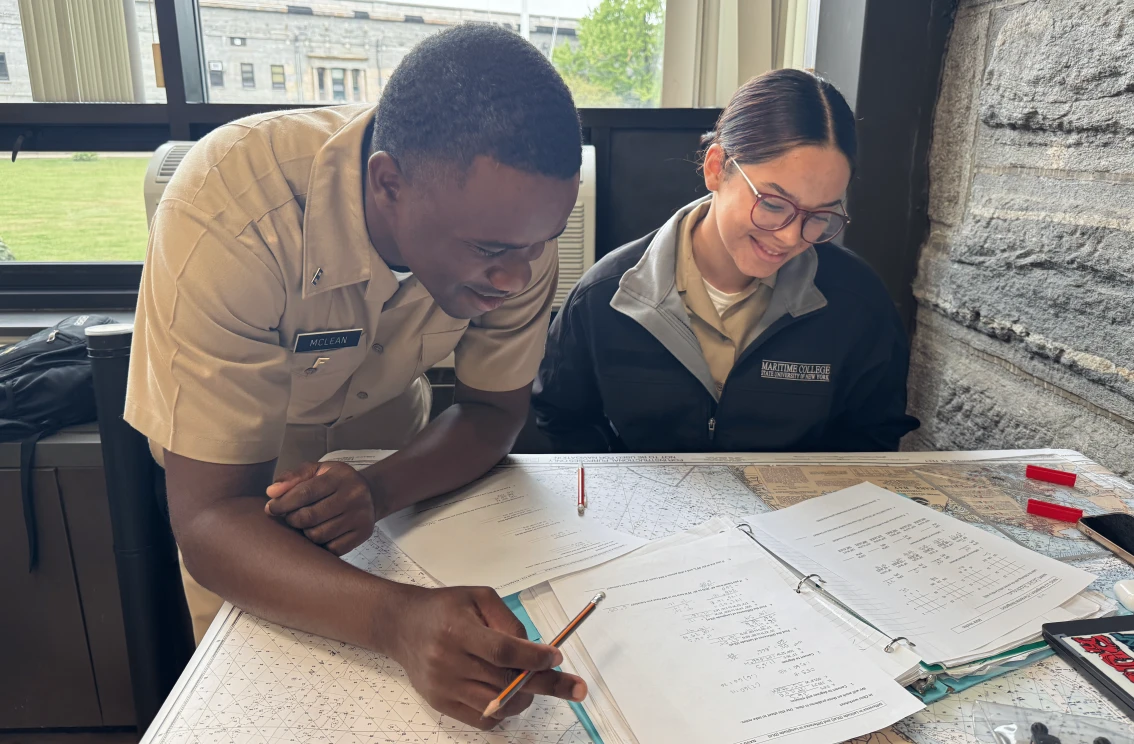
Founded in 1874, the SUNY Maritime College is a non-profit public higher education institution located in the urban setting of the metropolis of Throggs Neck (population range of 1,000,000-5,000,000 inhabitants), New York.
Officially accredited by the Middle States Commission on Higher Education, SUNY Maritime College (SUNY) is a very small-sized coeducational US higher education institution. SUNY Maritime College (SUNY) offers courses and programs leading to officially recognized higher education degrees such as pre-bachelor's degrees (i.e. certificates, diplomas, associate or foundation), bachelor's degrees and master's degrees in several areas of study.
This 150-year-old US higher-education institution has a selective admission policy based on entrance examinations and students' past academic records and grades. The acceptance rate range is 70-79% making this US higher education organization a moderately selective institution.
International students are welcome to apply for enrollment.
SUNY also provides several academic and non-academic facilities and services to students including a library, housing, sports facilities, financial aids and/or scholarships, study abroad and exchange programs, online courses and distance learning opportunities, as well as administrative services.
Location & Contact
SUNY Maritime College's campus location, postal address, and the channels students typically use to reach the admissions team. Verified contact points help avoid third-party impersonators.
Academic Details
The figures below cover SUNY Maritime College's academic scale, faculty depth, and recognised standing. Treat the enrolment count as a point-in-time snapshot; trends require multi-year comparison.
Academic Structures
SUNY Maritime College's internal academic organisation — faculties, schools, and constituent units — is broken down below. Each unit handles a specific subject cluster and houses its own programmes and faculty.
Unit 7 items
- Department of Engineering
- Department of Global Business and Transportation
- Department of Humanities
- Department of Marine Technology Small Vessel Operations
- Department of Marine Transportation
- Department of Physical Education
- Department of Science
Programs Offered
SUNY Maritime College's catalogue, searchable by name and grouped by level. Joint programmes with partner institutions appear here but carry dual-credentialing rules worth checking with both bodies.
Bachelor's Degree
10 programmes
SUNY Maritime College delivers 10 programmes at bachelor's level, the qualifications school-leavers most commonly apply to as their first step into higher education.
Natural Resources Conservation and Research Forestry & Natural Resources
Electrical, Electronics, and Communications Engineering Electrical Engineering
Mechanical Engineering Mechanical Engineering
Naval Architecture and Marine Engineering General Engineering
Industrial Engineering Industrial & Systems Engineering
Maritime Studies Liberal Arts
Multi/Interdisciplinary Studies, Other Liberal Arts
Atmospheric Sciences and Meteorology Climate Studies & Meteorology
Marine Transportation Supply Chain & Logistics
Business, Management, Marketing, and Related Support Services, Other Business Administration
No programmes match your filter in this level.
Master's Degree
2 programmes
At postgraduate taught level, SUNY Maritime College runs 2 programmes. These master's degrees suit applicants ready to concentrate on a narrower field than their bachelor's covered.
Maritime Studies Liberal Arts
Business Administration, Management and Operations Business Administration
No programmes match your filter in this level.
Associate, Certificate & Other Qualifications
3 programmes
Alongside its degrees, SUNY Maritime College provides 3 programmes at associate, certificate, diploma, and foundation level, typically shorter and more applied in focus.
Engineering/Engineering-Related Technologies/Technicians, Other General Engineering
Marine Transportation Supply Chain & Logistics
Business Administration, Management and Operations Business Administration
No programmes match your filter in this level.
How to apply to SUNY Maritime College
Application guidance for SUNY Maritime College, structured as five practical steps with attention to documents and admissions communication.
- 1 Browse the programme catalogue
Begin by reviewing the programmes section above. SUNY Maritime College offers 15 programmes grouped by qualification level. Decide on a target tier (bachelor's, master's, or doctoral) before narrowing by subject.
- 2 Check eligibility for your chosen programme
Each programme at SUNY Maritime College has its own entry requirements — academic minimums, language proficiency, supporting documents, and sometimes interviews or portfolios. Check the programme-specific page or contact admissions to confirm eligibility.
- 3 Get your documents ready
Most applications require certified academic records, identification documents, language test certificates (IELTS, TOEFL, or equivalent for English-medium programmes), CV/résumé, and a statement of purpose. Allow extra time for document authentication.
- 4 Apply through the official channel
Apply directly via SUNY Maritime College's online portal at www.sunymaritime.edu. Complete the application form, upload supporting documents, and pay any application fee. Confirmation emails typically arrive within a few business days.
- 5 Reach out and track your application
After submitting, confirm receipt with the admissions office and track your application status through the portal. You can reach the institution by email at [email protected] or by phone at +1 (718) 409 7200. Set reminders for any interview requests, additional document submissions, or admission decision deadlines.
Frequently Asked Questions about SUNY Maritime College
Quick answers to the most common questions about SUNY Maritime College — covering location, founding, ranking, programmes, and admissions context.
In what year was SUNY Maritime College established?
SUNY Maritime College was founded in 1874 (approximately 152 years ago).
Where can I find SUNY Maritime College?
The institution is located in Throgs Neck, United States.
Is SUNY Maritime College a public or private institution?
SUNY Maritime College operates as a public institution.
How many students does SUNY Maritime College have?
The institution has a student body of 1,000-1,999.
What is SUNY Maritime College's academic structure?
SUNY Maritime College is organised into 7 academic units across its disciplines.
Is SUNY Maritime College officially recognised?
SUNY Maritime College is accredited by Middle States Commission on Higher Education.
What is SUNY Maritime College's official website?
The institution's website is www.sunymaritime.edu.
Top-Ranked Universities in the United States
Looking for the strongest names in the United States? These are the highest-ranked institutions nationally — useful context for benchmarking SUNY Maritime College against the country's most established universities. National benchmarks also signal the upper bound of academic prestige in the United States.



Members of National Collegiate Athletic Association (NCAA)
Member institutions of National Collegiate Athletic Association (NCAA) often have reciprocity arrangements on accreditation — degrees from one member institution typically face fewer credential-recognition issues at others.

Faculties at Nearby Universities
If you're weighing SUNY Maritime College against other institutions in the area, these neighbouring universities offer overlapping faculties and similar admissions cycles. They are useful for shortlisting based on travel distance or campus environment.


Where Else to Study Liberal Arts
Supervision quality at the Liberal Arts programme level is hard to assess externally but affects research output and graduate-school placement. Talk to current students or alumni where possible.



Universities Often Compared with SUNY Maritime College
Peer universities to SUNY Maritime College by academic scale and prestige are listed below. These often share comparable faculty depth, research output, and graduate outcomes, making the comparison more meaningful than ranking alone.