
Trinity College
Hartford, United States • Founded 1823 • World Rank #4518
Updated Jun 2026
Overview
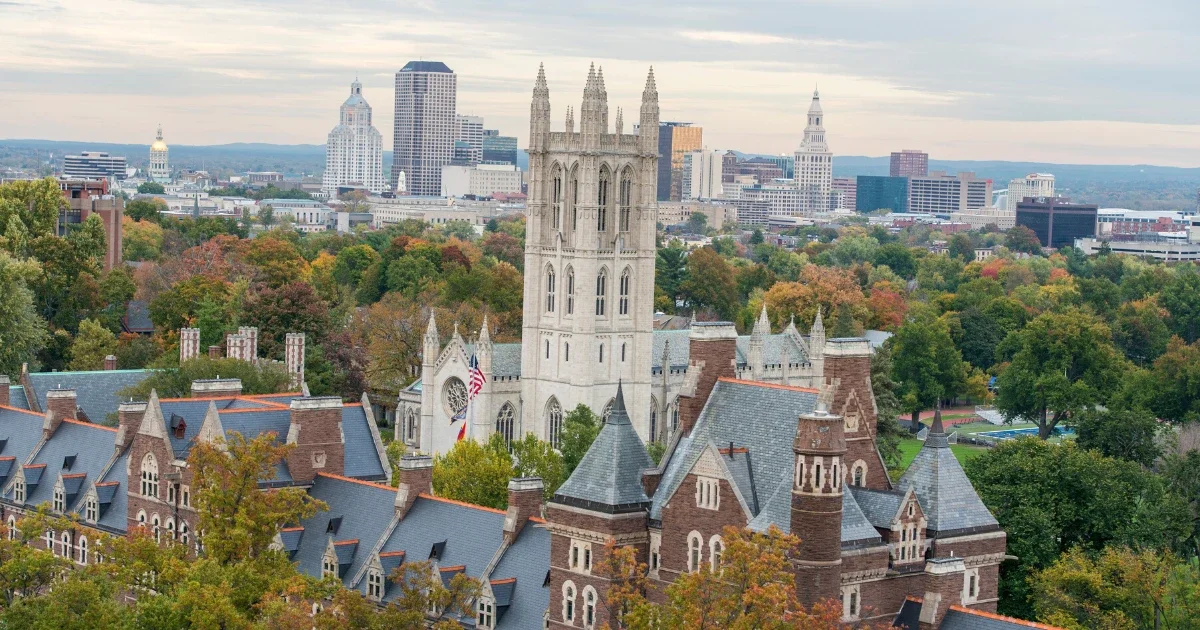


Established in 1823, the Trinity College is a non-profit private liberal arts higher education institution located in the urban setting of the small city of Hartford (population range of 50,000-249,999 inhabitants), Connecticut.
Officially accredited by the New England Commission of Higher Education, Trinity College (TC) is a small-sized coeducational US higher education institution. Trinity College (TC) offers courses and programs leading to officially recognized higher education degrees such as bachelor's degrees and master's degrees in several areas of study.
This 200-year-old US higher-education institution has a selective admission policy based on entrance examinations and students' past academic records and grades. The acceptance rate range is 30-39% making this US higher education organization a very selective institution.
International applicants are eligible to apply for enrollment.
TC also provides several academic and non-academic facilities and services to students including a library, housing, sports facilities, financial aids and/or scholarships, study abroad and exchange programs, as well as administrative services.
Location & Contact
Need to mail, call, or visit Trinity College? Address, phone, and digital contact options below. Religious and cultural accommodation queries route through specific student services.
Academic Details
Trinity College's student body, faculty composition, and recognition framework are summarised below. Use this section to gauge institutional weight before drilling into specific programmes.
Programs Offered
Below: Trinity College's programme list by level. Programme intakes vary — some offer multiple entry points per year (Sep, Jan, May), others a single annual intake.
54 programmes on record. Each level below shows a sample. Compare these on the programs page All programs in United States
Bachelor's Degree 44 programmes
Showing 10 of 44.
Master's Degree 8 programmes
Postgraduate Certificate 2 programmes
How to apply to Trinity College
Five steps that capture how most applications to Trinity College flow, from research through submission to follow-up correspondence.
-
1
Identify the right programme
Use the programme finder to browse Trinity College's 54 active programmes. Filter by keyword or scan by degree level. Read curriculum details on each programme's dedicated page if available.
-
2
Check entry requirements
Programme-level requirements at Trinity College typically include academic transcripts, language proficiency proof, identity documents, and a personal statement or interview. Confirm specific requirements with the admissions office.
-
3
Prepare your application documents
Prepare academic transcripts, ID/passport copies, language proficiency proof, a personal statement, and reference letters. International candidates may need apostilled or notarised translations — start early to avoid deadline pressure.
-
4
Submit via the institution
Trinity College processes applications through www.trincoll.edu. Create an account, fill out the application form, and submit your documents. Note application deadlines, which vary by intake and programme.
-
5
Get in touch with admissions
Confirm receipt of your application with the admissions office and keep an eye on your portal for status changes. Reach the institution by phone at +1 (860) 297 2000. Quick responses to any follow-up requests keep your application moving smoothly through the review process.
Frequently Asked Questions about Trinity College
Frequently asked questions about Trinity College, covering the institutional basics most prospective applicants want to confirm first.
How old is Trinity College?
The institution opened in 1823 (approximately 203 years ago).
Where can I find Trinity College?
The institution is located in Hartford, United States.
Is Trinity College a public or private institution?
It is a private higher-education institution.
How many students does Trinity College have?
The institution has a student body of 2,000-2,999.
What is Trinity College's ranking?
Trinity College is ranked #4518 globally and #478 in United States.
Who recognises Trinity College?
Yes, Trinity College is recognised by New England Commission of Higher Education.
Where can I learn more about Trinity College?
Trinity College's official website is www.trincoll.edu.
Top-Ranked Universities in the United States
Graduate-school placement rates among the United States's top universities set the upper bound for that signal. Trinity College's placement rate relative to leaders is one signal of academic preparation depth.



Members of National Collegiate Athletic Association (NCAA)
Beyond Trinity College, these universities also belong to National Collegiate Athletic Association (NCAA) — useful for students who weight inter-institutional partnerships, exchange programmes, or shared accreditation frameworks. Membership networks often translate into practical student benefits.



Faculties at nearby universities
Cost of living varies meaningfully across cities and towns hosting the universities below. Even within a single region, accommodation and transit costs can differ by 30–50%.


Where Else to Study Linguistics & Language Studies
Alumni outcomes data publication varies across Linguistics & Language Studies programmes in the United States. Where available, post-grad employment and salary data is the best signal of programme quality beyond marketing claims.


Universities Compared with Trinity College
Comparable peer metrics — selectivity, yield, faculty awards — give a fuller picture than headline rankings alone. The universities below cluster around Trinity College on most of these signals.



Studying in United States: guides and resources





Spotted something outdated or missing?
Help us keep this page accurate — it takes about 30 seconds.