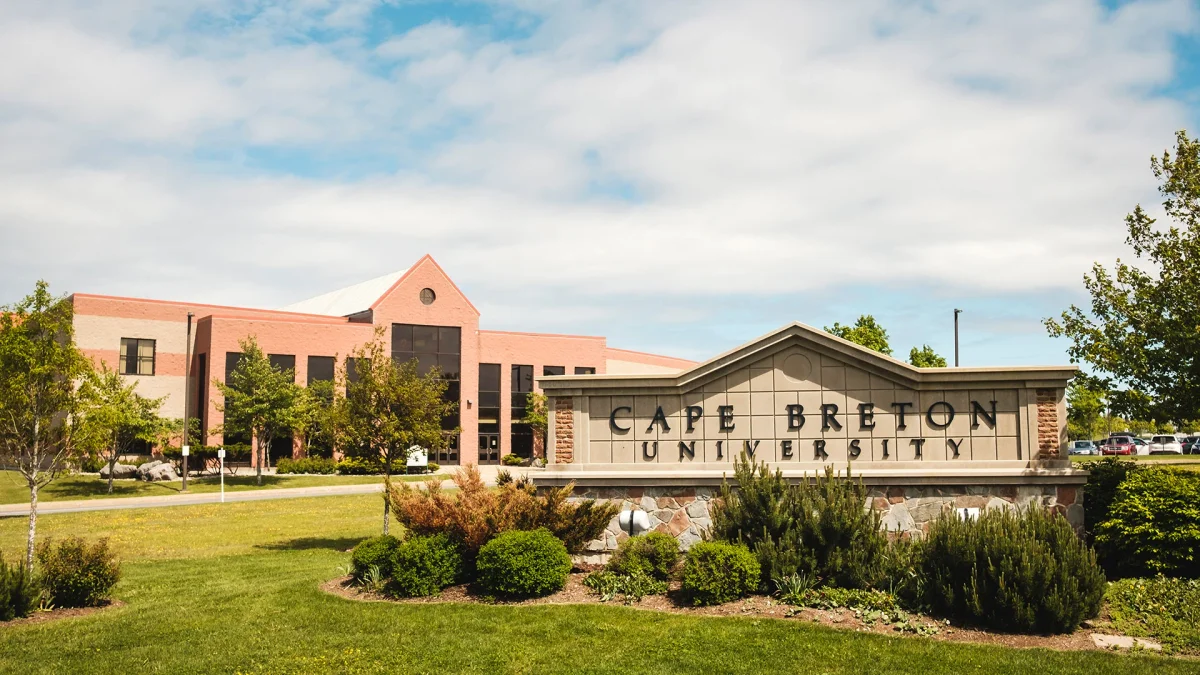
Bachelor of Engineering Technology in Mechanical is a bachelor's degree in Mechanical Engineering programme offered by Cape Breton University in Sydney, Canada. The programme runs for 3 years, delivered on campus. Tuition for international students is CAD 71,383 per total (CAD 33,994 per total for local students).
At a glance
Degree:Bachelor's Degree
Field:Mechanical Engineering
Duration: 3 years
Delivery: On Campus
Local tuition: CAD 33,994 / total
International tuition: CAD 71,383 / total
Information for the 2027/28 academic year · Last reviewed September 2026 ·
Program details
Overview
Cape Breton University's Bachelor of Engineering Technology (Mechanical), delivered on campus, covers mechanical design, manufacturing and fabrication, drafting, and project management or organizational planning, with optional areas of specialization in robotics, process control and professional practice. The degree is offered as a direct-entry option (90 credits) or an Advanced Mechanical option (120 credits), and includes an available co-op work-integrated learning placement for students who maintain a 70 percent overall average in program courses. CBU states plainly that this Bachelor of Engineering Technology credential does not lead directly to a professional engineering designation. The program is described as preparing graduates to design, analyze, build and maintain mechanical systems used across industries such as energy, construction, manufacturing and infrastructure, combining classroom instruction with hands-on labs and experiential learning. Career paths named include design and drafting technologist, maintenance or reliability technologist, mechanical engineering technologist, manufacturing engineering technician, and project coordinator or manager. The program suits students who want applied, technologist-level training in mechanical systems and are willing to pursue the optional co-op route for work experience, rather than students specifically seeking a professional engineering license.
Requirements
Minimum GPA:65.00 / %
Admission Requirements: This Bachelor of Engineering Technology in Mechanical page does not set its own admission average beyond its high-school course list; it otherwise defers to Cape Breton University's general admission requirements. Canadian high school graduates need English 12 (academic or advanced), Math 12 (academic or advanced), two Science 12 level courses with Chemistry recommended, and one further grade 12 academic or advanced course. Continuation into the co-op stream requires students to maintain a 70% overall average in programme courses. Transfer applicants, including diploma holders from Nova Scotia Community College, must be in good academic standing and meet the equivalent post-secondary requirement, and CBU's institution-wide domestic threshold of an overall average of at least 65% (minimum age 16) also applies. International applicants must meet CBU's English-language requirement: IELTS Academic/Indicator 6.5 (no band below 6.0), TOEFL iBT/Home Edition 80 (no skill below 20) before 21 January 2026 or 4.5 after, Duolingo 120, PTE Academic 59, Michigan English Test 58, CAEL 60, or Oxford ELLT 7.
Application Details
Application Deadline:Domestic applicants apply directly to Cape Breton University: for September 2027 entry, general undergraduate applications open 1 October 2026 and close 3 September 2027, while the Bachelor of Social Work closes earlier on 15 January 2027 (documents by 22 January) and the Bachelor of Science in Nursing closes 26 February 2027; January 2027 entry closes 15 December 2026, and May 2027 entry closes 15 April 2027 for most programmes -- except the Bachelor of Education, whose only intake is May 2027 (Spring) and which closes 15 January 2027 (documents by 22 January), not 15 April. International applicants use the same application, with the September 2027 intake open 1 October 2026 to 15 May 2027, January 2027 closing 15 October 2026, and May 2027 closing 15 February 2027. CBU states deadlines may close early once enrolment targets are met, so admission runs on a rolling basis within each posted window rather than a firm cut-off. These are institution-wide dates; this programme publishes no deadline of its own.