Cape Breton University
Sydney, Canada • Founded 1974
Updated Sep 2026
Overview
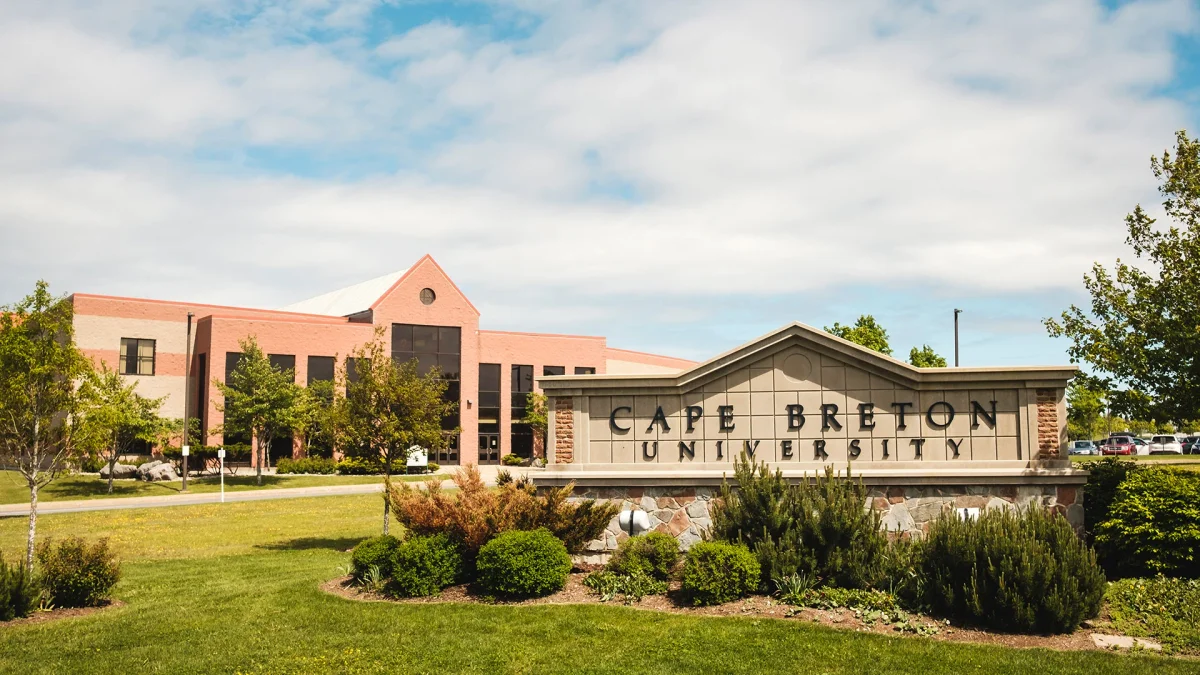
Founded in 1974, the Cape Breton University is a non-profit public higher education institution located in the suburban setting of the small city of Sydney (population range of 50,000-249,999 inhabitants), Nova Scotia.
This institution also has a branch campus in New Cairo. Officially recognized by the Department of Advanced Education of Nova Scotia, Cape Breton University (CBU) is a small-sized coeducational Canadian higher education institution.
Cape Breton University (CBU) offers courses and programs leading to officially recognized higher education degrees such as pre-bachelor's degrees (i.e. certificates, diplomas, associate or foundation), bachelor's degrees and master's degrees in several areas of study. This 50-year-old Canadian higher-education institution has a selective admission policy based on students' past academic records and grades.
The acceptance rate range is 50-59% making this Canadian higher education organization an averagely selective institution.
International students are welcome to apply for enrollment. CBU also provides several academic and non-academic facilities and services to students including a library, housing, sports facilities, financial aids and/or scholarships, study abroad and exchange programs, online courses and distance learning opportunities, as well as administrative services.
Location & Contact
Cape Breton University's address, phone, email, and social presence. Department-level scholarship enquiries route faster through the specific faculty rather than central admissions.
Academic Details
Below are the institutional metrics for Cape Breton University: scale, staffing balance, and accreditation context. These shape the academic experience more than headline rankings often suggest.
Academic Structures
The academic-side structure of Cape Breton University, broken down by unit type. International branch campuses, where they exist, are sometimes organised as separate units with their own structure.
Unit 5 items
- School of Arts and Social Sciences
- School of Professional Studies
- School of Science and Technology
- Shannon School of Business
- Unama'ki College
Programs Offered
The programme finder below covers every degree Cape Breton University currently offers. Programme codes here often map to international classification systems used for credential recognition abroad.
39 programmes on record. Each level below shows a sample. Compare these on the programs page All programs in Canada
Bachelor's Degree 33 programmes
Showing 10 of 33.
Master's Degree 6 programmes
How to apply to Cape Breton University
Step-by-step guidance for applying to Cape Breton University, covering the typical sequence from programme selection to admissions follow-up.
-
1
Identify the right programme
Begin by reviewing the programmes section above. Cape Breton University offers 39 programmes grouped by qualification level. Decide on a target tier (bachelor's, master's, or doctoral) before narrowing by subject.
-
2
Check entry requirements
Each programme at Cape Breton University has its own entry requirements — academic minimums, language proficiency, supporting documents, and sometimes interviews or portfolios. Check the programme-specific page or contact admissions to confirm eligibility.
-
3
Prepare your application documents
Most applications require certified academic records, identification documents, language test certificates (IELTS, TOEFL, or equivalent for English-medium programmes), CV/résumé, and a statement of purpose. Allow extra time for document authentication.
-
4
Submit via the institution
Apply directly via Cape Breton University's online portal at www.cbu.ca. Complete the application form, upload supporting documents, and pay any application fee. Confirmation emails typically arrive within a few business days.
-
5
Get in touch with admissions
After submitting, confirm receipt with the admissions office and track your application status through the portal. Reach the institution by phone at +1 (902) 539 5300. Set reminders for any interview requests, additional document submissions, or admission decision deadlines.
Frequently Asked Questions about Cape Breton University
Short Q&A on the institutional facts that matter most when shortlisting Cape Breton University as a study destination.
How old is Cape Breton University?
The institution opened in 1974 (approximately 52 years ago).
Where can I find Cape Breton University?
The institution is located in Sydney, Canada.
Is Cape Breton University public or private?
It is a public higher-education institution.
How many students does Cape Breton University have?
The institution has a student body of 7,000.
How is Cape Breton University organised academically?
Cape Breton University is organised into 5 academic units across its disciplines.
Is Cape Breton University accredited?
Cape Breton University is accredited by Department of Advanced Education of Nova Scotia.
How do I find Cape Breton University online?
The institution's website is www.cbu.ca.
Top-Ranked Universities in Canada
National rankings in Canada often weight different signals than international rankings. The leaders below typically top both, but the order can differ meaningfully.

Members of Universities Canada (UC)
Other members of Universities Canada (UC) are listed below.

Faculties at nearby universities
Also in Sydney: universities located close to Cape Breton University.

Where Else to Study Education & Teaching
Other institutions in Canada teaching Education & Teaching are listed below for comparison with Cape Breton University.

Universities Compared with Cape Breton University
Universities of a similar scale and standing to Cape Breton University are listed below.
Studying in Canada: guides and resources



Spotted something outdated or missing?
Help us keep this page accurate — it takes about 30 seconds.