University of Birmingham
Birmingham, United Kingdom • Founded 1900 • World Rank #148
Updated May 2026
Overview
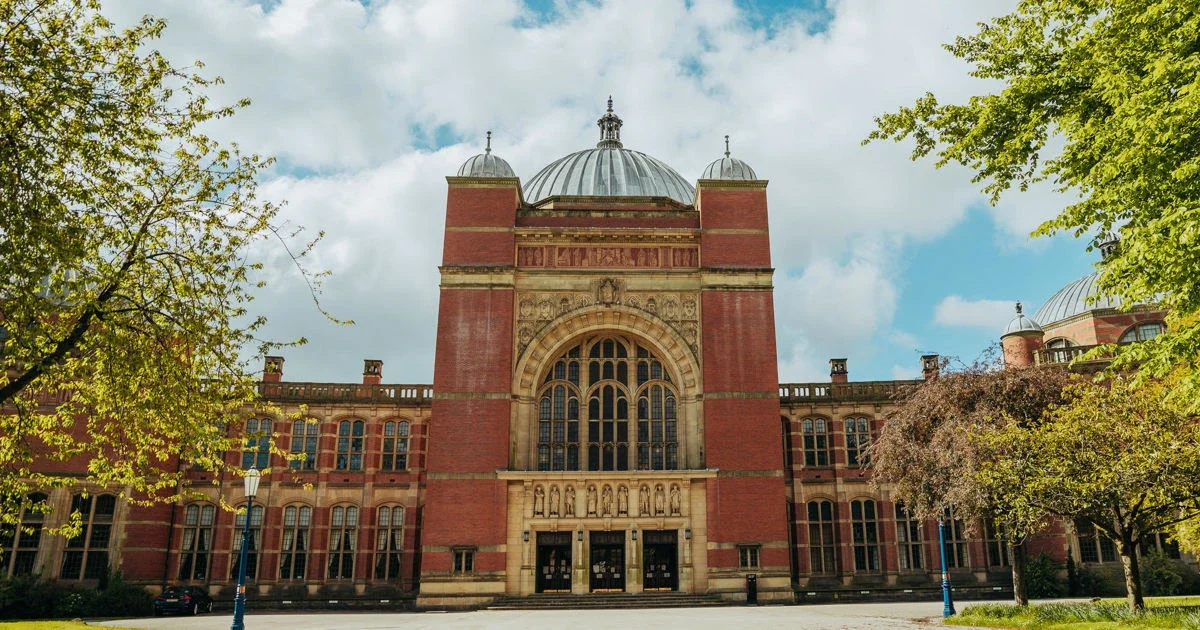


Founded in 1900, the University of Birmingham is a non-profit public higher education institution located in the urban setting of the metropolis of Birmingham (population range of 1,000,000-5,000,000 inhabitants), West Midlands.
Officially recognized/chartered by the Privy Council, University of Birmingham (BHAM) is a very large-sized coeducational UK higher education institution. University of Birmingham (BHAM) offers courses and programs leading to officially recognized higher education degrees such as pre-bachelor's degrees (i.e. certificates, diplomas, associate or foundation), bachelor's degrees, master's degrees and doctorate degrees in several areas of study.
This 123-year-old UK higher-education institution has a selective admission policy based on students' past academic records and grades. International students are welcome to apply for enrollment.
BHAM also provides several academic and non-academic facilities and services to students including a library, sports facilities, study abroad and exchange programs, as well as administrative services.
Location & Contact
Find University of Birmingham on the map and reach the right office through the contact channels listed below. Use these for general enquiries; specific departments often run their own contact pages.
Academic Details
Below are the institutional metrics for University of Birmingham: scale, staffing balance, and accreditation context. These shape the academic experience more than headline rankings often suggest.
Academic Structures
University of Birmingham's academic structure — the schools, colleges, and divisions inside the institution — is laid out below. Use this map when figuring out which faculty owns the programme you want.
Unit 6 items
- Birmingham Business School
- College of Arts and Law
- College of Engineering and Physical Sciences
- College of Life and Environmental Sciences
- College of Medical and Dental Sciences
- College of Social Sciences
Degrees
Whether you're considering bachelor's, master's, or doctoral study at University of Birmingham, qualifications are sorted by level. Stackable credentials (microcredentials adding up to full degrees) appear separately where available.
Bachelor's 13 programs
Bachelor's programmes build foundational expertise, preparing graduates for entry-level professional roles and further postgraduate study.
- Arts and Humanities
- Business Administration
- Education
- Engineering
- Fine Arts
- Health Sciences
- Information Sciences
- Law
- Mathematics and Computer Science
- Natural Sciences
- Performing Arts
- Philosophy
- Social Sciences
Master's 14 programs
Master's programmes develop advanced specialised expertise, suited to senior industry positions and applied research.
- Arts and Humanities
- Business Administration
- Education
- Engineering
- Health Sciences
- Information Sciences
- Law
- Mathematics and Computer Science
- Natural Sciences
- Performing Arts
- Religion
- Social Sciences
- Technology
- Welfare and Protective Services
Doctoral 42 programs
Doctoral programmes train independent researchers, leading to academic, scientific, and senior advisory careers.
- Accountancy
- African Studies
- American Studies
- Ancient Civilizations
- Applied Linguistics
- Archaeology
- Art History
- Biological and Life Sciences
- Canadian Studies
- Chemical Engineering
- Chemistry
- Civil Engineering
- Computer Science
- Dentistry
- Earth Sciences
- Economics
- Education
- English
- Environmental Studies
- Film
- Finance
- Geography
- Heritage Preservation
- History
- Law
- Management
- Marketing
- Mathematics
- Medicine
- Modern Languages
- Music
- Oncology
- Philosophy
- Physics
- Political Sciences
- Psychology
- Rehabilitation and Therapy
- Religion
- Sports
- Theatre
- Theology
- Writing
Faculties & Divisions
All faculties operate under Privy Council.
Arts and Law (College) 14 subjects offered
Specialisations & Subjects
- American Studies
- Ancient Civilizations
- Archaeology
- Art History
- Canadian Studies
- Cultural Studies
- English
- History
- Law
- Music
- Philosophy
- Religion
- Theatre
- Theology
Common Career Paths
- Lawyer
- Legal Consultant
- Compliance Officer
Illustrative career directions for this field; specific outcomes depend on programme and student choices.
Engineering and Physical Sciences (College) 12 subjects offered
Specialisations & Subjects
- Astronomy and Space Science
- Chemical Engineering
- Chemistry
- Civil Engineering
- Computer Engineering
- Computer Science
- Electrical and Electronic Engineering
- Materials Engineering
- Mathematics
- Mechanical Engineering
- Metallurgical Engineering
- Physics
Common Career Paths
- Engineer
- Project Manager
- Technical Consultant
Illustrative career directions for this field; specific outcomes depend on programme and student choices.
Life and Environmental Sciences (College) 6 subjects offered
Specialisations & Subjects
- Biological and Life Sciences
- Earth Sciences
- Environmental Studies
- Geography
- Psychology
- Sports
Common Career Paths
- Environmental Consultant
- Sustainability Officer
- Climate Analyst
Illustrative career directions for this field; specific outcomes depend on programme and student choices.
Medical and Dental Sciences (College) 6 subjects offered
Specialisations & Subjects
- Demography and Population
- Dentistry
- Health Sciences
- Immunology
- Medicine
- Oncology
Common Career Paths
- Physician
- Clinical Researcher
- Healthcare Specialist
Illustrative career directions for this field; specific outcomes depend on programme and student choices.
Social Sciences (College) 8 subjects offered
Specialisations & Subjects
- Accountancy
- Economics
- Education
- Finance
- Government
- Management
- Social Policy
- Social Sciences
Common Career Paths
- Researcher
- Policy Analyst
- Social Worker
Illustrative career directions for this field; specific outcomes depend on programme and student choices.
Programs Offered
University of Birmingham's catalogue, with name search and level grouping. Capstone or dissertation requirements vary across programmes — confirm what you'll be assessed on before applying.
564 programmes on record. Each level below shows a sample. Compare these on the programs page All programs in United Kingdom
Honours Degree 223 programmes
Showing 10 of 223.
Master of Business Administration 1 programme
Master's Degree 261 programmes
Showing 10 of 261.
Doctorate 54 programmes
Showing 10 of 54.
Professional Doctorate 8 programmes
Postgraduate Certificate 15 programmes
Showing 10 of 15.
Postgraduate Diploma 1 programme
How to apply to University of Birmingham
How to apply to University of Birmingham — a five-step structure with notes on documents, channels, and timing for each phase.
-
1
Find a programme that fits your goals
Use the programme finder to browse University of Birmingham's 564 active programmes. Filter by keyword or scan by degree level. Read curriculum details on each programme's dedicated page if available.
-
2
Confirm you meet the requirements
Programme-level requirements at University of Birmingham typically include academic transcripts, language proficiency proof, identity documents, and a personal statement or interview. Confirm specific requirements with the admissions office.
-
3
Assemble your application package
Prepare academic transcripts, ID/passport copies, language proficiency proof, a personal statement, and reference letters. International candidates may need apostilled or notarised translations — start early to avoid deadline pressure.
-
4
Submit your application
University of Birmingham processes applications through www.birmingham.ac.uk. Create an account, fill out the application form, and submit your documents. Note application deadlines, which vary by intake and programme.
-
5
Contact admissions and follow up
Confirm receipt of your application with the admissions office and keep an eye on your portal for status changes. Reach the institution by phone at +44 (121) 414 3344. Quick responses to any follow-up requests keep your application moving smoothly through the review process.
Frequently Asked Questions about University of Birmingham
The questions below summarise University of Birmingham's vital institutional details — useful as a quick reference before drilling into specific sections.
When did University of Birmingham open?
University of Birmingham traces its founding to 1900 (approximately 126 years ago).
Where can I find University of Birmingham?
The institution is located in Birmingham, United Kingdom.
What is University of Birmingham's control type?
University of Birmingham is a public institution.
How many students does University of Birmingham have?
The institution has a student body of 30,000-34,999.
How is University of Birmingham ranked?
University of Birmingham holds rank #148 globally and #10 in United Kingdom.
What degrees does University of Birmingham offer?
Programmes at University of Birmingham cover bachelor's, master's and doctoral programmes.
What is University of Birmingham's academic structure?
University of Birmingham has 6 academic units.
Who recognises University of Birmingham?
Yes, University of Birmingham is recognised by OfS, QAA.
How do I find University of Birmingham online?
The institution's website is www.birmingham.ac.uk.
Top-Ranked Universities in the United Kingdom
Below: the United Kingdom's top-ranked universities, providing benchmarks for University of Birmingham's academic standing. National rankings reflect a mix of research output, teaching quality, and graduate outcomes.



Members of European University Association (EUA)
Universities sharing European University Association (EUA) affiliation with University of Birmingham offer comparable mobility and recognition benefits. Affiliated institutions often coordinate on academic standards and credit-transfer pathways.





Faculties at nearby universities
Universities close to University of Birmingham typically fall within the same regional student-transit zones, where transit discounts and shared passes reduce living costs across the cluster.


Where Else to Study Natural Sciences & Mathematics
Other universities in the United Kingdom that teach Natural Sciences & Mathematics appear below — useful for comparing programme depth against University of Birmingham. Programme structures differ even within the same country, so detailed comparison is worth the effort.


Universities Compared with University of Birmingham
Rankings methodologies differ across peer institutions to University of Birmingham. National, subject-specific, and international rankings can all tell different stories about the same set of universities.



Studying in United Kingdom: guides and resources




Spotted something outdated or missing?
Help us keep this page accurate — it takes about 30 seconds.