University of Strathclyde
Glasgow, United Kingdom • Founded 1796 • QS 2027 #230 =
Updated Sep 2026 · Source: strath.ac.uk
Overview
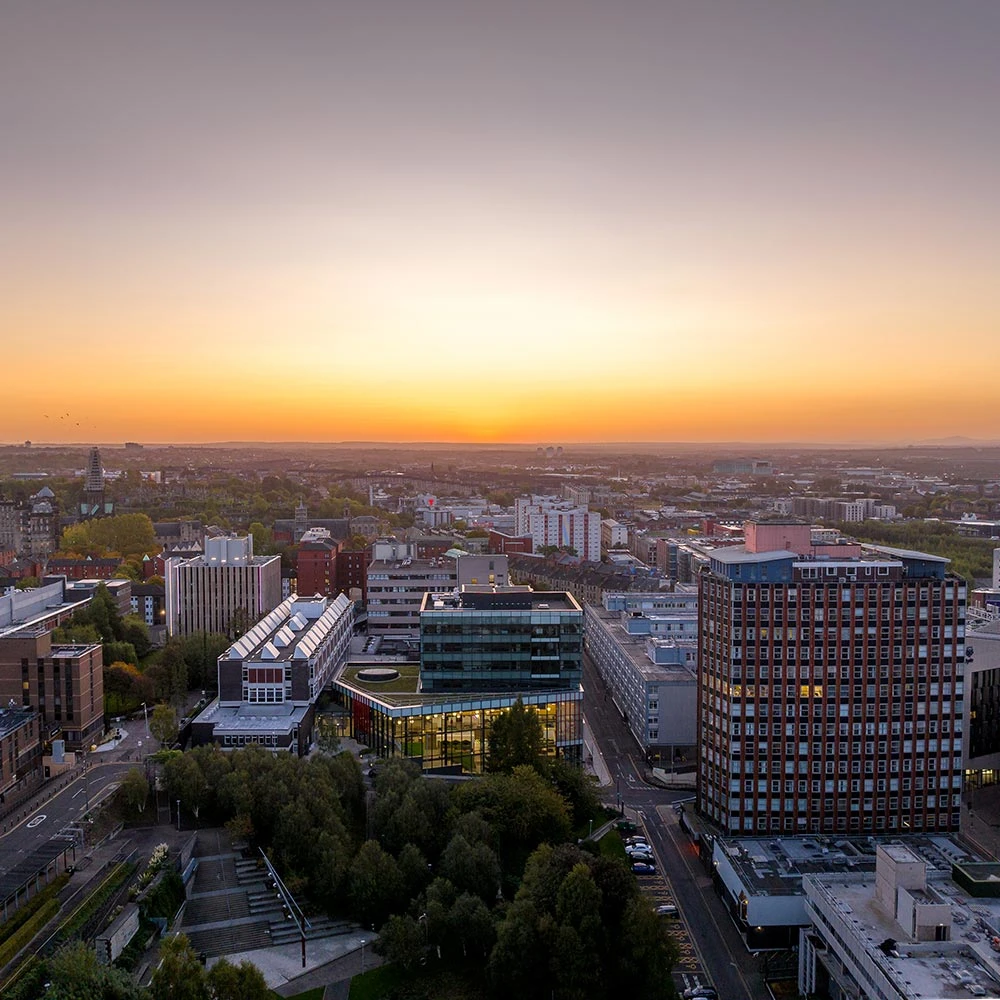


University of Strathclyde is located in Glasgow, Scotland, tracing its origins to the Scottish Enlightenment in 1796 as 'A Place of Useful Learning', and holding a Royal Charter granted in 1964.
The campus is set centrally in Glasgow, near Merchant City, close to the city's rail and transport links. The university is organised into four faculties, Engineering, Humanities & Social Sciences, Science, and Strathclyde Business School, covering subjects from architecture and law to computer science and business.
Strathclyde describes its founding purpose as delivering useful learning, with a stated emphasis on practical, industry-connected teaching and research; the university reports that almost 90 percent of its research output has been rated world-leading or internationally excellent under REF2021. It offers undergraduate, postgraduate taught, and postgraduate research degrees, and its Campus Village provides on-campus accommodation alongside nearby sports facilities.
Location & Contact
Find University of Strathclyde on the map and its contact channels below.
Academic Details
Scale, staffing, and recognition figures for University of Strathclyde are listed below.
Academic Structures
University of Strathclyde's faculties, schools, and constituent units are listed below.
Unit 5 items
- Faculty of Education
- Faculty of Engineering
- Faculty of Law Arts and Social Sciences
- Faculty of Science
- Strathclyde Business School
Faculties & Divisions
All faculties operate under Privy Council.
Engineering (Faculty) 14 subjects offered
Specialisations & Subjects
- Architecture
- Bioengineering
- Biomedical Engineering
- Chemical Engineering
- Civil Engineering
- Electrical and Electronic Engineering
- Energy Engineering
- Engineering
- Engineering Drawing and Design
- Engineering Management
- Marine Engineering
- Marine Transport
- Mechanical Engineering
- Production Engineering
Humanities and Social Sciences (Faculty) 22 subjects offered
Specialisations & Subjects
- Arts and Humanities
- Celtic Languages and Studies
- Education
- English
- Foreign Languages Education
- French
- Geography
- German
- Government
- History
- Italian
- Law
- Linguistics
- Modern Languages
- Political Sciences
- Psychology
- Regional Studies
- Social Sciences
- Sociology
- Spanish
- Speech Therapy and Audiology
- Sports
Science (Faculty) 14 subjects offered
Specialisations & Subjects
- Applied Chemistry
- Applied Physics
- Biology
- Biotechnology
- Chemistry
- Computer Science
- Immunology
- Mathematics
- Natural Sciences
- Pharmacology
- Pharmacy
- Physics
- Physiology
- Statistics
Business (School) 14 subjects offered
Specialisations & Subjects
- Accountancy
- Business and Commerce
- Computer Science
- Economics
- Finance
- Hotel Management
- Human Resources
- Information Sciences
- International Business
- Law
- Management
- Marketing
- Technology
- Tourism
Programs Offered
All active programmes at University of Strathclyde are listed by degree level.
356 programmes on record. Each level below shows a sample. Compare these on the programs page All programs in United Kingdom
Bachelor's Degree 3 programmes
Honours Degree 175 programmes
Showing 10 of 175.
Master of Business Administration 1 programme
Master of Philosophy 8 programmes
Master's Degree 129 programmes
Showing 10 of 129.
Doctorate 21 programmes
Showing 10 of 21.
Professional Doctorate 5 programmes
Postgraduate Certificate 12 programmes
Showing 10 of 12.
Postgraduate Diploma 2 programmes
Scholarships in United Kingdom
Funding options available to students studying in the United Kingdom, alongside University of Strathclyde's costs.
How to apply to University of Strathclyde
How to apply to University of Strathclyde — a five-step structure.
-
1
Browse the programme catalogue
Use the programme finder to browse University of Strathclyde's 356 active programmes. Filter by keyword or scan by degree level. Read curriculum details on each programme's dedicated page if available.
-
2
Check eligibility for your chosen programme
Programme-level requirements at University of Strathclyde typically include academic transcripts, language proficiency proof, identity documents, and a personal statement or interview. Confirm specific requirements with the admissions office.
-
3
Get your documents ready
Prepare academic transcripts, ID/passport copies, language proficiency proof, a personal statement, and reference letters. International candidates may need apostilled or notarised translations — start early to avoid deadline pressure.
-
4
Apply through UCAS or direct entry
University of Strathclyde takes undergraduate applications through the UCAS system (ucas.com). Postgraduate applicants apply directly through University of Strathclyde's own admissions portal at www.strath.ac.uk instead.
-
5
Reach out and track your application
Confirm receipt of your application with the admissions office and keep an eye on your portal for status changes. Reach the institution by phone at +44 (141) 552 4400. Quick responses to any follow-up requests keep your application moving smoothly through the review process.
Frequently Asked Questions about University of Strathclyde
Common questions about University of Strathclyde — answers from its published profile.
How old is University of Strathclyde?
The institution opened in 1796 (approximately 230 years ago).
Where can I find University of Strathclyde?
The institution is located in Glasgow, United Kingdom.
Is University of Strathclyde a public or private institution?
It is a public higher-education institution.
How many students does University of Strathclyde have?
The institution has a student body of 22,225.
How is University of Strathclyde ranked?
University of Strathclyde holds rank QS 2027 #230 =.
What degrees does University of Strathclyde offer?
University of Strathclyde delivers bachelor's, master's and doctoral programmes across its academic units.
How many faculties does University of Strathclyde have?
University of Strathclyde has 5 academic units.
Who recognises University of Strathclyde?
The institution holds recognition from Privy Council.
How do I find University of Strathclyde online?
You can find University of Strathclyde online at www.strath.ac.uk.
Top-Ranked Universities in the United Kingdom
Ranking methodologies vary across the United Kingdom — national rankings, subject-specific rankings, and international tables can each tell different stories about the same universities.


Members of European University Association (EUA)
Members of European University Association (EUA), alongside University of Strathclyde.


Faculties at nearby universities
The institutions below are geographically close to University of Strathclyde.


Where Else to Study Legal Studies
Universities in the United Kingdom with Legal Studies programmes appear below, alongside University of Strathclyde.


Universities Compared with University of Strathclyde
Universities of a similar scale and standing to University of Strathclyde are listed below.


Studying in United Kingdom: guides and resources



Spotted something outdated or missing?
Help us keep this page accurate — it takes about 30 seconds.
Save this university to your shortlist
Save universities and programs, follow countries, and get deadline reminders by email. Free, takes a few seconds.