St. Thomas University
Fredericton, Canada • Founded 1910
Updated Sep 2026
Overview



St.
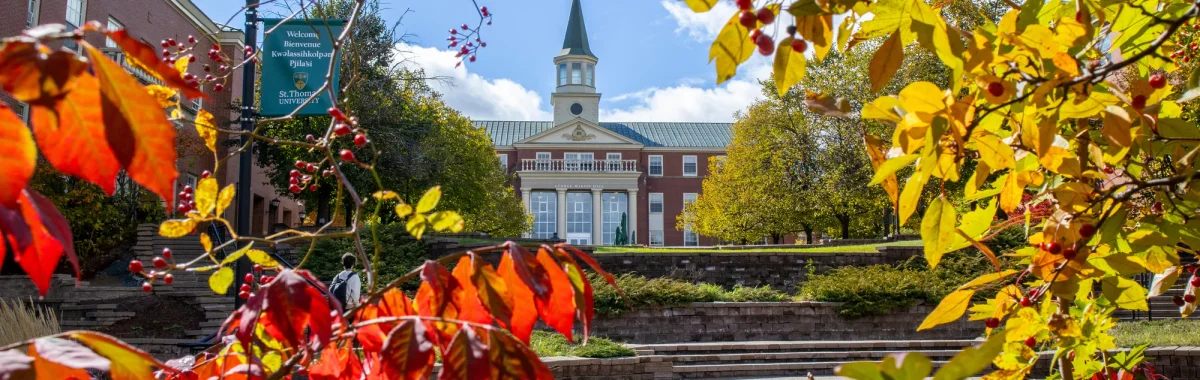
Thomas University (STU) is a small, primarily undergraduate public university in Fredericton, New Brunswick, devoted to the liberal arts. It traces its origins to 1910, when St.
Thomas College opened in Chatham, New Brunswick; it received its university charter in 1934, took its present name in 1960 and moved to Fredericton in 1964, where it occupies its own campus beside the University of New Brunswick. Although the two institutions cooperate under a 1963 federation agreement, St.
Thomas grants its own degrees, sets its own admission rules and controls its own curriculum.
The university has grown from fewer than 500 students at the time of the move to roughly 1,600 students taught by about 90 full-time faculty, with international students making up about 11 per cent of the student body. Classes are small and are always taught by professors rather than teaching assistants.
The core credential is a four-year Bachelor of Arts in which students choose majors, minors and honours options from more than 30 subject areas in the humanities and social sciences, including criminology and criminal justice, journalism, human rights, psychology, political science and the Great Books program; a Bachelor of Arts (Aviation Stream) pairs the degree with ground school and flight training through MFC Training. The School of Social Work offers a Bachelor of Social Work, a Master of Social Work and a Mi'kmaq and Wolastoqey Bachelor of Social Work, and the School of Education runs a 10-month post-degree Bachelor of Education.
Bachelor of Applied Arts degrees in criminal justice and gerontology are delivered jointly with the New Brunswick Community College. Students can live in on-campus residences, join study-abroad exchanges and travel-study courses, and compete for entrance scholarships and need-based bursaries.
Location & Contact
Need to get in touch with St. Thomas University or find your way to campus? Address, phone, email, and online links are below. These reflect what the institution publishes on its official channels.
Academic Details
St. Thomas University at the institutional level: enrolment, staffing, and accreditation summary. Accreditation has expiry and renewal cycles worth checking on the awarding body site for currency.
Academic Structures
The departmental layout below shows how St. Thomas University groups subjects, faculties, and teaching units. Subject grouping reflects institutional priorities, research strengths, and historical evolution.
Unit 4 items
- Humanities
- School of Education
- School of Social Work
- Social Sciences
Degrees
Find the degree level matching your study stage at St. Thomas University. Bologna-process cycles (1st/2nd/3rd) map roughly to bachelor's, master's, and doctoral but with country-specific variations.
Bachelor's 8 programs
Bachelor's programmes build foundational expertise, preparing graduates for entry-level professional roles and further postgraduate study.
- Applied Arts in Criminal Justice
- Applied Arts in Gerontology
- Applied Arts in Gerontology for Practical Nurses
- Arts
- Arts (Aviation Stream)
- Education
- Mi'kmaq and Wolastoqey Social Work
- Social Work
Master's 1 program
Master's programmes develop advanced specialised expertise, suited to senior industry positions and applied research.
- Social Work
Diploma & Certificate 4 programs
Diploma and certificate routes deliver focused, applied training for fast entry into skilled occupations.
- Criminology and Criminal Justice
- Digital and Media Literacy
- Experiential Learning and Community Engagement
- Gerontology
Faculties & Divisions
All faculties operate under Department of Post-Secondary Education, Training and Labour of New Brunswick.
School of Social Work (school) 1 subject offered
Specialisations & Subjects
- Social Work
School of Education (school) 1 subject offered
Specialisations & Subjects
- Education
Common Career Paths
- Teacher
- Educational Administrator
- Curriculum Specialist
Illustrative career directions for this field; specific outcomes depend on programme and student choices.
Social Sciences (division) 12 subjects offered
Specialisations & Subjects
- Anthropology
- Business and Social Entrepreneurship
- Criminology and Criminal Justice
- Economics
- Gerontology
- International Relations
- Law, Politics, and Society
- Political Science
- Psychology
- Sociology
- Sustainability and Environmental Studies
- Women's Studies and Gender Studies
Common Career Paths
- Researcher
- Policy Analyst
- Social Worker
Illustrative career directions for this field; specific outcomes depend on programme and student choices.
Humanities (division) 20 subjects offered
Specialisations & Subjects
- Catholic Studies
- Communications and Public Policy
- Digital Media and Creative Arts
- Disability, Aging, and Human Rights
- English Language and Literature
- English as a Second Language
- Fine Arts
- French
- Great Books
- History
- Human Rights
- Interdisciplinary Studies
- Interdisciplinary Major in Humanities
- Irish Studies
- Journalism
- Native Studies
- Philosophy
- Religious Studies
- Romance Languages
- Spanish and Latin American Studies
Common Career Paths
- Researcher
- Editor
- Cultural Analyst
Illustrative career directions for this field; specific outcomes depend on programme and student choices.
Programs Offered
St. Thomas University's current programme offering broken down by degree level. Curriculum revisions happen periodically; check the version year on each programme page if accreditation portability matters.
10 programmes on record. Compare these on the programs page All programs in Canada
Bachelor's Degree 9 programmes
How to apply to St. Thomas University
The standard application path for St. Thomas University, broken into five practical steps with the documents and channels you will need at each stage.
-
1
Browse the programme catalogue
Start by exploring the programmes section on this page. St. Thomas University runs 10 active programmes across multiple degree levels. Narrow by qualification tier and read each programme description before shortlisting.
-
2
Check eligibility for your chosen programme
Before applying to St. Thomas University, confirm you meet the academic, language, and document requirements for your chosen programme. International applicants should also check visa eligibility for Canada.
-
3
Get your documents ready
Standard documents: official transcripts, identity proof, language test results, personal statement, and references. Confirm exact requirements with St. Thomas University's admissions office before assembling, as expectations vary by programme.
-
4
Apply through the official channel
Lodge your application through the official website (www.stu.ca). Online forms are the standard route. Save your draft frequently and submit before the programme deadline.
-
5
Reach out and track your application
Verify your application has been received by the admissions team. You can reach the institution by email at [email protected] or by phone at +1 (506) 452 0532. Monitor the portal for status updates, interview invitations, or document requests, and respond within the stated deadlines.
Frequently Asked Questions about St. Thomas University
Quick reference for St. Thomas University: founding, control type, student body, rankings, and recognition status in one place.
In what year was St. Thomas University established?
St. Thomas University was founded in 1910 (approximately 116 years ago).
Where is St. Thomas University located?
St. Thomas University is located in Fredericton, Canada.
What is St. Thomas University's control type?
St. Thomas University is a public institution.
What is the student enrolment at St. Thomas University?
Student enrolment at St. Thomas University is around 2,000-2,999.
What qualification levels does St. Thomas University offer?
Programmes at St. Thomas University cover bachelor's and master's programmes.
What is St. Thomas University's religious tradition?
St. Thomas University is associated with Christian-Catholic.
How is St. Thomas University organised academically?
St. Thomas University has 4 academic units.
Who recognises St. Thomas University?
Yes, St. Thomas University is recognised by Department of Post-Secondary Education, Training and Labour of New Brunswick.
Where can I learn more about St. Thomas University?
St. Thomas University's official website is www.stu.ca.
Top-Ranked Universities in Canada
Below are the highest-ranked universities in Canada — natural comparison points for St. Thomas University. Top institutions in Canada typically have the strongest international recognition and graduate-school placement.

Members of International Federation of Catholic Universities (IFCU)
The universities below share St. Thomas University's International Federation of Catholic Universities (IFCU) membership, often coordinating on academic standards. Coordination simplifies credit transfer and joint-programme delivery between member institutions.


Other Canadian Universities Affiliated with Christian-Catholic
Religious-text study options and theology programmes appear consistently at Christian-Catholic universities. St. Thomas University and the peers below often share similar degree offerings in religious studies.

Faculties at nearby universities
Regional industry partnerships shape career outcomes across the cluster near St. Thomas University. Comparable employer networks often persist whether you choose St. Thomas University or a neighbour.

Where Else to Study Social Work
Programme-level scholarships for Social Work students vary substantially across Canada institutions. Often the less-marketed scholarships are the easiest to secure for qualified applicants.



Universities Compared with St. Thomas University
Faculty mobility between St. Thomas University and peer institutions is common — academics often move within a comparable tier. This signals shared academic standards and salary structures.

Studying in Canada: guides and resources




Spotted something outdated or missing?
Help us keep this page accurate — it takes about 30 seconds.