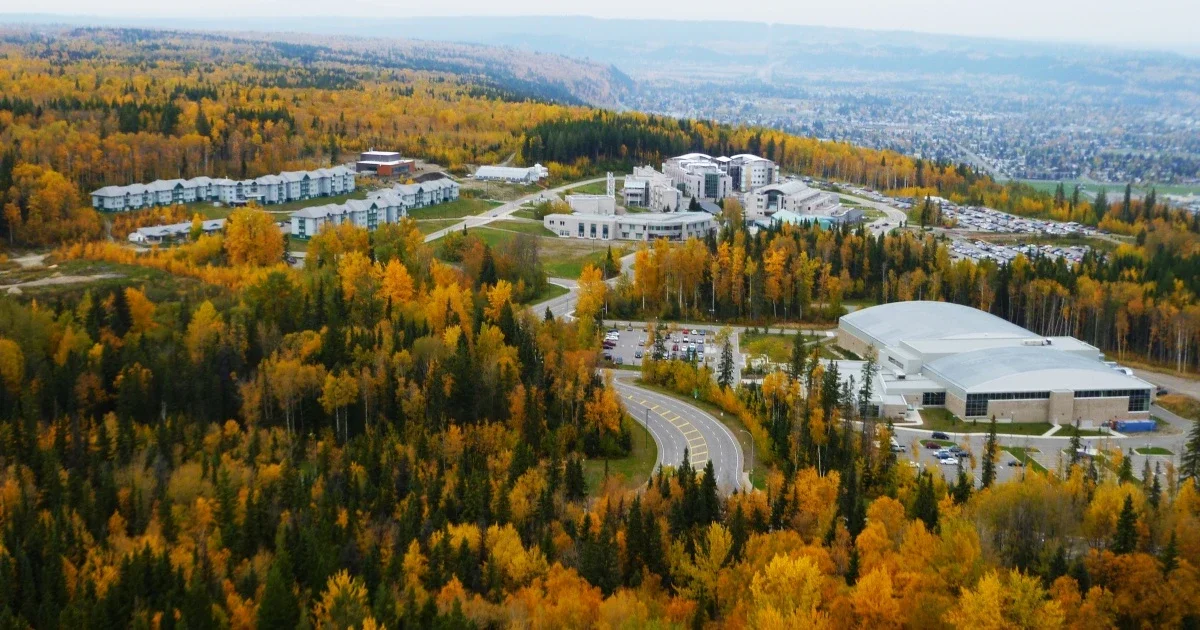
Established in 1990, the University of Northern British Columbia is a non-profit public higher education institution located in the suburban setting of the small city of Prince George (population range of 50,000-249,999 inhabitants), British Columbia.
This institution also has branch campuses in Fort St. John, Quesnel and Terrace.
Officially recognized by the Ministry of Post-Secondary Education and Future Skills of British Columbia, University of Northern British Columbia (UNBC) is a small-sized coeducational Canadian higher education institution. University of Northern British Columbia (UNBC) offers courses and programs leading to officially recognized higher education degrees such as pre-bachelor's degrees (i.e. certificates, diplomas, associate or foundation), bachelor's degrees, master's degrees and doctorate degrees in several areas of study.
This 34-year-old Canadian higher-education institution has a selective admission policy based on students' past academic records and grades.
International applicants are eligible to apply for enrollment. UNBC also provides several academic and non-academic facilities and services to students including a library, sports facilities, study abroad and exchange programs, online courses and distance learning opportunities, as well as administrative services.
Location & Contact
Below are the location pin, postal details, and primary contact methods for University of Northern British Columbia. International applicants should account for postal mail processing time when sending physical documents.
Enrolment, faculty headcount, and accreditation data for University of Northern British Columbia — the academic basics in one place. Cross-reference these against programme-specific data when finalising your shortlist.
Student Enrollment: 3
Academic Staff Range: 100-199
Campus Setting: Suburban
Memberships & Networks
Universities Canada (UC) Association of Commonwealth Universities (ACU) University of the Arctic (UArctic) Association of University Forestry Schools of Canada (AUFSC) Canadian Bureau for International Education (CBIE) Canadian University Press (CUP)
Academic Structures
The internal academic structure of University of Northern British Columbia — by faculty, school, and unit. Research-only units exist alongside teaching units; their function and student involvement differ.
Unit3 items
College of Arts, Social and Health Sciences
College of Science and Management
Graduate School
Programs Offered
Search the University of Northern British Columbia programme catalogue or scan it by degree level. The catalogue updates periodically; recently added programmes may not yet appear in some search-engine results.
Bachelor's Degree
38 programmes
These 38 programmes make up University of Northern British Columbia's undergraduate catalogue. A bachelor's degree is the baseline credential for most graduate careers and advanced study.
Bachelor of Science in Nursing, LPN PathwayHealth Sciences2 yearsOn-campusEnglish
The LPN Pathway – NBNP is a five consecutive semester degree program offered at the Fort St. John and Prince George, BC campuses. The LPN Pathway – NBNP is explicitly designed for graduates of Practical Nursing (PN) diploma programs recognized by BCCNM or elsewhere in Canada to earn a Bachelor of Science in Nursing (BScN) degree. Graduates of the LPN Pathway - NBNP will be prepared to address the health care needs of rural and northern populations. As practitioners and leaders in northern B.C., graduates will contribute to improved health and health service delivery for people in the region.
Global and International Studies: Bachelor of Arts Degree (BA)Arts4 yearsOn-campusEnglish
The Global and International Studies: Bachelor of Arts Degree. This program is ideal for those whose eyes are on the future of our planet. You will study critical concepts that promote healthy, just, peaceful, prosperous, and sustainable societies for all. Global environment and sustainability, Global cultures and diversity, Global governance and social justice. Global political economy and development are the four core themes in this program.
Biochemistry & Molecular Biology: Bachelor of Science Degree (BSc)Science4 yearsOn-campusEnglish
The Bachelor of Science Degree in Biochemistry and Molecular Biology allows you to understand how simple, inanimate molecular interactions support life. You'll explore the foundations of biochemistry, such as organic and physical chemistry, and then explore biological molecules and how they operate in living systems. You'll gain skills in laboratory techniques that will prepare you for research positions, or you can pursue furher education and careers in medicine, teaching, pharmacy, biotechnology, science policy, and more.
The Bachelor of Applied Science Degree in Civil Engineering is about learning how to design essential infrastructure, and analyze the effects of deterioration on infrastructure elements while considering system interdependencies and life-cycle impacts. You'll experience an integrated approach to civil engineering which is in keeping with the themes of design, life-cycle assessment, systems engineering, sustainable materials, renewable energy, and low-impact development throughout. Additionally, you'll have the option to complete co-op work terms to further prepare you for a career in engineering.
The Bachelor's Degree in Commerce provides education in business as well as exposure to the liberal arts, social sciences, and natural sciences. The program offers students the ability to major in the areas of Accounting, Finance, General Business, International Business or Marketing, with special emphasis placed on industries and firms of relevance to the region of northern British Columbia including small business/entrepreneurship, tourism and forestry.
Economics: Bachelor of Arts Degree (BA)Arts4 yearsOn-campusEnglish
The Economics: Bachelor of Arts Degree is the study of how societies provide for the well-being of their citizens and the public policies that promote this well-being. This degree allows you to uncover how consumers, governments, and businesses interact to build a healthy (or fragile) society. Prepare for a mix of courses that touch on almost every social science. Apply theory and methodology to explain the causal relationships between wages, natural resources, inflation, public policy and more.
The Bachelor's Degree in Elementary Education (grades K - 7) prepares you to work with the unique learning needs of children who are beginning their school years, particularly in BC's northern rural and remote schools. You'll join a cohort of teacher candidates that normally begin and finish the program together. Focus is placed on the integration of literacy and numeracy skills, inquiry-based learning, inclusion of diverse learners' perspectives, and topics like how Aboriginal and Indigenous education or Truth and Reconciliation have an impact on teaching and learning practices and approaches. The BEd program provides you with the coursework and practical classroom experience to prepare them to be qualified teachers.
The Bachelor's Degree in Secondary Education prepares you to to teach in grades 8 through 12 in specialty areas, particularly in BC's northern rural and remote schools. You'll join a cohort of teacher candidates that normally begin and finish the program together. Focus is placed on the integration of literacy and numeracy skills, inquiry-based learning, inclusion of diverse learners' perspectives, and topics like how Aboriginal and Indigenous education or Truth and Reconciliation have an impact on teaching and learning practices and approaches. The BEd program provides you with the coursework and practical classroom experience to prepare them to be qualified teachers.
Health Sciences: Bachelor's Degree (BHSc)Health Sciences4 yearsOn-campusEnglish
The Bachelor of Health Sciences Degree draws courses from the natural sciences, social sciences and humanities to provide you with a broad understanding of issues while preparing you for further studies in diverse areas such as community health, epidemiology, management and administration, medicine, occupational and environmental health, rehabilitation sciences and speech pathology. You'll take courses in a variety of disciplines, including the life sciences, social sciences, behavioural sciences, and ethics and law.
History: Bachelor of Arts Degree (BA)Arts4 yearsOn-campusEnglish
The History: Bachelor of Arts Degree draws on almost every time period, theory and geographical space. Choose from a variety of subjects, including the record of First Nations in Canada, women in European medieval society, and history of law, or delve into religious, race and economic issues that span global borders. Our faculty bring a mix of methodologies to their instruction—you are encouraged to follow your personal interests in course selection and independent research. The department offers specialized courses in the history of law, crime and punishment.
Nursing: Bachelor of Science Degree - Northern Collaborative Baccalaureate Nursing Program (BScN)Health Sciences4 yearsOn-campusEnglish
The Northern Collaborative Baccalaureate Nursing Program (NCBNP) is offered collaboratively by UNBC, the College of New Caledonia (CNC), and Coast Mountain College (CMTN). The integrated program of studies leads to a Bachelor of Science in Nursing (BScN), awarded by UNBC. Your learning experiences Learning experiences take place in the classroom, community, laboratory, and in clinical settings promoting integration of theoretical knowledge into practice. Upon graduation, you will be well grounded in acute care nursing, rural nursing, community health and First Nations health, and will be prepared for the changing context of health care and health care delivery.
Women's Studies: Bachelor of Arts Degree (BA)Arts4 yearsOn-campusEnglish
In Women's Studies: Bachelor of Arts Degree, you will apply a multi-disciplinary approach to the study of women’s and gender issues with subjects including anthropology, First Nations studies, history, and environmental studies. Examine concepts of literary theory, colonialism, masculinity, globalization, feminism, and justice while you learn to think critically about the meaning of gender in society.
Mathematics: Bachelor of Science Degree (BSc)Science4 yearsOn-campusEnglish
The Bachelor of Science Degree in Mathematics provides you training in pure mathematics, applied mathematics, and statistics. There is an early emphasis on the development of abstract reasoning and the relation of the abstract to the concrete.
Nursing: Bachelor of Science Degree - Northern Baccalaureate Nursing Program (BScN)Health Sciences2 yearsOn-campusEnglish
The Northern Baccalaureate Nursing Program (NBNP) provides you with the skills and knowledge to enter the registered nursing field. The NBNP introduces you to the unique aspects of delivering health care in small urban and rural communities located throughout northern BC and beyond.
Social Work: Bachelor's Degree (BSW)Others2 yearsOn-campusEnglish
The Bachelor of Social Work Degree is designed to prepare you for beginning-level generalized social work practice with individuals, families, groups and communities. The program's orientation places emphasis on Social Work in northern and remote areas, Indigenous peoples, women and the human services, and community practice and research. Analyses of class, gender and race relations are considered central to the Social Work program. Upon graduation, you'll be equipped with the intellectual, analytical, practical and professional skills needed to advocate for justice and equality and to promote beneficial change.
Wildlife and Fisheries: Bachelor of Science Degree (BSc)Science4 yearsOn-campusEnglish
The Wildlife and Fisheries: Bachelor of Science Degree provides you with a solid foundation in wildlife and fisheries biology, with considerable indoor and outdoor laboratory experience, exposing students to an integrated approach to resource issues that confront today's professionals. The combination of theoretical and applied ecology with practical labs and exercises in the Wildlife and Fisheries degree gives students the background to pursue post-graduate studies and public- and private-sector employment in the wildlife or fisheries professions. Students completing all courses in the Wildlife and Fisheries degree meet the education requirements for eligibility as a Registered Professional Biologist (RPBio) in BC.
Nisga'a Language Fluency: Bachelor of Arts Degree (BA)Arts4 yearsOn-campusEnglish
Nisga'a Language Fluency: Bachelor of Arts Degree (BA) provides an immersive education in the Nisg̱a'a language, intended to create new Nisg̱a'a language speakers. The fundamental pedagogical approach is to offer as much Nisg̱a'a language instruction as possible, as early as possible.
Public Administration and Community Development: Bachelor of Arts Degree (BA)Arts4 yearsOn-campusEnglish
The Bachelor of Arts Degree in Public Administration and Community Development gives you the skills required to function within a range of groups, organizations, and offices. Upon graduation, you'll be able to interact with appropriate professionals, receive their input and reports, and collate a wide range of information and material in service of their group/organization/office. Skills in analysis and synthesis are complemented by an ability to work cooperatively and effectively, and an ability to communicate clearly through written, oral, and graphic media.
Nature-Based Tourism Management: Bachelor of Arts Degree (BA)Business4 yearsOn-campusEnglish
The Bachelor of Arts Degree in Nature-Based Tourism Management examines the various components of the nature-based tourism system, giving emphasis to the entrepreneurial perspectives and sustainability issues in the industry. You'll be able to select from the following Areas of Specialization: marketing and entrepreneurship, outdoor education and leadership, communities and tourism, or environment and society. Upon graduation, you'll be prepared to work in nature-based tourism, which comprises attractions, activities and experiences involving interaction with natural and cultural resources (e.g., ecotourism, adventure tourism, indigenous tourism).
The Bachelor of Planning (BPl) Degree provides a broad education of the relationship between people and the environment. You will learn how decisions are made about human settlements, resource management, environmental protection, human health and well-being, economic development, and many other areas. You'll be engaged through in-class discussions, group work, and 'real world' community-based projects. Courses include environmental assessment, ecological design, local economic development, First Nations planning, land use planning, sustainable communities, professional practice, and more.
Integrated Science: Bachelor of Science Degree (BSc)Science4 yearsOn-campusEnglish
The Bachelor of Science Degree in Integrated Sciences provides a broad science base and integrates more than one area of study. The program allows you to transfer into single-discipline science majors built on a foundation of Biology, Chemistry, Mathematics and Physics, or alternatively to switch from them to the Bachelor of Science Degree in Integrated Sciences.
Political Science: Bachelor of Arts Degree (BA)Science4 yearsOn-campusEnglish
The Bachelor of Science Degree in Planning is the foundation in four fields of political science: Canadian Government, Comparative Politics, International Relations and Political Philosophy. You'll systematically investigate citizenship and diplomacy in local, national and international communities. Upon graduation, you'll be prepared for careers in government, law, the non-governmental sector, media, and business.
Psychology: Bachelor of Science Degree (BSc)Science4 yearsOn-campusEnglish
The Bachelor of Science Degree in Psychology is about the behaviour, feelings, and thinking. You'll learn about the biopsychosocial and developmental mechanisms and processes that regulate the behaviour of individuals. Upon graduation, you'll be prepared for further study in psychology.
Northern Studies: Bachelor of Arts Degree (BA)Arts4 yearsOn-campusEnglish
The Bachelor of Arts in Northern Studies allows you to learn about northern issues like climate change, resource development (renewable and non-renewable), and Indigenous rights. You'll study related socio-economic and cultural issues, such as competing land use demographic concerns, and rural infrastructure development. During the program, you'll have the opportunity to conduct research on the concerns facing the north, and will graduate prepared to work in all levels of government, in social service agenices, resource and economics development, non-governmental organizations, conservation, and more.
Physics: Bachelor of Science Degree (BSc)Science4 yearsOn-campusEnglish
The Bachelor of Science Degree in Physics is about nature at its most fundamental level. You'll take courses in calulculus, computer programming, waves and electricity, thermal physics, quantum mechanics, electromagnetism, and more. The program will prepapre you for advanced study in such diverse fields as biophysics, medicine, astrophysics, chemical physics, engineering, meteorology, and computer science.
Chemistry: Bachelor of Science Degree (BSc)Science4 yearsOn-campusEnglish
The Bachelor of Arts Degree in Chemistry is about nature of substances and the changes occurring in them. You'll have the opportunity to study analytical chemistry, biochemistry, inorganic chemistry, organic chemistry, and physical chemistry. A major or minor in chemistry or minor in biochemistry prepares you for a variety of careers in industry, education, ecology, and public service, or for graduate study and research in chemistry and many related fields.
Environmental and Sustainability Studies: Bachelor of Arts Degree (BA)Arts4 yearsOn-campusEnglish
The Bachelor of Arts in Environmental and Sustainability Studies emphasizes a social science and humanities perspective on environmental and sustainability challenges and opportunities. The program provides a strong philosophical, social and scientific basis for understanding the full diversity of environmental and sustainability issues, and positions students to be effective agents of social and environmental innovation, who can promote mitigation of, and/or adaptation to, environmental challenges. An understanding of the foundations of environmental citizenship is emphasized. The degree offers students substantial opportunity for experiential learning through a number of courses.
Environmental Science: Bachelor of Science Degree (BSc)Science4 yearsOn-campusEnglish
The Bachelor of Arts Degree in Environmental and Sustainability Studies emphasizes an integrated social science and humanities perspective, and focuses on the foundations of environmental citizenship. You'll learn about the ecological underpinnings of environmental issues and the social aspects of environmental challenges, such as ethics, policy, governance, Indigenous perspectives, gender, and environmental justice. You'll also gain skills in GIS, cartography, communication and public engagement techniques.
Anthropology: Bachelor of Arts Degree (BA)Arts4 yearsOn-campusEnglish
The Anthropology: Bachelor of Arts Degree, you will study the most fascinating subject of all – ourselves. Anthropology is the biological, social and cultural investigation of humans, in the past, present, and future. This program includes courses in sociocultural, archaeological, biological, and linguistic anthropology. You can choose from a broad range of courses that reflect specific areas of interest. If your pursuit is sociocultural, you might select courses in First Nations studies, geography, history, and political science. If you are interested in archaeology, you might also take courses in biological and soil sciences, and environmental studies. You are taught to apply principles of culturally respectful research, lab work and excavation to work in the field and classroom.
Conservation Science and Practice: Bachelor of Science Degree (BSc)Science4 yearsOn-campusEnglish
The Bachelor of Science Degree in Conservation Science and Practice will help you understand and address the contemporary challenges facing the sustainable use and conservation of our environment. The degree is focused on the natural sciences but draws on methods, theory, and practice from the social sciences. This recognizes that humans are part of socio-ecological systems; thus, the human dimensions of conservation are integral components of the curriculum.
English: Bachelor of Arts Degree (BA)Arts4 yearsOn-campusEnglish
In the English: Bachelor of Arts Degree you will engage in critical writing and analyses of Canadian, British, American and International literature in English. Craft your storytelling skills with classes in creative writing (fiction, poetry and non-fiction). The Bachelor of English degree encourages interdisciplinary learning through cultural studies and visual media, gender studies, literature and the environment, and animal studies. This program unites literary studies, creative writing, and film and television studies under one popular department.
First Nations Studies: Bachelor of Arts Degree (BA)Indigenous Focus4 yearsOn-campusEnglish
The Bachelor of Arts Degree in First Nations Studies takes the points of view of First Nations people and communities as the starting point for description and analysis, and contextualizes issues from this perspective. Courses in First Nations Studies will re-orient you to question the underlying assumptions of everyday understanding and will develop clarity in thought and presentation critical to advanced study. Upon graduation, you'll be prepared for further studies or careers in fields such as education, public administration, business, law, cultural property management, social services, and more.
Forest Ecology and Management: Bachelor of Science Degree (BSc)Business4 yearsOn-campusEnglish
The Bachelor of Science Degree in Forest Ecology and Management provides you with a thorough understanding of the science, philosophy, and practice of managing forested ecosystems. The program is designed to expose you to contemporary knowledge and techniques drawn from a variety of disciplines in the natural and social sciences.
Biology: Bachelor of Science Degree (BSc)Science4 yearsOn-campusEnglish
The Bachelor of Science in Biology explores major concepts in biology from molecular to community levels. Emphasis is placed on northern ecosystems and the adaptations and adjustments of northern and temperate-climate plants and animals to natural and disturbed environments. You'll be able to choose to focus on specific interests such as plant and animal ecology or physiology, conservation biology, wildlife and fisheries ecology, or molecular ecology. Upon graduation, you'll have lab and practical experience that will have prepared you for careers related to northern ecosystems.
Computer Science: Bachelor of Science Degree (BSc)Technology (IT)4 yearsOn-campusEnglish
The Bachelor of Science Degree in Computer Science gives you a thorough exposure to basic areas like computer architecture, programming languages and methodology, algorithms and data structures, systems programming, operating systems and networking, knowledge-based and database systems, software engineering, and theory. By the end of the program, you will have developed the advanced practical computing and problem-solving skills required for professional work.
Geography: Bachelor of Science Degree (BSc)Science4 yearsOn-campusEnglish
The Bachelor of Science Degree in Geography focuses on geography as an earth science, with introductions to biology, chemistry, mathematics and physics, followed by upper-level courses in climatology, hydrology, geomorphology, soils and weathering, and geomatics. This combination enables the understanding of the interactions between the atmosphere, lithosphere, hydrosphere and biosphere, aided by the use of statistical techniques, mapping, remote sensing and geographic information systems. Courses develop applied field and technical skills for associated career paths.
The Bachelor of Applied Science Degree (BASc) in Environmental Engineering at UBC and UNBC features all aspects of environmental engineering with a focus on sustainable development, drinking water delivery to northern communities, wastewater management, and remediation and reclamation of resource extraction sites. You'll gain communication skills and an interdisciplinary approach in addition to knowledge of environmental engineering, and have the opportunity to participate in a co-op program. Upon graduation, you'll be prepared to work as an environmental engineer.
Geography: Bachelor of Arts Degree (BA)Arts4 yearsOn-campusEnglish
The Bachelor of Arts Degree in Geography provides you with training in the study of human geography, emphasizing the cultural, social, economic, and political connections between people and their environments. You'll gain the conceptual and methodological means to make sense of the places and spaces you occupy and to understand how these relate to the rest of the world. Particular emphasis is on issues of community development, social justice, environmental equity, and population health in northern environments as a starting point for understanding the dynamics of place-making in a global context.
At postgraduate taught level, University of Northern British Columbia runs 29 programmes. These master's degrees suit applicants ready to concentrate on a narrower field than their bachelor's covered.
International Studies: Master of Arts (MA)ArtsOn-campusEnglish
For information visit the institution's website: [International Studies: Master of Arts (MA)](https://www.unbc.ca/calendar/graduate/international-studies)
Mathematics: Master of Science (MSc)ScienceOn-campusEnglish
For information visit the institution's website: [Mathematics: Master of Science (MSc)](https://www2.unbc.ca/calendar/graduate/mathematics-msc-program)
Natural Resources and Environmental Studies: Master of Arts (MA)ArtsOn-campusEnglish
For information visit the institution's website: [Natural Resources and Environmental Studies: Master of Arts (MA)]( https://www2.unbc.ca/calendar/graduate/nres-ma)
Natural Resources and Environmental Studies: Master of Science (MSc)ScienceOn-campusEnglish
For information visit the institution's website: [Natural Resources and Environmental Studies: Master of Science (MSc)]( https://www2.unbc.ca/calendar/graduate/nres-msc)
Natural Resources and Environmental Studies: Master's Degree (MNRES)OthersOn-campusEnglish
For information visit the institution's website: [Natural Resources and Environmental Studies: Master's Degree (MNRES)]( https://www2.unbc.ca/calendar/graduate/nres-mnres)
Nursing - Family Nurse Practitioner: Master of Science (MScN-FNP)Health SciencesOn-campusEnglish
For information visit the institution's website: [Nursing - Family Nurse Practitioner: Master of Science (MScN-FNP)](https://www.unbc.ca/calendar/graduate/nursing#NP)
Health Sciences: Master of Science (MSc)Health SciencesOn-campusEnglish
For information visit the institution's website: [Health Sciences: Master of Science (MSc)]( https://www2.unbc.ca/calendar/graduate/health-sciences-msc-program)
Wood Engineering: Master of Engineering (MEng)Engineering & TechnologyOn-campusEnglish
For information and to apply visit the institution's website: [Wood Engineering: Master of Engineering (MEng)](https://www.unbc.ca/calendar/graduate/meng-in-wood-engineering)
Interdisciplinary Studies: Master of Arts (MA)ArtsOn-campusEnglish
For information visit the institution's website: [Interdisciplinary Studies: Master of Arts (MA)]( https://www2.unbc.ca/calendar/graduate/interdisciplinary-studies)
Interdisciplinary Studies: Master of Science (MSc)ScienceOn-campusEnglish
For information visit the institution's website: [Interdisciplinary Studies: Master of Science (MSc)]( https://www2.unbc.ca/calendar/graduate/interdisciplinary-studies)
Biochemistry: Master of Science (MSc)ScienceOn-campusEnglish
For information visit the institution's website: [Biochemistry: Master of Science (MSc)](https://www.unbc.ca/calendar/graduate/biochemistry-msc-program)
Business Administration: Master of Science (MSc)BusinessOn-campusEnglish
For information visit the institution's website: [Business Administration: Master of Science (MSc)]( http://www.unbc.ca/calendar/graduate/business-administration-msc)
Computer Science: Master of Science (MSc)Technology (IT)On-campusEnglish
For information visit the institution's website: [Computer Science: Master of Science (MSc)](https://www.unbc.ca/calendar/graduate/computer-science-msc-program)
Counselling: Master of Education (MEd)Education & TeachingOn-campusEnglish
For information visit the institution's website: [Counselling: Master of Education (MEd)](https://www.unbc.ca/calendar/graduate/counselling-med-program)
Development Economics: Master of Arts (MA)ArtsOn-campusEnglish
For information visit the institution's website: [Development Economics: Master of Arts (MA)](https://www.unbc.ca/calendar/graduate/development-economics)
Disability Management: Master of Arts (MA)BusinessOn-campusEnglish
For information visit the institution's website: [Disability Management: Master of Arts (MA)](https://www.unbc.ca/calendar/graduate/disability-management)
Engineering: Master of Applied Science (MASc)Engineering & TechnologyOn-campusEnglish
For information visit the institution's website: [Engineering: Master of Applied Science (MASc)]( https://www2.unbc.ca/calendar/graduate/engineering-masc-program)
University of Northern British Columbia delivers 3 programmes at doctoral level for graduates committed to advancing the frontier of their discipline through original inquiry.
Natural Resources and Environmental Studies: Doctor of Philosophy (PhD)ArtsOn-campusEnglish
For information visit the institution's website: [Natural Resources and Environmental Studies: Doctor of Philosophy (PhD)](https://www.unbc.ca/calendar/graduate/nres-phd)
Health Sciences: Doctor of Philosophy (PhD)Health SciencesOn-campusEnglish
For information visit the institution's website: [Health Sciences: Doctor of Philosophy (PhD)]( https://www.unbc.ca/calendar/graduate/health-sciences-phd)
University of Northern British Columbia delivers 1 programme at doctoral level for graduates committed to advancing the frontier of their discipline through original inquiry.
Medicine: Doctor Degree - Northern Medical Program (MD)Health Sciences4 yearsOn-campusEnglish
The Doctor of Medicine Northern Medical Program (NMP) is a distributed site of UBC’s Faculty of Medicine MD Undergraduate Program, delivered in partnership with UNBC. The NMP is focused on training physicians from and for northern and rural communities. The NMP incorporates the practices of rural and remote medical education from around the world, providing classroom and early clinical exposure to rural healthcare delivery. You'll have the chance to undertake numerous rural health and northern living experiences as part of extracurricular shadowing opportunities, Indigenous cultural experiences, and NMP/student social activities.
Alongside its degrees, University of Northern British Columbia provides 50 programmes at associate, certificate, diploma, and foundation level, typically shorter and more applied in focus.
Leading for Learning Graduate CertificateOthersOn-campusEnglish
For information visit the institution's website: [Leading for Learning Graduate Certificate](https://www.unbc.ca/calendar/graduate/education#leading-for-learning-graduate-certificate)
Indigenous Child and Youth Mental Health Graduate CertificateHealth SciencesOn-campusEnglish
For information visit the institution's website: [Indigenous Child and Youth Mental Health Graduate Certificate](https://www.unbc.ca/calendar/graduate/social-work#indigenous-child-and-youth-mental-health-graduate-certificate)
For information visit the institution's website: [Change Leadership Graduate Certificate](https://www2.unbc.ca/calendar/graduate/business-administration#CertChangeLead)
Ecosystems Field Data Collection Micro-credentialOthersOn-campusEnglish
The Ecosystems Field Data Collection Micro-Credential trains resource and/or forestry practitioners in the use of field skills to identify ecosystems in the field, describe and map ecological strata, identify and describe critical soil hazards and site issues. Procedures and methodologies taught will allow practitioners to classify areas, even if they are devoid of vegetation due to wildfire, or other alterations.
For information and to apply visit the institution's website: [Environmental Monitoring Online Certificate](https://www.unbc.ca/continuing-studies/courses/em-environmental-monitoring-online-certificate)
Forest Health and Silviculture Micro-credentialHealth SciencesOnlineEnglish
Whether you're on the path to becoming a Registered Professional Forester (RPF), looking to expand your technical knowledge, or aiming to move into a more advanced role, this micro-credential gives you the skills and confidence to lead in forest health and sustainable silviculture. Through a series of online, self-paced courses grounded in UNBC’s accredited forestry curriculum, you’ll build applied knowledge that translates directly to your work in the field. Take on its own or as part of the Sustainable Forest Management Certificate.
The Indigenous Entrepreneurship Micro-credential program, developed by UNBC Continuing Studies and Hubspace, introduces the principles and practices of entrepreneurship and small businesses to Indigenous learners. Starting a business is about more than just understanding the steps. It is about working through your ideas, identifying opportunities, and having the chance to connect with people who have successfully started their own business
Land Reclamation CertificateOthersOn-campusEnglish
For information and to apply visit the institution's website: [Land Reclamation Certificate](https://www.unbc.ca/continuing-studies/courses/land-reclamation-certificate)
Mass Timber Micro-credentialOthersOn-campusEnglish
Whether you’re looking for introductory training or detailed software, manufacturing, or modeling courses, the Mass Timber Micro-credential will provide you with knowledge and skills for your current or aspiring career. The use of mass timber is growing in BC, bringing jobs in construction, design, and fabrication. Those who wish to work in this field will benefit from further training in mass-timber-specific manufacturing techniques.
This Photography Foundations Micro-Credential provides you with the essential skills required to produce high-quality photographs using a digital SLR camera. Students will learn how to edit and modify their images using Adobe Photoshop. Organizing and exporting photographs to print and other online platforms will be explored.
The Typography Foundations Micro-credential provides students with an understanding of contemporary typography and the skills required to create graphic designs for print and online production. Students learn how to effectively combine type and image to convey complex ideas, construct meanings, implied narratives, and emotions. Topics include the anatomy of the letterform, distinctions between typefaces, shaping the page with type, and accessible content. Students will be introduced to contemporary graphic designers and their impact on visual communication and the written language.
Video Post-Production Foundations Micro-credentialOthersOnlineEnglish
This Video Post-Production Foundations Micro-credential provides you with the essential skills required to produce high quality online video content. Students learn software skills in video and audio editing, video and audio effects, and animation, using Adobe Premiere Pro and Adobe After Effects.
User Experience (UX) Design Foundations Micro-credentialOthersOn-campusEnglish
This User Experience (UX) Design Foundations Micro-credential provides you with the essential skills required to create compelling user experiences for desktop, tablet, and mobile users. Students will learn to plan, and design effective user interfaces based on aesthetic, psychological, scientific, and technological considerations.
Applied Financial Analysis and Decision Making Micro-credentialOthers4 weeksOn-campusEnglish
The Applied Financial Analysis and Decision Making Micro-credential focuses on applying financial management concepts through a capstone project using real company financial statements and case studies.
Fundamentals of Financial Reporting and Budgeting Micro-CredentialOthers4 weeksOn-campusEnglish
The Fundamentals of Financial Reporting and Budgeting Micro-Credential introduces core financial management principles for learners with limited accounting or finance experience. Delivered in partnership with UNBC's School of Business. Learners gain practical skills in understanding financial statements, preparing budgets, and applying analytical tools to monitor performance and cash flow.
First Nations Language & Culture Education Diploma - Elementary yearsIndigenous Focus3 yearsOn-campusEnglish
The Education Diploma in a First Nations Language and Culture is a teacher education program based on the design and the principles of the BEd program model. The program prepares you to teach an approved First Nations language and culture at the Elementary Years level.
General First Nations Studies CertificateIndigenous Focus1 yearOn-campusEnglish
The General First Nations Studies Certificate is a multidisciplinary program allowing you to pursue your interests in First Nations Studies through a concentrated program of courses on First Nations subjects. The program ladders well into a major in First Nations Studies, Anthropology, Biology, History, Education, English, Environmental Studies, Forestry, Geography, Nursing and Community Health, Political Science, Psychology, Social Work and Women's Studies.
Nisga'a Language Fluency DiplomaOthers2 yearsOn-campusEnglish
The Nisga'a Language Fluency Diploma provides an immersive education in the Nisga'a language, and is intended to create new Nisga'a language speakers. The fundamental pedagogical approach is to offer as much Nisga'a language instruction as possible, as early as possible. The program is offered in a manner that recognizes that learners, knowledge keepers, and their communities as a whole benefit from, and contribute to, the (re)development of Nisga'a language fluency.
The Rural Nursing Certificate provides Registered Nurses (RNs) with the opportunity to pursue concentrated coursework in rural nursing through specialty education. The curriculum is practice-driven, evidence informed and reality-based, and is designed to be completed on a part-time basis through distance education, workshops, and clinical placements. Coursework includes: Health Assessment and RN First Call; Chronic Disease Management, Palliative Care and Wound Care; Nursing Practice with Older Persons; Perinatal Care; Foundations in Emergency and Trauma Nursing; Mental Health and Addictions, and; Living and Working in a Rural Community.
Local Government Administration CertificateOthers1 yearOn-campusEnglish
This Certificate provides a comprehensive overview of local government administration in Canada, with a focus on British Columbia. The Certificate complements existing degree programs at UNBC and is designed to help students prepare for careers in local government administration, policy, planning and economic development. Some of the courses in the Certificate also meet the requirements for provincial certification programs for local government administrators.
Nisga'a Language Fluency CertificateOthers1 yearOn-campusEnglish
The Nisga'a Language Fluency Certificate provides an immersive education in the Nisga'a language, intended to create new Nisga'a language speakers. The fundamental pedagogical approach is to offer as much Nisga'a language instruction as possible, as early as possible. The program is offered in a manner that recognizes that learners, knowledge keepers, and their communities as a whole benefit from, and contribute to, the (re)development of Nisga'a language fluency.
The Métis Studies Certificate offers a program that allows individuals to pursue their interests through a concentrated program of courses on the Métis Nation. It is designed for persons of Métis descent, other aboriginal people, and people who are working with aboriginal organizations.
The Nisga'a Studies Certificate offers a program that allows individuals to pursue their interests in First Nations Studies through a concentrated program of courses on the Nisga'a First Nation. The program is designed for persons of Nisga'a descent, other aboriginal people, and people who are working with aboriginal organizations.
Individual Courses in Health and SafetyHealth SciencesOn-campusEnglish
For information and to apply visit the institution's website: [Individual Courses in Health and Safety](https://www.unbc.ca/continuing-studies/programs?field_cs_course_category_target_id=2736)
Individual Courses in Supervisor FundamentalsOthersOn-campusEnglish
For information and to apply visit the institution's website: [Individual Courses in Supervisor Fundamentals](https://www.unbc.ca/continuing-studies/programs?field_cs_course_category_target_id=2733)
For information and to apply visit the institution's website: [Project Management Associate Certificate - Online]( https://www.unbc.ca/continuing-studies/courses/core-and-associate-certificates-project-management-virtual-delivery)
Administrative Assistant Professional CertificateOthersOn-campusEnglish
For information and to apply visit the institution's website: [Administrative Assistant Professional Certificate](https://www.unbc.ca/continuing-studies/courses/administrative-assistant-professional-certificate-virtual-delivery)
For information and to apply visit the institution's website: [Executive Leadership Core Certificate](https://www.unbc.ca/continuing-studies/courses/executive-leadership-core-certificate-virtual-delivery)
Individual Courses in Natural ResourcesOthersOn-campusEnglish
For information and to apply visit the institution's website: [Individual Courses in Natural Resources](https://www.unbc.ca/continuing-studies/courses/natural-resources-programming)
For information and to apply visit the institution's website: [Executive Leadership Associate Certificate](https://www.unbc.ca/continuing-studies/courses/core-and-associate-certificates-executive-leadership#associate%20certificate)
Individual Courses in Language and WritingOthersOn-campusEnglish
For information and to apply visit the institution's website: [Individual Courses in Language and Writing](https://www.unbc.ca/continuing-studies/programs?field_cs_course_category_target_id=2735)
Individual Courses in Professional DevelopmentOthersOn-campusEnglish
For information and to apply visit the institution's website: [Individual Courses in Professional Development](https://www.unbc.ca/continuing-studies/programs?field_cs_course_category_target_id=2725)
Machine Learning and AI Bootcamp CertificateOthersOn-campusEnglish
For information and how to apply visit the institution's site: Machine Learning and AI Bootcamp Certificate](https://www.unbc.ca/continuing-studies/courses/machine-learning-ai-bootcamp-certificate)
Teaching English to Speakers of Other Languages CertificateEducation & TeachingOn-campusEnglish
For information and to apply visit the institution's website: [Teaching English to Speakers of Other Languages Certificate](https://www.unbc.ca/continuing-studies/courses/teaching-english-speakers-other-languages-tesol-virtual-delivery)
Safe and Effective Electrofishing CertificateOthersOn-campusEnglish
For information and how to apply visit the institution's site: [Safe and Effective Electrofishing Certificate](https://www.unbc.ca/continuing-studies/courses/safe-and-effective-electrofishing-certificate)
Individual Courses in Mental Health and WellnessHealth SciencesOn-campusEnglish
For information and to apply visit the institution's website: [Individual Courses in Mental Health and Wellness](https://www.unbc.ca/continuing-studies/programs?field_cs_course_category_target_id=2727)
Individual Courses in Web, Technology and DesignTechnology (IT)On-campusEnglish
For information and to apply visit the institution's website: [Individual Courses in Web, Technology and Design](https://www.unbc.ca/continuing-studies/programs?field_cs_course_category_target_id=2737)
Occupational Health and Safety - Occupational Health & Safety CertificateHealth SciencesOnlineEnglish
For information and to apply visit the institution's website: [Occupational Health and Safety - Occupational Health & Safety Certificate](https://www.unbc.ca/continuing-studies/courses/ohs-occupational-health-safety-online-certificate)
Individual Courses in General InterestOthersOn-campusEnglish
For information and to apply visit the institution's website: [Individual Courses in General Interest](https://www.unbc.ca/continuing-studies/programs?field_cs_course_category_target_id=2726)
Machine Learning Foundation Micro-credentialOthersOnlineEnglish
The Machine Learning Foundation Micro-credential serves as an introduction for those interested in exploring a career in artificial intelligence and data science. Machine learning career opportunities are emerging in industries such as health care, mining, forestry, energy, and construction. Offered online, four modules will cover: - Python commands - Introduction to data - Classification - Sandbox project This course uses an interactive and experiential teaching model. It is suitable for those who want to learn Python basics and how to use the machine learning libraries to process data. No previous experience in coding is necessary.
Becoming a Content Creator Advanced Social Media Marketing for Creative Entrepreneurs Micro-credentialBusinessOn-campusEnglish
The Becoming a Content Creator Advanced Social Media Marketing for Creative Entrepreneurs Micro-credential is designed for emerging creative entrepreneurs. The course builds on the skills and concepts taught in the Social Media Marketing for Creative Professionals course. You will learn how to develop their unique voice and professional brand, reaching both wide and focused audiences, to acquire and retain customers profitably and increase their competitiveness in the field.
Introduction to Tourism and Cultural Tourism in BC Micro-credentialOthersOn-campusEnglish
The Introduction to Tourism and Cultural Tourism in BC course provides a broad overview of the tourism industry in the province. Participants will gain practical skills and knowledge about how BC’s tourism industry is organized and an overview of the major sectors.
For information and to apply visit the institution's website: [Wildlife Monitoring Certificate]( https://www2.unbc.ca/continuing-studies/courses/wildlife-monitoring-certificate)
For information and how to apply visit the institution's site: [Project Management Core Certificate]( https://www.unbc.ca/continuing-studies/courses/core-certificate-project-management-virtual-delivery)
Aboriginal Community Resource Planning CertificateIndigenous Focus1 yearOn-campusEnglish
The Aboriginal Community Resource Planning Certificate (ACP) consists of 10 courses drawn primarily from First Nations Studies and Environmental Planning, with offerings from Geography, Commerce, Outdoor Recreation and Tourism, and Natural Resources and Environmental Management. The courses from First Nations Studies provide you with foundations in First Nations in Canada, cultures and languages, internal and external issues, and First Nations environmental philosophies. The courses from Environmental Planning provide foundations in the principles of traditional planning. The program is designed so that the knowledge can be transferred to different community settings.
Aboriginal/Indigenous Health and Healing DiplomaHealth Sciences1 yearOn-campusEnglish
The Aboriginal / Indigenous Health and Healing Diploma offers a multidisciplinary program allowing you to pursue your interest in Aboriginal / Indigenous Health and Healing through a concentrated program of courses on Aboriginal Health and Health Science subjects. The program is designed for those working with Aboriginal communities in a health-related field or desiring to pursue a degree in the health sciences with a concentration on Aboriginal health.
First Nations Public Administration CertificateIndigenous Focus1 yearOn-campusEnglish
The First Nations Public Administration Certificate consists of courses that provide you with foundations in internal and external First Nations issues and culture, and in the principles of government, politics, and public administration, as well as some specialization in First Nations law, self-government and administration. The program provides requisite education to assist individuals involved in the administration of First Nations governments and expanded educational opportunities at the university level for students who are not in a position to commit to a four-year program of study.
First Nations Language CertificateIndigenous Focus1 yearOn-campusEnglish
The First Nations Language Certificate offers a program that allows you to pursue an interest in First Nations language through a concentrated program of courses on a particular language. The program is designed for those who may not wish to commit to a full majors program, persons of First Nations descent, and people who are working in the area of indigenous education.
First Nations Language DiplomaIndigenous Focus1 yearOn-campusEnglish
The First Nations Language Diploma offers a program that allows you to pursue an interest in First Nations language through a concentrated program of courses on a particular language. The program is designed for those who may not wish to commit to a full majors program, persons of First Nations descent, and people who are working in the area of aboriginal education.
Aboriginal/Indigenous Health and Healing CertificateHealth Sciences1 yearOn-campusEnglish
The Aboriginal / Indigenous Health and Healing Certificate offers a multidisciplinary program allowing you to pursue your interest in Aboriginal / Indigenous Health and Healing through a concentrated program of courses on Aboriginal Health and Health Science subjects. The program is designed for those working with Aboriginal communities in a health-related field or desiring to pursue a degree in the health sciences with a concentration on Aboriginal health.
How to apply to University of Northern British Columbia
A short guide to applying to University of Northern British Columbia — five steps covering the path from programme selection to confirmation of receipt.
1
Browse the programme catalogue
University of Northern British Columbia's catalogue includes 121 programmes. Browse by level, identify candidates matching your prior qualifications, and note their entry requirements for the next step.
2
Check eligibility for your chosen programme
Entry requirements vary by programme and degree level. Verify academic minimums, language tests (if international), and any additional documents required for University of Northern British Columbia's admissions process.
3
Get your documents ready
Typical documents include academic transcripts, identity proof (passport or national ID), language proficiency test scores, a personal statement or motivation letter, and recommendation letters. International applicants should account for translation and notarisation time.
4
Apply through the official channel
Submit your completed application through University of Northern British Columbia's official website at www.unbc.ca. Most institutions use an online portal — register an account, complete the application form, and upload your prepared documents. Keep copies of all submissions and confirmation receipts.
5
Reach out and track your application
Follow up to confirm your application was received and is being processed. Reach the institution by phone at +1 (250) 960 5555. Admissions teams may request interviews or additional documents — respond promptly to keep your application active.
Frequently Asked Questions about University of Northern British Columbia
Frequently asked questions about University of Northern British Columbia, covering the institutional basics most prospective applicants want to confirm first.
How old is University of Northern British Columbia?
The institution opened in 1990 (approximately 36 years ago).
Where can I find University of Northern British Columbia?
The institution is located in Prince George, Canada.
What is University of Northern British Columbia's control type?
It is a public higher-education institution.
How many students does University of Northern British Columbia have?
The institution has a student body of 3,000-3,999.
Where does University of Northern British Columbia stand in university rankings?
It ranks #3451 globally and #57 in Canada.
What is University of Northern British Columbia's academic structure?
The institution comprises 3 academic units.
Is University of Northern British Columbia accredited?
Yes, University of Northern British Columbia is recognised by Ministry of Post-Secondary Education and Future Skills of British Columbia.
Where can I learn more about University of Northern British Columbia?
You can find University of Northern British Columbia online at www.unbc.ca.
Top-Ranked Universities in Canada
These are the most highly ranked universities in Canada. Putting University of Northern British Columbia alongside them gives a clearer picture of where it sits in the national academic landscape, especially when reputation matters for credential portability.
Members of Association of Commonwealth Universities (ACU)
Network-level rankings exist for some Association of Commonwealth Universities (ACU) groupings (e.g., U21, Universitas 21). These differ from country rankings and reflect coordinated members' shared performance.
Alumni networks within a region often outlast individual institutional choice. Universities near University of Northern British Columbia share post-grad employer connections that benefit students from any of them.
Choosing the right Others programme is rarely about one university alone. Institutions across Canada cover the same discipline as University of Northern British Columbia from different academic angles, and the right fit depends on what kind of teaching environment suits you.
Universities Often Compared with University of Northern British Columbia
Cross-peer scholarship reciprocity exists in some systems where peer institutions accept each other's scholarship students. Worth checking for University of Northern British Columbia if location flexibility matters.