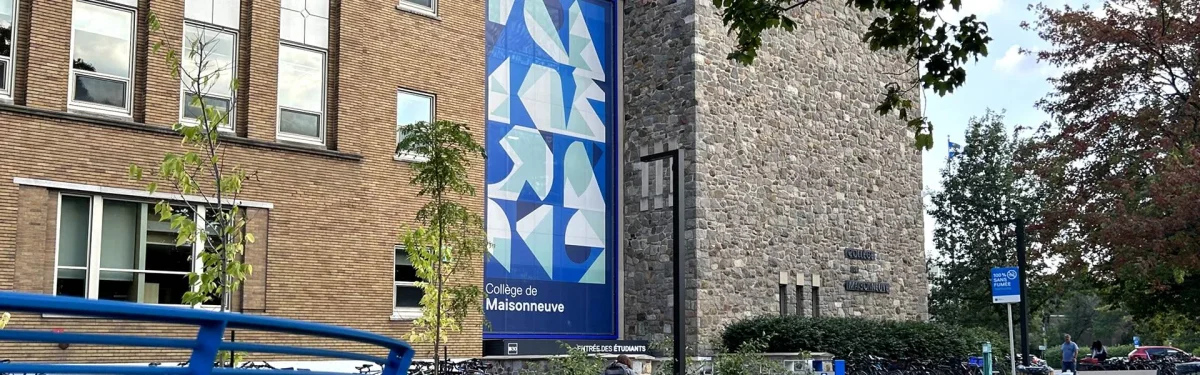
Collège de Maisonneuve offers Diploma in Techniques d’intervention en criminologie, a diploma in Criminal Law & Justice programme in Montréal, Canada. The programme runs for 6 semesters. Teaching is in French. Tuition for international students is CAD 15,150 per year (CAD 3,740 per year for local students).
At a glance
Degree:Diploma
Field:Criminal Law & Justice
Duration: 6 semesters
Language: French
Local tuition: CAD 3,740 / year
International tuition: CAD 15,150 / year
Information for the 2027/28 academic year · Last reviewed September 2026 ·
Program details
Overview
Techniques d'intervention en criminologie (310.B1) is a six-term technical program at Collège de Maisonneuve leading to a Diploma of Collegial Studies (DEC). It trains students to intervene with diverse populations affected by crime, deviance, or victimization, with an emphasis on prevention, empowerment, and social reintegration within applicable legislative and professional frameworks. Coursework covers intervention strategies for both adult and youth clients from an inclusion-oriented perspective, including cultural diversity and LGBTQ2+ populations, and students take part in simulated case scenarios and feedback workshops with peers, learn to write intervention plans and assess risk of reoffending, and work with clients facing issues such as victimization, behavioural problems, substance use, and mental-health difficulties. Many instructors come from correctional, youth-centre, court, and social-service backgrounds. The program includes a dedicated simulation room and extensive field placements across several different settings, structured as a short observation placement, a part-time involvement placement over a number of weeks, and a full-time intervention placement near the end of the program. Graduates are prepared for technician-level roles in correctional, community, and social-intervention settings. It suits students interested in direct social intervention work with justice-involved or at-risk populations.
Requirements
Admission Requirements: Techniques d'intervention en criminologie (310.B1) states no specific secondary-level prerequisite course: "Aucun préalable". Admission still rests on the DES (Diplôme d'études secondaires) or training judged equivalent, on holding or completing any programme prerequisites (none for this programme), and on passing whatever tests or particular conditions the college sets. Applications go exclusively through the SRAM (admission.sram.qc.ca). International applicants follow the college's dedicated international-students process, and Sport-Études athletes follow Alliance Sport-Études criteria; adults with prior college or university study may access an intensive DEC format. The programme page states no language requirement, portfolio, interview, competitive average or criminal-record-check condition of its own. International applicants must additionally meet Collège de Maisonneuve's own requirement of French at level B2 in all four skills (TEF, TCF tout public, CIEP or Bright-langue).
Application Details
Start Date:September
Application Deadline:Domestic applicants (Quebec/Canadian) apply through SRAM (admission.sram.qc.ca): for Fall 2027 entry the first-round deadline is 1 March 2027, with later rounds assessed while seats remain; for Winter 2027 entry SRAM opens 15 September 2026 and the first-round deadline is 1 November 2026. International applicants also apply through SRAM: the Fall 2027 file-completion deadline is 14 March 2027, and Collège de Maisonneuve's own page sets a 31 August deadline for Winter entry — the Winter 2027 occurrence (31 August 2026) has passed, so the next one is 31 August 2027, for Winter 2028 entry. Admission is not open-ended; later applicants are placed only while seats remain. These are institution-wide dates; this programme publishes no deadline of its own.