Welcome back. Keep your shortlist and get deadline reminders with a free account.

Carleton University institutional logo

MA/MS in Materials Engineering

Carleton University

Ottawa, Ontario, Canada•QS 2027 #801-850

Official program page (opens in a new tab)

At Carleton University in Ottawa, Canada, MA/MS in Materials Engineering is offered as a master's degree in Materials Science programme. The programme runs for 2 years, delivered on campus. Tuition is CAD 19,000 per total for local students.

At a glance

Degree: Master's Degree
Field: Materials Science
Duration: 2 years
Delivery: On Campus
Local tuition: CAD 19,000 / total

We have no an application deadline on record for this programme yet — see the official programme page. — it helps other students.

Last checked September 2026 · Source: graduate.carleton.ca ·

Program details

Overview

The Master of Applied Science (MASc) in Materials Engineering at Carleton University is a thesis-based research degree offered through the Department of Mechanical and Aerospace Engineering and the Ottawa-Carleton Institute for Mechanical and Aerospace Engineering, a joint institute combining the research strengths of Carleton and the University of Ottawa. Students undertake a research project demonstrating their ability to apply field knowledge to investigate a specific question or problem in a rigorous, scholarly way, with fields of specialization including combustion and heat transfer, materials and manufacturing processes, metamaterials, nanotechnology, nuclear materials, solar and thermal energy, and solids and fracture mechanics. A collaborative Specialization in Climate Change and Data Science is available. Admission is conditional on a faculty member agreeing to supervise the student's thesis research, which is the applicant's responsibility to arrange. The program runs over a nominal two years of full-time study, delivered in person, with Fall, Winter, and Summer intakes. Graduates pursue careers in advanced materials research and engineering, with access to industry and government research facilities such as the National Research Council.

Requirements

Admission Requirements: Admission to the thesis-based MASc program is conditional on a faculty member agreeing to supervise the student's research; it is the applicant's responsibility to arrange a supervisor before applying.

Application Details

Start Date: Fall, Winter and Summer

About Carleton University

“Ours the Task Eternal”

Type: University
Control: Public
Campus setting: Suburban
Founded: 1942
Students: 30,675
QS rank: #801-850
Programs: 243
Location: Ottawa, Ontario, Canada
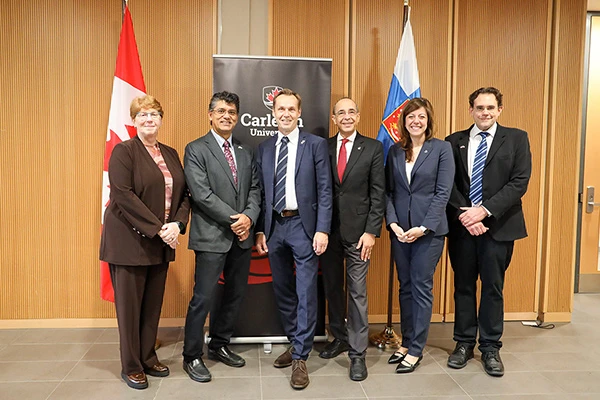
Carleton University community on campus
1 / 5

View the full Carleton University profile

Similar programs in Canada

More programs at Carleton University

Other universities in Canada

Scholarships in Canada

  • Arthur Kroeger College National Scholarships — CAD 2,000
  • Carleton Renewable Entrance Scholarship (85-89.9% average) — CAD 1,000
  • Carleton Renewable Entrance Scholarship (90-94.9% average) — CAD 2,000
  • Carleton Renewable Entrance Scholarship (95-100% average) — CAD 3,000
  • Carleton University Entrance Bursary

Frequently asked questions

What degree does MA/MS in Materials Engineering award?

Carleton University awards a Master's Degree in the field of Materials Science on completion of this programme.

How long does MA/MS in Materials Engineering take?

The programme runs for 2 years.

How much does MA/MS in Materials Engineering cost?

Tuition is CAD 19,000 per total for local students.

Can MA/MS in Materials Engineering be studied online?

No — the programme is taught on campus at Carleton University.

Browse all articles →

Spotted something outdated or missing?

Help us keep this page accurate — it takes about 30 seconds.

Save this program and never miss its deadline

Save universities and programs, follow countries, and get deadline reminders by email. Free, takes a few seconds.

Free calculators and converters to plan your study-abroad journey.

Latest Articles

Fresh guides and advice for studying abroad.

View all →

Compare Compare