Universiteit Twente crest

Universiteit Twente

Enschede, Netherlands Founded 1961 World Rank #375

Overview

English Name: University of Twente
Local Name: University of Twente
Acronyms: UT
Founded: 1961
Control Type: Public
Entity Type: Non-profit
World Rank: #375
Rank in Netherlands: #11
Motto: De ondernemende universiteit
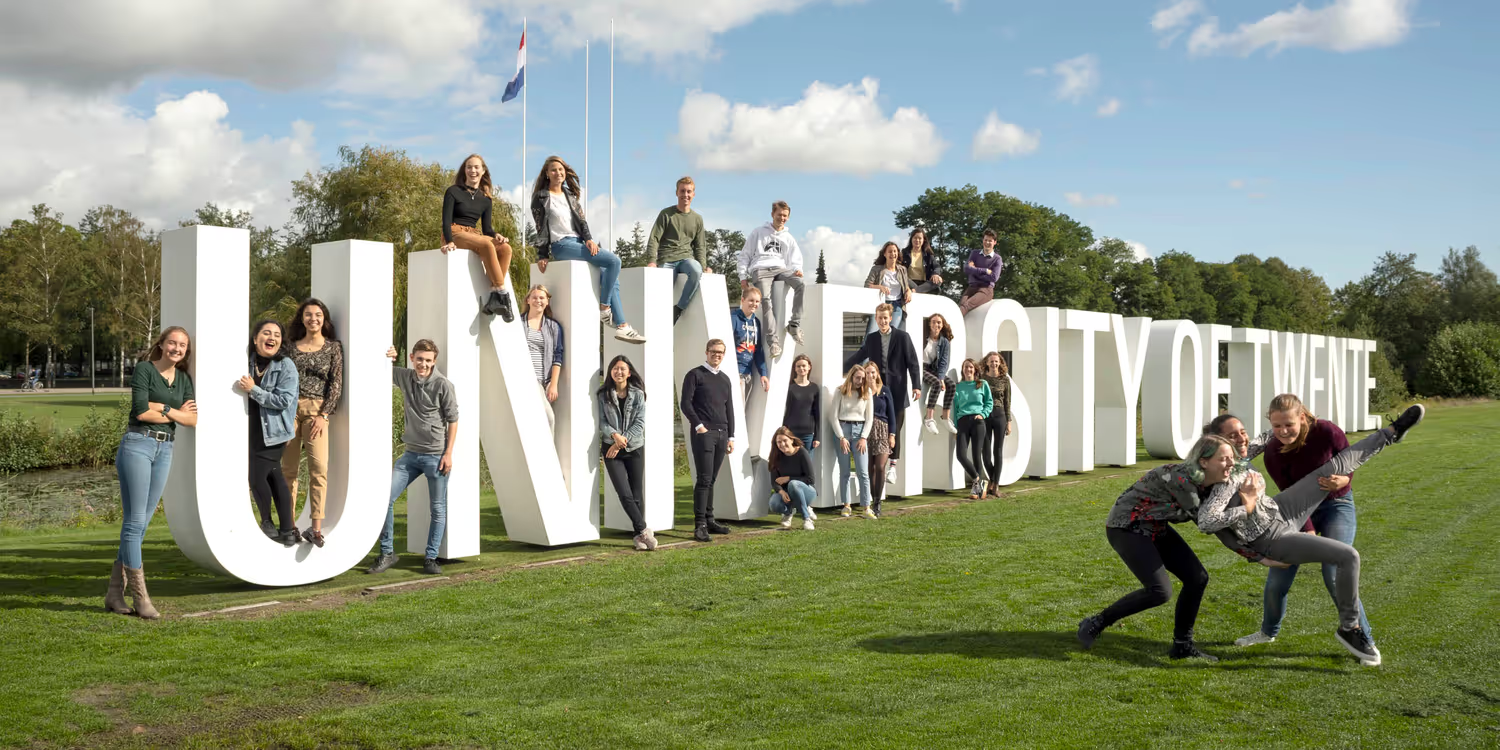
Universiteit Twente main campus view
1 / 3

Founded in 1961, the Universiteit Twente (University of Twente) is a non-profit public higher education institution located in the small city of Enschede (population range of 50,000-249,999 inhabitants), Overijssel.

This institution also has a branch campus in Amsterdam. Officially recognized by the Ministerie van Onderwijs, Cultuur en Wetenschap, Nederland (Ministry of Education, Culture and Science of the Netherlands), Universiteit Twente (UT) is a medium-sized coeducational Dutch higher education institution.

Universiteit Twente (UT) offers courses and programs leading to officially recognized higher education degrees such as bachelor's degrees, master's degrees and doctorate degrees in several areas of study. International students are welcome to apply for enrollment.

UT also provides several academic and non-academic facilities and services to students including a library, housing, sports facilities, study abroad and exchange programs, online courses and distance learning opportunities, as well as administrative services.

Location & Contact

Looking to reach Universiteit Twente? Address, contact details, and online links below. For finance and tuition payment queries, the bursar or finance office is typically a separate contact point.

Address: Postbus 217
Postal Code: 7500 AE
Phone: +31 (53) 489 9111
Fax: +31 (53) 489 2000
Social Media:

Academic Details

Below: the academic-side numbers and recognition that shape Universiteit Twente's reputation. Recognition and accreditation are distinct — recognition is government-level, accreditation programme-specific.

Academic Year: September to July
Accrediting Agency: Accreditation Organisation of the Netherlands and Flanders (NVAO). European Association for Public Administration Accreditation
Admission Requirements: Dutch VWO or equivalent
Student Enrollment: 9
Academic Staff Range: 600-699
Memberships & Networks
European University Association (EUA) Conference of European Schools for Advanced Engineering Education and Research (CESAER) European Consortium of Innovative Universities (ECIU)

Academic Structures

The institutional units housing Universiteit Twente's programmes. Subject overlap across faculties is normal — interdisciplinary fields like data science or environmental studies often span multiple units.

Unit 5 items
  • Faculty of Electrical engineering, Mathematics and Computer science
  • Faculty of Engineering
  • Faculty of Science and Technology
  • Faculty of Social Sciences
  • Faculty of geo-information science

Degrees

Universiteit Twente's qualifications are listed below by level, so you can quickly find the route that matches your study stage. Some levels feed naturally into the next, while others stand alone.

Bachelor's 21 programs

Bachelor's programmes build foundational expertise, preparing graduates for entry-level professional roles and further postgraduate study.

  • Applied Mathematics
  • Applied Physics
  • Biomedical Engineering
  • Business Administration
  • Business and Commerce
  • Chemical Engineering
  • Civil Engineering
  • Communication Studies
  • Computer Science
  • Educational Sciences
  • Electrical Engineering
  • Health Sciences
  • Industrial Design
  • Industrial Engineering
  • Industrial Management
  • Information Technology
  • International Business
  • Mechanical Engineering
  • Psychology
  • Public Administration
  • Technology
Master's 30 programs

Master's programmes develop advanced specialised expertise, suited to senior industry positions and applied research.

  • Applied Mathematics
  • Applied Physics
  • Biomedical Engineering
  • Business Administration
  • Business Computing
  • Chemical Engineering
  • Civil Engineering
  • Communication Studies
  • Computer Engineering
  • Computer Science
  • Construction Engineering
  • Earth Sciences
  • Educational Sciences
  • Electrical Engineering
  • Energy Engineering
  • Environmental Studies
  • European Studies
  • Health Sciences
  • Industrial Design
  • Industrial Engineering
  • Industrial Management
  • Mechanical Engineering
  • Media Studies
  • Nanotechnology
  • Natural Sciences
  • Philosophy
  • Public Administration
  • Social Studies
  • Surveying and Mapping
  • Technology

Faculties & Divisions

All faculties operate under Ministerie van Onderwijs, Cultuur en Wetenschap, Nederland.

Behavioural Sciences (Faculty) 7 subjects offered

Specialisations & Subjects

  • Communication Studies
  • Educational Sciences
  • Educational Technology
  • Ethics
  • Philosophy
  • Psychology
  • Science Education

Common Career Paths

  • Research Scientist
  • Lab Technician
  • Analyst

Illustrative career directions for this field; specific outcomes depend on programme and student choices.

Electrical Engineering, Mathematics and Computer Science (Faculty) 8 subjects offered

Specialisations & Subjects

  • Applied Mathematics
  • Artificial Intelligence
  • Computer Networks
  • Computer Science
  • Electrical Engineering
  • Software Engineering
  • Systems Analysis
  • Telecommunications Engineering

Common Career Paths

  • Electrical Engineer
  • Power Systems Engineer
  • Automation Specialist

Illustrative career directions for this field; specific outcomes depend on programme and student choices.

Engineering Technology (Faculty) 8 subjects offered

Specialisations & Subjects

  • Civil Engineering
  • Construction Engineering
  • Energy Engineering
  • Engineering Management
  • Environmental Engineering
  • Industrial Design
  • Industrial Engineering
  • Mechanical Engineering

Common Career Paths

  • Engineer
  • Project Manager
  • Technical Consultant

Illustrative career directions for this field; specific outcomes depend on programme and student choices.

Geo-Information Science and Earth Observation (Faculty) 1 subject offered

Specialisations & Subjects

  • Geography

Common Career Paths

  • Research Scientist
  • Lab Technician
  • Analyst

Illustrative career directions for this field; specific outcomes depend on programme and student choices.

Science and Technology (Faculty) 5 subjects offered

Specialisations & Subjects

  • Applied Physics
  • Biomedical Engineering
  • Chemical Engineering
  • Medical Technology
  • Nanotechnology

Common Career Paths

  • Research Scientist
  • Lab Technician
  • Analyst

Illustrative career directions for this field; specific outcomes depend on programme and student choices.

Mechanics, Processes and Control (Research Division) 6 subjects offered

Specialisations & Subjects

  • Applied Physics
  • Chemical Engineering
  • Civil Engineering
  • Electrical Engineering
  • Mathematics
  • Mechanical Engineering
Nanotechnology (Research Division) 1 subject offered

Specialisations & Subjects

  • Nanotechnology
Social Sciences and Technology (Research Division) 2 subjects offered

Specialisations & Subjects

  • Social Sciences
  • Technology

Common Career Paths

  • Researcher
  • Policy Analyst
  • Social Worker

Illustrative career directions for this field; specific outcomes depend on programme and student choices.

Telematics and Information Technology (Research Division) 7 subjects offered

Specialisations & Subjects

  • Behavioural Sciences
  • Business Administration
  • Computer Science
  • Electrical Engineering
  • Engineering Management
  • Mathematics
  • Public Administration

Common Career Paths

  • IT Consultant
  • Network Engineer
  • Cybersecurity Analyst

Illustrative career directions for this field; specific outcomes depend on programme and student choices.

Management and Governance (School) 14 subjects offered

Specialisations & Subjects

  • Business Administration
  • Economics
  • European Union Law
  • Health Administration
  • Human Resources
  • Industrial Management
  • Information Management
  • Information Technology
  • International Business
  • International Law
  • Political Sciences
  • Public Administration
  • Public Law
  • Sociology

Common Career Paths

  • Operations Manager
  • Project Manager
  • HR Manager

Illustrative career directions for this field; specific outcomes depend on programme and student choices.

Programs Offered

Every programme Universiteit Twente currently runs, grouped by degree level and searchable. Status and intake details vary by programme — verify with the institution before committing to applications.

Bachelor's Degree

10 programmes

Universiteit Twente runs 10 programmes at bachelor's level — undergraduate programmes that usually span three to four years and serve as the standard entry route into a profession or further study.

International Business Administration Business & Management 3 years 180 ECTS credits English

Do you want to make an impact in the world of business? In this Bachelor's, you learn how to help companies grow, innovate, and become more sustainable, while also making a positive difference in society. You won’t just study business from textbooks: you will explore real organisations from around the globe and tackle challenges through a lens of innovation and entrepreneurship. Besides, you will gain knowledge and hands-on skills in areas like strategy, marketing, finance and management.

Whether you dream of building a career abroad or want to work in the Netherlands, this study programme will prepare you for an international future. You will develop a global mindset, collaborate with people from different cultures, and work on real-life projects with companies, both local and international. After graduation, you can join a small start-up or a large multinational, work in the public or private sector, or even launch your own business.

Duration: 3 years
Credits: 180 ECTS credits
Local tuition: 2,694 EUR/year
International tuition: 12,300 EUR/year
Civil Engineering Engineering & Technology 3 years 180 ECTS credits English

How do you construct a new, sustainable residential area? How do we protect countries against rising sea levels? And what developments play a role in traffic and transport management? This Bachelor’s will equip you with both the technical and non-technical expertise you need to tackle complex civil engineering challenges. You learn to design, construct, and manage large projects in construction and infrastructure, water management, and traffic and transport. This combination of technology (including mathematics and mechanics) and soft skills (like management and communication) makes this study unique both in the Netherlands and internationally.

The demand for civil engineers is high, and Dutch engineers are known to be the best in the world. With a degree in Civil Engineering, you will devise and implement projects that make the world future-proof. That's why graduates tend to quickly find well-paying jobs in engineering, consultancy firms, contractors and the government.

Duration: 3 years
Credits: 180 ECTS credits
Local tuition: 2,694 EUR/year
International tuition: 16,400 EUR/year
Communication Science Communicatiewetenschap Social Sciences & Education 3 years 180 ECTS credits English

We often think we know exactly why we do what we do, and that our behaviour is rational. But did you know that only a small part of our behaviour is conscious? The rest happens unconsciously, influenced by others and by technology. In this Bachelor’s, you will learn how communication shapes human behaviour, often without us realising it – whether it's social media, smart apps or digital campaigns. You will explore how communication can help tackle pressing issues like fake news, sustainability, and mental health.

The study programme is built around three key themes: behaviour in a digital society, communication within organisations, and the role of design and technology. You will study in an international environment with lots of personal support. After graduation, you can pursue a career in areas like marketing, public communication, media, education, or consultancy – or you can specialise further with a master’s degree.

Duration: 3 years
Credits: 180 ECTS credits
Local tuition: 2,694 EUR/year
International tuition: 12,300 EUR/year
Technical Computer Science Engineering & Technology 3 years 180 ECTS credits English

Are you fascinated by computers? Do you want to know how they work - and what you can do with them? This Bachelor’s equips you to combine computer technology and engineering in creating ICT solutions for people, businesses, and society. You will be broadly educated: from programming to networks and systems to databases, AI and security. This will help you understand the devices, services, and processes needed to exchange, process, and store information. As a computer scientist, you can tackle challenges in many domains, including transport, business, finance, environment, health and politics.

In this Bachelor's, you focus on both your professional and personal development, and you work on hands-on projects with experts from other disciplines. Moreover, the study has a strong international community, with students and staff from many countries. After graduation, you will have many job opportunities in international business, finance, ICT, research, and consultancy.

Duration: 3 years
Credits: 180 ECTS credits
Local tuition: 2,694 EUR/year
International tuition: 16,400 EUR/year
Creative Technology Engineering & Technology 3 years 180 ECTS credits English

In this Bachelor’s, you’ll learn to use smart technology and emerging applications of artificial intelligence to design and build solutions for a better future: from AI-driven approaches to urban flooding to social robots. You’ll develop expertise in design, creative processes, and the impact of media and technology on people. You’ll also explore how to use AI responsibly and thoughtfully. With a foundation in computer science and electrical engineering, you’ll cover the full design process: from problem analysis to building and testing prototypes. Through project-based learning, you’ll work across cultures and disciplines with students from all around the world. Creative Technology students are enterprising, inventive and eager to make a difference. Therefore, there’s plenty of room for your ideas and interests.

There is also the possibility to follow this study programme at VU Amsterdam. In that case, you will occasionally have practicals at the University of Twente in Enschede.

Duration: 3 years
Credits: 180 ECTS credits
Local tuition: 2,694 EUR/year
International tuition: 16,400 EUR/year
Creative Technology (location Vrije Universiteit) 3 years 180 ECTS credits English

The Bachelor’s in Creative Technology will equip you to use the latest technology for developing solutions that contribute to a better future for people and society. Throughout the many hands-on projects, you will gain technical knowledge and skills, as well as the ability to understand how media and technology influence humans, design and creative processes. Using your extensive knowledge of computer science and electrical engineering, you will learn to cover the entire creation process: from identifying the core question to building a working prototype and testing it on users.

Duration: 3 years
Credits: 180 ECTS credits
Local tuition: 2,694 EUR/year
International tuition: 16,400 EUR/year
Industrial Engineering & Management Business & Management 3 years 180 ECTS credits English

Effective and efficient business processes are essential for the success of an organisation. In this Bachelor's, you will be involved in designing, managing and improving these business processes. Using mathematical models and optimisation techniques, you will analyse the strengths and weaknesses of an organisation and learn how to efficiently implement the necessary changes and estimate their consequences. During projects, you will work in teams on challenges in industry, transport, healthcare and finance.

After completing this Bachelor's, you will have the knowledge to understand business processes, and you will have the professional, social and entrepreneurial skills to successfully implement solutions in organisations. Your job opportunities after this Bachelor's are excellent: most students find a suitable job within three months after graduation.

Duration: 3 years
Credits: 180 ECTS credits
Local tuition: 2,694 EUR/year
International tuition: 16,400 EUR/year
Chemical Science & Engineering Scheikundige Technologie Engineering & Technology 3 years 180 ECTS credits English

Do you want to work on topics like sustainable energy and chemicals, the production of drinking water, medical innovations, and the development of supermaterials? Our society requires a new generation of chemists to design the processes and materials it needs. Chemical engineers tackle all sorts of challenges, from developing tiny chemical structures - so small they can fit on a chip - to maintaining, improving and designing reactors or installations, for example.

This Bachelor’s offers an excellent academic environment and prepares you for this broad, fascinating field, with subjects ranging from (bio-)organic chemistry to the design of advanced materials and the operation of chemical processes. As a graduate, you might develop an energy-saving process that does not yet exist today. Or perhaps your research will contribute to the development of a battery that efficiently stores electrical energy and is capable of delivering peak power. As a chemist, your work will matter!

Duration: 3 years
Credits: 180 ECTS credits
Local tuition: 2,694 EUR/year
International tuition: 16,400 EUR/year
Electrical Engineering Engineering & Technology 3 years 180 ECTS credits English

How can you make a robotic arm move quickly and accurately? How do you design a chip that works 10 times faster with 10 times less power? And how do you secure your computer to prevent the interception of WiFi codes? These are typical questions you might encounter in this Bachelor's.

You will learn to devise groundbreaking electrical engineering solutions - from chips, robots, self-driving cars and nanoelectronics to medical devices. You will study mathematics, physics, computer science, electromagnetism, and electronics, as well as computer systems, systems & control, network systems and wireless communication. With your knowledge, you will later be able to contribute to innovations in almost every field of society. After graduating (and following a master's programme), you can work in, for example, the chip industry, robotics, telecommunications, or at other high-tech companies or engineering firms.

Duration: 3 years
Credits: 180 ECTS credits
Local tuition: 2,694 EUR/year
International tuition: 16,400 EUR/year
Advanced Technology Engineering & Technology 3 years 180 ECTS credits English

Are you interested in different aspects of science and technology? And do you want to find your own way through various fields of expertise and not just focus on one discipline? Then this Bachelor’s is for you! You will immerse yourself in electrical engineering, applied mathematics, process engineering and mechanical engineering, as well as nanotechnology, robotics and mechatronics, big data, energy and sustainable technology. Knowing the language of each of these disciplines means you can complete and supervise multidisciplinary projects from beginning to end, rather than focusing on a single component and passing that on to the next specialist.

Where you end up working depends on the master’s you choose. You could become a researcher, process engineer or software engineer, just to name a few. As you will also develop your leadership skills, you could end up in a consultancy or management position, too – or start your own business. Your possibilities are endless!

Duration: 3 years
Credits: 180 ECTS credits
Local tuition: 2,694 EUR/year
International tuition: 16,400 EUR/year

Master's Degree

24 programmes

At postgraduate taught level, Universiteit Twente runs 24 programmes. These master's degrees suit applicants ready to concentrate on a narrower field than their bachelor's covered.

Philosophy of Science, Technology & Society Humanities & Cultural Studies 2 years 120 ECTS credits English

How should we think about autonomous robots, and what do they mean for society and our understanding of autonomy? How can we address privacy concerns about tracking apps? What are the ethical implications of using AI to detect crime? In this Master’s, you learn to critically examine the role of technology in society. You will explore philosophical questions about technology, human nature, and ethics, and assess the benefits and risks of emerging technologies that reshape how governments and businesses operate.

The programme offers room for personalisation: you can pursue a double degree with Public Administration or Business Administration, or deepen your research skills in one of three tracks – 4TU Ethics, AI, or Sustainability. There's a growing demand for experts who understand how science, technology, and society interact. After graduation, you will find career opportunities as a researcher, government adviser, concept developer, or innovation consultant.

Duration: 2 years
Credits: 120 ECTS credits
Local tuition: 2,694 EUR/year
International tuition: 18,200 EUR/year
Robotics Engineering & Technology 2 years 120 ECTS credits English

In this Master’s, you will learn how to develop innovative robotic solutions for real-world challenges in industries like healthcare, manufacturing and society at large. You will explore every aspect of robotics – from the hardware (mechatronics) to the smart software and AI that brings it all to life.

This programme is highly multidisciplinary, combining insights from computer science, electrical engineering, mechanical engineering and even the social sciences. You shape your own learning journey based on your interests. Choose a profile (research, design engineering or innovation & entrepreneurship) and one of three specialisations: robot hardware, software, or human-robot interaction. With your skillset, you will be ready to work at robotics startups, high-tech companies, automation and manufacturing firms, healthcare institutions, medical research centres or consumer electronics companies.

Duration: 2 years
Credits: 120 ECTS credits
Local tuition: 2,694 EUR/year
International tuition: 21,700 EUR/year
Construction Management & Engineering Engineering & Technology 2 years 120 ECTS credits English

Complicated supply chains, resource shortages, advances in technologies, ageing infrastructure and the need for sustainable, future-proof buildings: construction projects are becoming more complex, especially as digitalisation is revolutionising the construction sector drastically. This Master's helps you manage large projects within the contemporary construction industry by combining management and digital skills.

From building and maintaining roads to coordinating construction projects, you will learn to manage all processes involved (i.e. design, construction, maintenance and demolition). You can focus on the technological and the organisational aspects. After graduation, you have great career opportunities. Thanks to your broad yet expert knowledge and skills, organisations will be eager to onboard you, from contractors to engineering and consultancy firms to government institutions. You can also pursue an academic career and follow up your Master's with a PhD or EngD programme.

Duration: 2 years
Credits: 120 ECTS credits
Local tuition: 2,694 EUR/year
International tuition: 21,700 EUR/year
Applied Mathematics Engineering & Technology 2 years 120 ECTS credits English

Can you predict when something goes viral? How can you detect diseases using medical imaging? And what happens in your brain during an epileptic seizure? These questions have one thing in common: mathematics provides the answer. In this Master’s, you will apply mathematics to challenging issues in diverse sectors. You learn how to discover new patterns and how to predict them through mathematical models.

Within your specialisation, you have room for quite a few electives. In addition to courses, you will do an internship or project at a company or organisation outside the University. This can be abroad or at a company in the Netherlands. Both in your internship and your master’s assignment, you have quite some freedom in choosing your topic. With employers in the technical, financial, medical, and social sectors increasingly seeking mathematicians who can come up with practical solutions, you will be important to society as well as hugely in demand in the job market.

Duration: 2 years
Credits: 120 ECTS credits
Local tuition: 2,694 EUR/year
International tuition: 21,700 EUR/year
Interaction Technology Engineering & Technology 2 years 120 ECTS credits English

Modern technology is integrated into our daily lives more than ever. None of the advanced technologies we use today would have been successful if humans failed to interact with them, or when technology misinterprets the behaviour of the user. Human-computer interaction is one of the most important considerations in technological development. So, how can you include the user? In this Master’s, you will learn to design intelligent, interactive, and socially aware systems that align with end-user needs and enhance user experience.

With many courses to choose from within domains of technology, social sciences, design, research, entrepreneurship, and more, you can create your own profile. You can even go for a double degree and spend one year abroad! Now that smart innovations are rapidly unfolding, there’s a growing demand for experts who can truly embody the view of the user. You can look forward to great career opportunities after graduation, as a designer, researcher, or entrepreneur.

Duration: 2 years
Credits: 120 ECTS credits
Local tuition: 2,694 EUR/year
International tuition: 21,700 EUR/year
Health Sciences Medicine & Health 1 year 60 ECTS credits English

The healthcare sector faces major challenges: staffing shortages, rising costs, an aging population, and climate impact. Do you want to help shape the future of healthcare and public health? In this master’s, you will tackle complex healthcare issues.

You learn how to apply policy, management, and technology to create accessible, affordable, and sustainable healthcare. Think of e-health, data-driven innovation, and involving citizens in their own health and in healthcare policy-making. You will deal with questions like: how do we keep healthcare affordable? How can we focus on prevention and use technology to influence people’s attitudes and behavior? Can data be used to predict healthcare needs and guide policy? And what is needed to make healthcare more sustainable? This master’s is open to students from diverse backgrounds — from health and technology to organisation and design. After graduation, you can pursue a career in hospitals, home care, government, insurance, or consultancy.

Duration: 1 year
Credits: 60 ECTS credits
Local tuition: 2,694 EUR/year
International tuition: 18,200 EUR/year
Psychology Social Sciences & Education 1 year 60 ECTS credits English

How can we encourage healthy behaviour or prevent criminal activity? How do people process information? And what makes people trust innovations like robots in healthcare or self-driving cars? For many of today’s challenges in society, understanding human thinking and behaviour is essential. In this Master’s, you will explore various psychological perspectives to understand and influence behaviour. You will learn how to combine theory and hands-on practice to tackle complex issues – both now and in the future.

You will choose a focus in one of five unique specialisations and develop your own expertise in areas such as clinical, health or educational psychology, (social) safety or human factors. One specialisation prepares you to become a psychologist, while another paves the way for a role as adviser, policy maker or researcher – in government, healthcare, education, industry or the commercial sector.

Duration: 1 year
Credits: 60 ECTS credits
Local tuition: 2,694 EUR/year
International tuition: 18,200 EUR/year
Humanitarian Engineering Engineering & Technology 2 years 120 ECTS credits English

Promoting well-being of underserved communities is not just an act of charity. If you want to create sustainable, impactful solutions that empower communities towards better health, stability, and self-sufficiency, you need a scientific approach – an approach that requires knowledge of engineering as well as sociocultural dynamics.

Do you feel called to tackle complex humanitarian challenges worldwide and co-create sociotechnological solutions together with people on location? For example, by contributing to disaster-resilient housing made from recycled plastic, developing water filtration systems for safe water access or developing renewable energy solutions for refugee camps? Then the Master’s in Humanitarian Engineering is right for you! You will be prepared for a meaningful career in organisations such as NGOs, international development agencies, and governmental bodies, where you can work on innovative solutions to drive sustainable development and make a lasting impact.

Duration: 2 years
Credits: 120 ECTS credits
Local tuition: 2,694 EUR/year
International tuition: 21,700 EUR/year
Civil Engineering & Management Engineering & Technology 2 years 120 ECTS credits English

Sustainable housing, dike improvements, the railway network and the Delta works are all technically feasible civil engineering projects. However, technology isn’t the only factor that determines the result. Many other factors need to be taken into account, such as sustainability and circularity, policy, land expropriation, environmental impact studies, budgeting and price control, logistic efficiency, and safety.

The job market requires engineers who are true process thinkers, and can oversee, analyse and predict all aspects of the design and execution of civil engineering projects. This Master’s will train you to be just such an engineer within the fields of construction management, water management, transport management, sustainability and resilience and/or hydraulic and geo-structures. It’s the first Master’s in the Netherlands that focuses on both the technical and non-technical aspects of the planning, design, realisation, and maintenance of civil engineering projects and systems.

Duration: 2 years
Credits: 120 ECTS credits
Local tuition: 2,694 EUR/year
International tuition: 21,700 EUR/year
Applied Physics Engineering & Technology 2 years 120 ECTS credits English

Can you build electronic systems that are almost as energy efficient as the neurons in our brains? Or encryption technology that makes credit card payments impossible to crack? What about making solar panels more efficient, or medical imaging techniques faster and more accurate? What opportunities could a quantum computer offer? How fast are icebergs melting, and what does turbulence have to do with this? These questions cannot be answered without an understanding of the laws of physics.

In this Master’s, you will combine fundamental physics with engineering and develop strong analytical skills to find technical solutions to complex problems across various areas. The physics department of the University of Twente belongs to the top of the world. After graduation, you will have great career opportunities in areas such as electronics, high-tech manufacturing and the chip industry, healthcare, IT, consultancy, sustainable energy technology, semiconductor, space, agriculture, and finance.

Duration: 2 years
Credits: 120 ECTS credits
Local tuition: 2,694 EUR/year
International tuition: 21,700 EUR/year
Industrial Design Engineering Engineering & Technology 2 years 120 ECTS credits English

In everyday life, you are surrounded by products. Why do they look the way they do? What user requirements must they meet, what processes lie behind their development, and which technologies play a role? This Master's focuses on exactly that. You will gain deep scientific insights to develop sustainable and innovative products that enrich people’s lives. Additionally, you will learn to oversee and improve the entire development process. You can specialise in designing with new technologies, the relationship between humans and technology, or the organisation of product development.

The demand for industrial designers is high and continues to grow, as innovation and intelligent design play an important role in our society. After graduation, your job prospects will be excellent – whether you want to become a specialist in developing a specific type of product, a manager overseeing the entire production process, or a researcher applying the latest scientific insights in product design.

Duration: 2 years
Credits: 120 ECTS credits
Local tuition: 2,694 EUR/year
International tuition: 21,700 EUR/year
Geo-information Science & Earth Observation Natural Sciences & Mathematics 2 years 120 ECTS credits English

We live in a geo-enabled world where geographic information and earth observation data are vital for designing and managing a sustainable planet. These data drive decision-making, help monitor our environment and resources, track species occurrences, assess ecosystems, and map health risks, land use, and environmental changes over time. As our planet transforms, understanding where and how these changes occur – and what their impact is – is critical.

This Master’s teaches you the geospatial skills needed to tackle today’s global challenges with local solutions. You will learn to harness geographic and earth observation data and geospatial technologies to analyse complex problems and create sustainable, data-driven solutions. You will gain expertise in both theory and application fields, develop technical skills, and build data competencies to make a real-world impact. After graduation, you could work for NGOs, companies, government organisations, consultancies, or research institutes.

Duration: 2 years
Credits: 120 ECTS credits
Environmental & Energy Management Business & Management 1 year 60 ECTS credits English

Making the world more resilient and sustainable is an urgent yet complex task. What does it take to organise, manage, and lead socio-technical change towards solving global environmental challenges? That’s what this University of Twente Master’s, offered in Leeuwarden, Friesland, is all about. It prepares you to drive change where social, technological, and ecological systems meet.

You will gain the knowledge and skills to understand and tackle the root causes of today’s environmental, water, and energy challenges. With a strong focus on both thinking and doing, the programme combines insights from governance, law, and management. It explores the administrative, organisational, and technical factors behind these issues, as well as the strategies to address them and support sustainable development. You can specialise in energy, environmental, or water management. After graduation, you are able to work in multidisciplinary teams in business, government, consultancy, or research.

Duration: 1 year
Credits: 60 ECTS credits
Local tuition: 2,694 EUR/year
International tuition: 18,200 EUR/year
Biomedical Engineering Engineering & Technology 2 years 120 ECTS credits English

Are there less painful and less harmful methods to detect breast cancer? Can you pave the way for personalised medicine and animal-free drug testing by developing mini organs-on-a-chip that can mimic an actual human organ? And what about developing an exoskeleton to train paralysed patients to walk?

This Master’s teaches you to research, design and develop medical innovations so you can contribute to the improvement of diagnostics, treatment, and rehabilitation, but also to prevention and a better quality of life. You will combine engineering skills in disciplines such as chemistry, physics, nanotechnology, electrical engineering and/or mechanical engineering with in-depth knowledge of biology and medicine. After graduation, you may find a job in the health technology or healthcare industry. You could join an R&D department, work as a product specialist, opt for a career as a researcher, or start up your own business.

Duration: 2 years
Credits: 120 ECTS credits
Local tuition: 2,694 EUR/year
International tuition: 21,700 EUR/year
Business Administration Business & Management 1 year 60 ECTS credits English

In today’s business world, social and technological changes are rapidly unfolding, shaking up entire markets and their associated customer expectations, supply chains and business models. In such an evolving field, there’s no sense in doing business as usual. This Master's will teach you how to develop and transform businesses. You will tackle complex and often cross-border business challenges to make companies sustainable for the future.

There are seven unique specialisations to build your expertise. You can even go for a double degree with one of our partner universities in Germany (Berlin), Italy (L’Aquila), or Finland (Lappeenranta). After graduation, you will be in high demand in the (international) job market. You could pursue exciting jobs in business development, marketing & sales, consultancy, project management, operations & IT, or even in research or education, or you could start up your own business.

Duration: 1 year
Credits: 60 ECTS credits
Local tuition: 2,694 EUR/year
International tuition: 18,200 EUR/year
Public Administration Social Sciences & Education 1 year 60 ECTS credits English

How can governments help tackle climate change? How do we protect people’s privacy and safety in a digital world? And how can we keep healthcare affordable for everyone? In the Master's in Public Administration, you will learn how governments and public organisations play a key role in addressing major challenges like these. You will explore current political, social and technological issues and create your study profile based on a theme that matches your interests, such as sustainability, security, healthcare, public affairs or the Dutch government. This will make your degree both personal and future-focused.

With ageing populations, digitalisation and complex regulations, there is a growing demand for smart and socially engaged public administrators. After graduation, you will be able to work as a policy adviser, lobbyist, researcher or consultant - anywhere you want to make a real impact with your knowledge.

Duration: 1 year
Credits: 60 ECTS credits
Local tuition: 2,694 EUR/year
International tuition: 18,200 EUR/year
Computer Science Engineering & Technology 2 years 120 ECTS credits English

In this Master’s, you will learn to design, analyse, validate, secure, develop, and improve ICT systems for various areas, such as health, finance, education, communication, and energy. The University of Twente is a prominent player in the field of computer science, with a strong emphasis on interdisciplinary innovation, cutting-edge technologies, and close ties to industry.

You will learn from and work closely with our top researchers, building expertise in computer networks and security, system reliability, wireless and sensor systems, software engineering, artificial intelligence, and data science. With your specialised technical knowledge and expert skills in developing and improving technology systems that power everyday life, you will be able to play a crucial role in any company or organisation. Excellent career prospects await you, including roles such as systems architect, data scientist, cyber security specialist, and software developer.

Duration: 2 years
Credits: 120 ECTS credits
Local tuition: 2,694 EUR/year
International tuition: 21,700 EUR/year
Spatial Systems & Society 2 years 120 ECTS credits English

Climate change, poverty, natural disasters, food shortages and epidemics - each one a major, complex issue with no simple solution. These so-called wicked problems call for smart, socially engaged engineers who use technology to create real, sustainable impact.

In this Master’s, you learn how to use geographic information systems (GIS), data analysis and urban design, urban planning and modelling to contribute to a better world. You will combine technical skills with knowledge of social, economic and cultural contexts, and map the interests of different stakeholders to develop creative, practical solutions to complex challenges. You will learn to look beyond standard models, redefine problems, and work together on projects tackling urban development, food security and climate adaptation. After graduation, you can work at organisations in fields like water management, infrastructure, renewable energy, environmental remote sensing, or agriculture and nature conservation.

Duration: 2 years
Credits: 120 ECTS credits
Local tuition: 2,694 EUR/year
International tuition: 18,200 EUR/year
Nanotechnology Engineering & Technology 2 years 120 ECTS credits English

How can you detect cancer at an early stage? Can energy be stored more sustainably? And can you measure water pollution with smart sensors? In this Master’s, you will discover how nanotechnology offers solutions to important societal challenges. You will learn to think, design, and experiment on the nanoscale – a world where materials behave differently, opening up new possibilities. You will work in the advanced NanoLab of the MESA+ Institute, which includes one of the largest cleanrooms in Europe.

The applications of nanotechnology are nearly endless, but the three main areas are healthcare, ICT, and sustainability. Whether you are developing new materials, creating groundbreaking technologies, or designing innovative products, this Master’s provides a solid foundation for a future in research, high-tech, or entrepreneurship. After your studies, you can pursue a PhD, start working at a high-tech company, or launch your own startup.

Duration: 2 years
Credits: 120 ECTS credits
Local tuition: 2,694 EUR/year
International tuition: 21,700 EUR/year
Educational Science & Technology Humanities & Cultural Studies 1 year 60 ECTS credits English

Education is a key factor in growth and progress in society. But what motivates people to learn? And what role can technology play in this? In this Master's, you will explore how to improve learning processes and environments.

You will learn to analyse, design, and guide learning and change processes. For example, you might use digital technologies such as virtual reality and e-learning. Within this Master’s, you can focus on the context of education, human resource development, or combine both areas. After graduation, you will be able to advise organisations on professional development and change processes, or conduct research on topics such as digital learning environments in primary education. You can pursue a career in schools, HR departments, educational and training agencies, educational publishers, or governmental institutions.

Duration: 1 year
Credits: 60 ECTS credits
Local tuition: 2,694 EUR/year
International tuition: 18,200 EUR/year
Business Information Technology Engineering & Technology 2 years 120 ECTS credits English

Information technologies continue to drastically change the way we live and work. Businesses today cannot function without them, and numerous complex business challenges find their solutions in IT. This Master’s enables you to help businesses become smarter, resilient and more sustainable, using innovative IT-based solutions. It will give you insights into complex business processes and organisations, as well as in-depth knowledge of modern information systems and their underlying technologies.

You will build your expertise within one of the three specialisations. Whichever direction you choose, you will surely be in high demand in the job market. You could pursue a career as, for example, a data analyst, IT consultant, enterprise architect, data scientist, or IT security manager at software companies, financial institutions, consultancy agencies, commercial businesses, or healthcare institutions, to name some options.

Duration: 2 years
Credits: 120 ECTS credits
Local tuition: 2,694 EUR/year
International tuition: 21,700 EUR/year
Embedded Systems Engineering & Technology 2 years 120 ECTS credits English

Embedded systems are the building blocks of many modern systems such as medical devices, automobiles, industrial machinery, and GPS systems. Even your car’s antilock braking system (ABS) is an embedded system. The design of such systems is crucial for their functionality. In this Master’s, you will learn to tackle the increasing complexity of modern embedded systems by integrating hardware and software from the early stages of the design process.

You will gain the necessary engineering skills and knowledge in embedded artificial intelligence, real-time operating systems, digital hardware design, computer architecture, embedded software development, sensor integration and chip technology. After completing this Master’s, you can look forward to excellent career prospects, as you will be able to design embedded systems that meet the desired performance requirements, such as time latency, power consumption, reliability, and cost efficiency for various applications.

Duration: 2 years
Credits: 120 ECTS credits
Local tuition: 2,694 EUR/year
International tuition: 21,700 EUR/year
Mechanical Engineering Engineering & Technology 2 years 120 ECTS credits English

What does it take to build and optimise renewable energy systems, like wind turbines or heat pumps? How can you make smart material choices for the design of aircraft, machine parts, or medical equipment? You will learn this and much more during this Master's. It focuses on the design, analysis, and maintenance of machinery, structures, and products, as well as production processes.

It covers the breadth of the field of mechanical engineering, addressing subareas like solid and fluid mechanics, materials science, control and robotics, design, manufacturing techniques, tribology, biomechanics, and more. You can develop your expertise by choosing one of the seven specialisations. As a mechanical engineer, you can pursue a career in a broad range of engineering positions, and in a wide variety of sectors, from manufacturing, energy, transport, aeronautics, automotive, consumer goods, and the maritime industry to the biomedical field.

Duration: 2 years
Credits: 120 ECTS credits
Local tuition: 2,694 EUR/year
International tuition: 21,700 EUR/year
Sustainable Energy Technology Engineering & Technology 2 years 120 ECTS credits English

The global population keeps growing, and our energy consumption is rising rapidly. Fossil fuels are slowly but surely running out, and the effects of climate change are becoming increasingly clear. That’s why there’s a growing need for smart, sustainable solutions – and for engineers who can both design and implement them.

In this Master’s, you will dive into sustainable energy technology while developing the skills needed to bring real change to our energy systems. This programme offers a unique combination of technological and socio-economic aspects. You will explore how energy is generated, distributed and stored – and how to cleverly connect different technologies. Additionally, you will gain expertise in the wider framework of today’s energy markets, entrepreneurship, business models and management. This way, you will grow into a real energy expert: someone who can implement sustainable energy within both existing and future networks.

Duration: 2 years
Credits: 120 ECTS credits
Local tuition: 2,694 EUR/year
International tuition: 21,700 EUR/year

Associate, Certificate & Other Qualifications

3 programmes

This group collects Universiteit Twente's 3 programmes of certificates, diplomas, and foundation or associate programmes — practical entry points or stepping stones toward a degree.

Photogrammetry and 3D Mapping Natural Sciences & Mathematics English

As the demand for precise and accurate geospatial data grows, professionals rely on high and medium-resolution multispectral imagery and data structures like 3D point clouds. These multispectral images are captured by various airborne sensors, including cutting-edge platforms like UAVs. 3D point clouds are generated using advanced technologies such as laser scanning. These technologies and data types are essential for applications in infrastructure monitoring, environmental analysis, urban planning, disaster management, agricultural monitoring, and natural resource management. In these fields, accurate topographic data plays a key role in informed decision-making, helping to improve sustainability, optimize land use, and mitigate risks.

The course is structured into two sequential modules, each lasting three weeks. The first module focuses on Earth observation sensors and digital airborne image orientation, while the second delves into 3D data extraction and processing techniques. By the end of the course, you will be proficient in using both automated and semi-automated workflows to generate accurate 3D topographic data, equipped with the expertise to apply advanced 3D mapping techniques to real-world projects.

For more information on this course or other courses, please visit our website at www.itc.nl

Geo-information Science & Earth Observation (Postgraduate diploma) Natural Sciences & Mathematics 60 ECTS credits English

This 1-year Postgraduate diploma programme (60 credits) caters for young and mid-career professionals who need to be proficient in applying geo-information science and earth observation in their field of interest, analysing problems and applying new methods and techniques, and managing (multi)disciplinary scientific teams.

What will you learn?
Important elements of the programme include developing a critical understanding of appropriate tools; exposure to new methods and techniques; gaining competence in developing tools for the acquisition, processing, transformation, analysis, modelling, storage and presentation of spatial data; and using geo-information in identifying and responding to development problems and in drafting development policies.

Specialisations
The programme is offered with specialisations in

  • Disaster Resilience
  • Geospatial Artificial Intelligence (GeoAI)
  • Resource Security
  • Urban and Land Future
  • Spatial Data Science

Mor information: https://ut.onl/pgd-geo

Credits: 60 ECTS credits
Fundamentals of Geospatial Science Agriculture & Environmental Sciences 2 months 15 ECTS credits English

Geo-information Systems and Science (GIS) and Earth Observation by Remote Sensing (RS) are among the main focus areas at ITC. With the help of GIS and RS we increase our understanding of processes that shape our environment, predict the possible effects of changes, and provide information to support planning and policy making. In this course you will learn the principles of GIS and RS and how to apply them in the handling and processing of geospatial data. The course will take you through the main stages of a geospatial problem-solving cycle: from the identification of a geospatial problem, via the exploration and analysis of map data and RS images, to the generation of relevant geospatial information.

For more information on this course or on other courses, please visit our website at www.itc.nl/education.

Duration: 2 months
Credits: 15 ECTS credits

How to apply to Universiteit Twente

Five steps that capture how most applications to Universiteit Twente flow, from research through submission to follow-up correspondence.

  1. 1
    Research programmes at Universiteit Twente

    Use the programme finder to browse Universiteit Twente's 37 active programmes. Filter by keyword or scan by degree level. Read curriculum details on each programme's dedicated page if available.

  2. 2
    Review admissions criteria

    Programme-level requirements at Universiteit Twente typically include academic transcripts, language proficiency proof, identity documents, and a personal statement or interview. Confirm specific requirements with the admissions office.

  3. 3
    Gather supporting documents

    Prepare academic transcripts, ID/passport copies, language proficiency proof, a personal statement, and reference letters. International candidates may need apostilled or notarised translations — start early to avoid deadline pressure.

  4. 4
    Lodge your application

    Universiteit Twente processes applications through www.utwente.nl. Create an account, fill out the application form, and submit your documents. Note application deadlines, which vary by intake and programme.

  5. 5
    Confirm receipt and track progress

    Confirm receipt of your application with the admissions office and keep an eye on your portal for status changes. You can reach the institution by email at [email protected] or by phone at +31 (53) 489 9111. Quick responses to any follow-up requests keep your application moving smoothly through the review process.

Frequently Asked Questions about Universiteit Twente

Below are the key facts most prospective students ask about Universiteit Twente, drawn directly from institutional records.

When did Universiteit Twente open?

Universiteit Twente traces its founding to 1961 (approximately 65 years ago).

What city is Universiteit Twente in?

Universiteit Twente operates from Enschede, Netherlands.

What is Universiteit Twente's control type?

Universiteit Twente operates as a public institution.

How big is Universiteit Twente's student body?

Universiteit Twente serves approximately 9,000-9,999 students.

How is Universiteit Twente ranked?

Universiteit Twente holds rank #375 globally and #11 in Netherlands.

What degrees does Universiteit Twente offer?

Programmes at Universiteit Twente cover bachelor's and master's programmes.

How is Universiteit Twente organised academically?

The institution comprises 5 academic units.

Is Universiteit Twente officially recognised?

Yes, Universiteit Twente is recognised by Accreditation Organisation of the Netherlands and Flanders (NVAO). European Association for Public Administration Accreditation.

Where can I learn more about Universiteit Twente?

Universiteit Twente's official website is www.utwente.nl.

Top-Ranked Universities in the Netherlands

When shortlisting in the Netherlands, students often start with the top-ranked institutions. Below are the national leaders worth comparing against Universiteit Twente, helpful for calibrating where Universiteit Twente sits in the broader landscape.

Members of European University Association (EUA)

The universities below share Universiteit Twente's European University Association (EUA) membership, often coordinating on academic standards. Coordination simplifies credit transfer and joint-programme delivery between member institutions.
Faculties at Nearby Universities

If Universiteit Twente's location appeals to you, these nearby universities offer comparable environments and academic breadth. Local clusters tend to share cultural, linguistic, and employment context, which can matter as much as institutional choice itself.

Where Else to Study Engineering & Technology

Beyond Universiteit Twente, several other universities in the Netherlands deliver focused Engineering & Technology programmes worth exploring before you commit to a single application. Programme depth and elective range vary significantly between institutions.

Universities Often Compared with Universiteit Twente

Universities at a similar tier to Universiteit Twente appear below, useful for cross-comparison on academic credentials. Comparable institutions often share faculty mobility patterns and external recognition signals.

Explore More Universities in Netherlands

Free calculators and converters to plan your study-abroad journey.

Latest Articles

Fresh guides and advice for studying abroad.

View all →
System Share
Copy Link
More Share Options