Klaipėda University emblem

Klaipėda University

Klaipėda, Lithuania World Rank #3598

Overview

English Name: Klaipėda University
Control Type: Public
World Rank: #3598
Rank in Lithuania: #6
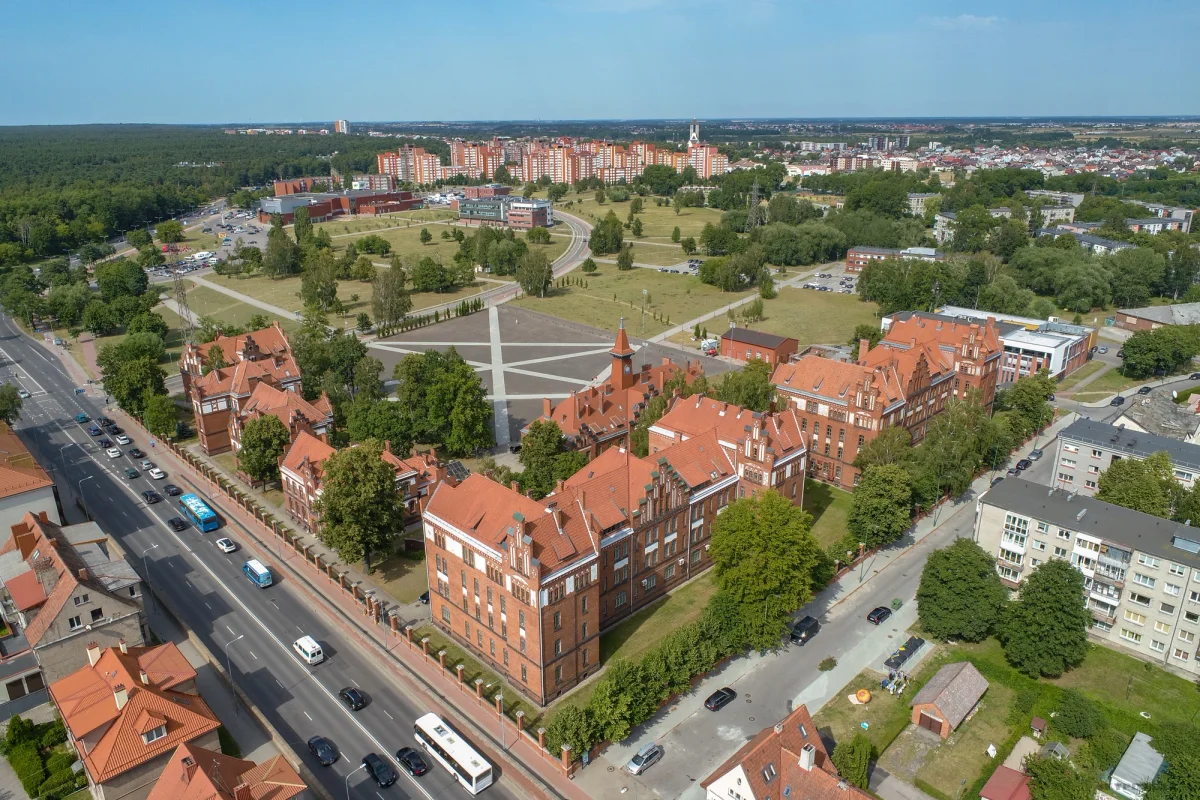
Front view of Klaipėda University
1 / 2

Operating from Klaipėda, Lithuania, Klaipėda University delivers higher education as a public university. It serves as a higher-education provider within Lithuania.

Klaipėda University's academic profile spans multiple qualification levels, organised across multiple faculties. The institution maintains a broad programme catalogue for enrolled students.

Approximately 2,500 students study at Klaipėda University across its programmes. The institution's daily rhythm unfolds within its campus environment, supported by academic and administrative staff.

On academic rankings, Klaipėda University is ranked #3598 globally and #6 within Lithuania. The institution participates in Lithuania's academic ecosystem alongside other higher-education providers.

Location & Contact

Below are the location pin, postal details, and primary contact methods for Klaipėda University. International applicants should account for postal mail processing time when sending physical documents.

Address: Herkaus Manto g. 84
Postal Code: 92294
Phone: 370 46398 908
Social Media:

Academic Details

Key statistics on Klaipėda University's student population, faculty size, and external recognition. International vs domestic student split is often missing from these figures but matters for campus culture.

Academic Year: September to June (September-January; February-June)
Accrediting Agency: Ministry of Education and Science (Švietimo ir mokslo ministerija)
Admission Requirements: Secondary school certificate (Brandos Atestatas)
Total Students: 2,500
Full-Time Academic Staff: 812

Degrees

KU implements doctoral studies in partnership with other national universities: http://www.ku.lt/en/research/doctoral-phd-studies/

Diploma & Certificate 59 programs

Diploma and certificate routes deliver focused, applied training for fast entry into skilled occupations.

  • Archaeology
  • Arts and Humanities
  • Automation
  • Baltic Languages
  • Biological and Life Sciences
  • Biotechnology
  • Business Administration
  • Chemical Engineering
  • Communication Studies
  • Computer Engineering
  • Computer Science
  • Ecology
  • Economics
  • Education
  • Educational Psychology
  • Educational Sciences
  • Electrical Engineering
  • Engineering
  • English
  • Environmental Studies
  • Ethnology
  • Fishery
  • French
  • Geography
  • Geography (Human)
  • German
  • Government
  • Health Administration
  • Health Sciences
  • History
  • Information Technology
  • Leisure Studies
  • Lithuanian
  • Management
  • Marine Biology
  • Marine Science and Oceanography
  • Marine Transport
  • Marketing
  • Mechanical Engineering
  • Nursing
  • Parks and Recreation
  • Pedagogy
  • Philology
  • Physical Education
  • Physical Therapy
  • Physics
  • Political Sciences
  • Primary Education
  • Production Engineering
  • Psychology
  • Public Administration
  • Public Health
  • Social Sciences
  • Social Studies
  • Social Work
  • Sports
  • Surveying and Mapping
  • Tourism
  • Transport Engineering

Faculties & Divisions

The schools at Klaipėda University and their associated subjects. Centres of excellence within faculties signal subjects where the institution invests in research and graduate-level activity.

Health Sciences (Faculty) 11 subjects offered

Specialisations & Subjects

  • Health Administration
  • Health Sciences
  • Holistic Medicine
  • Medical Technology
  • Nursing
  • Parks and Recreation
  • Physical Therapy
  • Public Health
  • Social Work
  • Sports
  • Tourism

Common Career Paths

  • Research Scientist
  • Lab Technician
  • Analyst

Illustrative career directions for this field; specific outcomes depend on programme and student choices.

Marine Technology and Natural Sciences (Faculty) 11 subjects offered

Specialisations & Subjects

  • Chemical Engineering
  • Coastal Studies
  • Computer Engineering
  • Computer Science
  • Electrical Engineering
  • Engineering
  • Marine Engineering
  • Marine Science and Oceanography
  • Mathematics
  • Mechanical Engineering
  • Natural Sciences

Common Career Paths

  • Research Scientist
  • Lab Technician
  • Analyst

Illustrative career directions for this field; specific outcomes depend on programme and student choices.

Social Sciences and Humanities (Faculty) 10 subjects offered

Specialisations & Subjects

  • Arts and Humanities
  • Economics
  • Fine Arts
  • Management
  • Parks and Recreation
  • Pedagogy
  • Performing Arts
  • Public Administration
  • Social Work
  • Tourism

Common Career Paths

  • Researcher
  • Policy Analyst
  • Social Worker

Illustrative career directions for this field; specific outcomes depend on programme and student choices.

Baltic Region History and Archaeology (Institute) 3 subjects offered

Specialisations & Subjects

  • Archaeology
  • Baltic Languages
  • History
Marine Research Institute (Institute) 4 subjects offered

Specialisations & Subjects

  • Biology
  • Ecology
  • Environmental Management
  • Marine Biology

Programs Offered

Browse Klaipėda University's programmes by level, or filter by name to find a specific course. The grouping helps when you have a target qualification tier but want to compare specific programme content.

Bachelor's Degree

26 programmes

Browse 26 programmes at Klaipėda University for undergraduate entry. Each combines core theory with the credits needed to progress toward honours or a master's.

Journalism Žurnalistika Social Sciences & Education 4 years On-campus
General Description: Objective(s) of a study programme: 1) To provide students with the latest general university knowledge in the field of communication, language use and professional journalism. 2) To develop students' skills to carry out research work in radio, television and various magazines and provide transferable skills that graduates use them in the various practical activities. 3) To develop students' capacity to focus on local and international social and political life, good understand and realize the functions of journalism in a democratic society, objectively and intelligently reflect a variety of social, political, cultural and economic events and phenomena in different media. Learning outcomes: Successful graduates are able to: understand the interrelations between various phenomena and objects, analyze their structure and qualities, gather data, interpret it, and present it in various means of mass media. Graduates develop their general skills of native language and foreign language use, teamwork, and readiness to learn independently. They are able to reveal various different social, political, cultural and economic events and phenomena. Graduates can work in editorial offices of periodicals, television and radio stations, electronic (online) media portals, agencies, organizations and companies, and public relations services. Activities of teaching and learning: Lectures, exercise, laboratory work, practice, independent work. Methods of assessment of learning achievements: Independent work assessments, exams. Framework: Study subjects (modules), practical training: Media Technologies, Theory of Journalism, History of Lithuanian Journalism, Broadcast Journalism, Theory of Communication, Journalism Practice 1,2, Photojournalism, Mass Communication Theory, TV and Radio Montage, Journalism Course Paper 1,2, Electronic Media, Reporter Job in Media, Media Law, Investigative Journalism, Advertising Theory and Practice, Journalist Ethics/Professional ethic, Journalism Problems, Media and Society, Journalism Style and Language 1,2, Educational Journalism, Media Marketing, Oratory and Broadcast Language, Visualization of Media and Information, Audio/Video/Text Practice, Bachelor‘s Final Thesis. Specialisations: None Optional courses: Elective field of study courses; freely elective courses; elective courses in another field of studies; elective courses in journalism. Distinctive features of a study programme: The program is focused on Western region demand for quality journalism. Access to professional activity or further study: Access to professional activity: Graduates can make a career in magazines, television and radio stations, electronic (online) media portals, agencies, companies and organizations, public relations services. Access to further study: Have the eligibility to enter second cycle studies under the procedure of the higher education institution.
Duration: 4 years
Delivery: On-campus
Geography Geografija Social Sciences & Education 4 years On-campus
General Description: Objective(s) of a study programme: Is to prepare specialists in human geography who are able to research, analyse, manage, and model socio-economic problems in society and economy, identify the spatial causes of the problems, and apply the principles of sustainable development in their solutions; to prepare regional development specialists, to provide them with the GIS competences, to prepare geography teachers. Learning outcomes: Knowledge and its application 1. Has fundamental knowledge about human geography phenomena, their qualitative and quantitative expression, knows geographical concepts, definition of phenomena and processes, patterns of development and interaction of natural and anthropogenic geospheres, has formal inventory knowledge about geographical objects; 2. Knows geographic research methods, geographic information systems (GIS), obtaining cartographic, mathematical and other geographic information, its analysis and interpretation methodology; 3. Knows societal changes and interaction in space and time, the critical scale of changes, their forecast, knowledge of humanities to achieve the goals of the profession, to form a scientific and philosophical worldview; 4. Able to identify and analyze new research problems in the fields of study, plan their solution strategy, combine elements of theory and practice. Research skills 5. Able to plan territorial research of social and phenomena and processes, formulate a territorial research problem, select research methods; 6. Able to apply the latest geographical research methods, general and principles of social sciences and humanities, analyzing ongoing processes at local, regional and global levels; 7. Able to observe and measure quantitative and qualitative social phenomena, independently carry out natural observations, document information Special skills 8. Able to analyze scientific publications, use databases, laboratory equipment and other sources of information; 9. Able to evaluate the adopted decisions on the use of public and landscape resources holistically, balancing costs, benefits, safety, quality and impact on the environment; 10. Understands new and significant scientific works analyzing social and landscape phenomena and processes and development directions; 11. Able to create spatial distribution maps of phenomena and processes, collect, systematize and analyze geo-informational data, applying geographic information systems (hereinafter - GIS) technologies, mathematical and statistical methods. Social skills 12. Able to responsibly assess the social, cultural, economic and political indicators and changes of society's life, the interaction between society and nature; 13. Able to evaluate decisions from ethical, legal, social, economic and safety perspectives in dynamic and new situations. Personal skills 14. Able to find information from primary and secondary sources, evaluate mathematical and statistical analysis, accuracy of data, summarization of information and its visual presentation; 15. Has skills in the use of information technologies: uses information networks and databases, prepares computer graphic documentation; 16. Able to communicate and convey knowledge and terminology of the subject in the correct Lithuanian language, in which the studies are organized, orally and in writing, as well as communicate in English or another language. Activities of teaching and learning: Theoretical lectures, practical tasks, seminars, field researches field trips, projective activities, study visits to business eneterprises, protected areas, schools. Methods of assessment of learning achievements: Framework: Study subjects (modules), practical training: Common Cartography and Topography, Development of Geographic Discoveries and Ideas, GIS Basics, Introduction to Social-Economic Geography, Geography of Behaviour, Geography of Transport and Communications, Geospheres and Physical Processes, Biogeography and Bioresources, Population Geography and Demography, Physical Geography of Lithuania, Geography of Landscape and Landscape‘s Management, Regional Studies and Regional Research Methods, Theory and Methodology of Social-Economic Geogaphy, Spatial Data Modelling, Social-Economic Geography of Lithuania, World‘s Social-Economic Geography, Economic Geography (Economic Branches, Oceans and Maritime Transport, Political Geography and Geopolitics, Basics and Models of Sustainable Regional Development, Cultural Geography, Geography of Tourism and Leisure, Rural Geography, Course Work 1, Course Work 2, Bachelor Thesis, Learning Practice (in Lithuania), Distant Practice (abroad), Practise of Speciality (in Lithuania). Specialisations: Optional courses: Geography of Services, Geography of Renewable Resources. Free Elective General University Courses (5). Distinctive features of a study programme: Bachelor studies of Geography adjoined to the studies of pedagogy, which student can elect after completion of the 1st course in order to become a highly qualified teachers of geography with GIS competence. Access to professional activity or further study: Access to professional activity: Graduates can work in municipal institutions, regional development agencies, national parks, employment services, social welfare departments, environmental protection, travel agencies, transportation, logistics, trade. Also can works as personnel, managers, regional development experts, project managers, strategic planning and GIS specialists. After obtaining an additional pedagogical qualification, they can work as geography teachers. Access to further study: To continue studies in the second cycle studies.
Duration: 4 years
Delivery: On-campus
Public health Visuomenės sveikata Health Sciences 3 years On-campus
General Description: Objective(s) of a study programme: The aim of the study programme is to train professionals with the in-depth knowledge of modern public health, the foundations of scientific work and the practical skills necessary to meet public and occupational health needs. Learning outcomes: 1. Can identify physical, chemical and lifestyle factors, and analyse ways of managing their impact on human health. 2. Can ensure public health safety by assessing threats to the population health and health of human groups, and providing first aid. 3. Can monitor health inequalities and their determinants, and predict trends in population health and lifestyle using modern public health research methodologies. 4. Can identify the unique health needs of community groups, and working as a team with other health professionals, deliver integrated, evidence-based health promotion and health enhancement programmes that build population responsibility of their health, increase public health literacy, effectively motivate health behaviour change and improve health-related quality of life. 5. Can organise, carry out and coordinate health promotion activities, demonstrate inter-professional competence to ensure equal access to health promotion services for all groups in the community, including people with special needs, by integrating them effectively into the community. 6. Can use modern technological tools, manage health-related information responsibly, and use it to systematically monitor changes in the health of the population, to critically evaluate their own performance, and to anticipate directions for professional development. 7. Can effectively implement the national public health strategy and health promotion programmes by applying theoretical knowledge and skills in health policy development and the organisation of public health care. Activities of teaching and learning: Tutoring sessions, discussions, brainstorming, independent studies, information search and analysis, training and presentation of project workers. Analysis and systematization of scientific articles, consultations and practicals, role-playing games, work in groups, independent learning, analysis of legal documents and preparation of an implementation plan. Information search and systematization, project work preparation and presentation, lectures, film screenings, concept mapping, case analysis, problem solving, practice-based learning. Independent preparation of analytical written works, preparation of presentations, lectures, classes in other (real workplaces) spaces, practice-based learning. Methods of assessment of learning achievements: Cumulative assessment (test, individual work, report, defense of laboratory work). The final grade sums up the grades of midterms and exams. Framework: Study subjects (modules), practical training: Health psychology Oral health Introduction to Public Health Studies Anatomy and physiology Demographic processes Environment and health Injury prevention and safety promotion Health policy and program development Public health practice 1 Fundamentals of biochemistry and health biophysics Biostatistics 1 Biostatistics 2 Basics of nursing Public health practice 2 Health promotion and education Basics of clinical medicine Basics of research methodology Course work 1 Health management Chronic non-infectious diseases and their prevention Microbiology, infectious diseases and their prevention Public health practice 3 Coursework 2 Health ethics and law Self-employment practice Occupational health Child and youth health Primary health care and disease management Bachelor thesis Lithuanian social policy Health impact assessment Social medicine Body image and public health Optional study subject of the field of study Ageing and public health Activities of a public health specialist in the community Basics of a healthy lifestyle Basics of unpaid blood donation Specialisations: Optional courses: Distinctive features of a study programme: Access to professional activity or further study: Access to professional activity: Access to further study:
Duration: 3 years
Delivery: On-campus
Public Administration Viešasis administravimas Business & Management 3 years On-campus
General Description: Objective(s) of a study programme: To train specialists of public administration able to analyse, to think critically, to resolve problems, and to take evidence-based management decisions, who would collaborate with citizens and stakeholders and enable them to take part in public management and who would be aware of, and able to recognize, public interests and ethical principles. Learning outcomes: 1. To know and understand theories and paradigms of public administration 2. To know and understand research methods in public administration 3. To know and understand systems of state steering and public administration; 4. To know and understand the legal basis of public administration 5. To know and understand the financing models of the public sector organizations: the sources of financing and their use and management. Activities of teaching and learning: Lectures, Seminaris, Projects, Case studies Methods of assessment of learning achievements: Individual project, Seminar, Case analysis (study), Examination, Paper, Test. Framework: Study subjects (modules), practical training: Introduction to Public Administration, Civil Service, Administration of Public Services Delivery, Economics, Quality Management in Public Sector, Corruption and it prevention, Public Sector Finance and Budget, System of EU Public Administration, System of Lithuanian Public Administration, Reseach practice Specialisations: None Optional courses: Elective field of study courses, Freely elective courses. Distinctive features of a study programme: Access to professional activity or further study: Access to professional activity: The graduates of study program of Public Administration can work in the public, non-governmental, and a private sector. The potential professional roles of Bachelor of Public Administration: manager, analyst of public policies, expert and assessor, advisor and consultant, specialist, operational staff, auditor and controller, developer and implementor of projects and programmes, inculcator of changes and innovations, initiator and leader of the restructuring of the public sector, etc. Access to further study: Access to the second cycle studies.
Duration: 3 years
Delivery: On-campus
Management Vadyba Business & Management 4 years On-campus
General Description: Objective(s) of a study programme: The objective is to train highly qualified management specialists complying to the needs of the labour market and the needs of the Western Region of Lithuania who would be able to work in organizations functioning in a fast- changing environment as middle and top level managers, to become self-employed, and to continue in graduate studies. Learning outcomes: • Will know the latest fundamental and applied theories, concepts and models of management science, their application for the creation, management and development of business. • Will know the latest fundamental and applied scientific research, regularities of market economy, methods of economics, their application in the field of professional managerial work. • Will know theories of planning, organizing, leadership and control, analytical methods and their application in marketing, human resource, finance, manufacturing and other organizational activities. • Will know main methods of mathematics, statistics, sociology, political science and other science, opportunities of information technology application in collecting quantitative and qualitative data, processing and using it for the solution of problems of organizational management. • Will know methods and theories of psychology, logics and communication that are used in the processes of planning, organizing, leadership and control of an organization. • Will be able to recognize events and processes happening in the environment of an organization, formulate problems of business management, to choose an object of research, to determine the goal of a research, to compose a plan for the research of the managerial problem. • Will be able to choose and apply quantitative and qualitative research methods of organization, its environment, business processes, economic, social phenomena, which will enable to analyze the problems of an organization or its elements. • Will be able to use information technologies, systems and databases that are needed for the analysis of managerial problems of an organization. • Will be able to prepare a report of analysis of managerial problems of an organization, to provide the explanation of research results verbally, using visual aids and mathematical, statistical methods. • Will be able to systematically analyze and evaluate the internal and external environment of an organization, possible consequences in short term and long-term perspective, to envisage possibilities for business development. • Will be able to generate, organize and coordinate the implementation of business ideas, following the principles of sustainable development and social responsibility. • Will be able to envisage means of improvement of functional activity, increasing the effectiveness of resource usage; apply the acts of law regulating the activities of an organization. • Will be able to plan, organize, coordinate and control the work of subordinates and departments of an organization, to manage marketing, finance, human resource and production departments, to use methods and means that are suited for the specifics of their activities. • Will be able to communicate in mother tongue and at least one of the foreign languages verbally and in writing, understandably transmit thoughts on the questions of business management, using Lithuanian and international managerial terminology. • Will be able to constructively discuss and collaborate with specialists of management, finance and marketing, to work in real and virtual teams, to operate in multicultural environment with tolerance. • Will be able to accept responsibility for the quality personal activity and activity of subordinates, to solve managerial problems of an organization, to make creative decisions and develop innovatory activity. • Will be able to create organizational culture, plan, organize, motivate and control the work of a group of subordinates following the rules of professional ethics and public spirit. • Will be able to determine learning requirements and independently learn in order to improve professional qualification in the context of learning for life. • Will be able to conduct professional activity constructively, ethically and with tolerance, to suggest creative and innovative solutions to managerial problems, to understand their consequences in the context of sustainable development. • Will be able to think systematically and self-critically, to make important decisions in an organization, to take initiative and entrepreneurial activity, to maintain and improve personal health. Activities of teaching and learning: Discussion, Formal lecture, Group work, Idea (mind) mapping, Literature analysis, Practical exercises (tasks), Seminar, Case analysis (Case study), Group work, Role play, Exercise classes, Practical exercises (tasks), One-to-one tutorials, Paper, Interactive lecture, Individual work, Design projects, Team project, Problem-based learning, Simulation of real-life (world) situations, Problem-solving task, Reflective journal, Simulation (engineering, technology or process simulation), Assignments. Methods of assessment of learning achievements: Case analysis (study), Examination, Group work, Individual work, Oral presentation, Reflection on action, Seminar, Reporting for practice work, Tutorial, Portfolios/learning logs, Course work, Reflective journal, Peer-assessment, Problem-solving task, Test, Control work. Framework: Study subjects (modules), practical training: Accounting Business Communication Business ethics and social responsibility Business law Business projects Crisis Management Document management E-business Economics Elective subject of general university studies Entrepreneurship Finance management Innovation management Leadership Management Management course work Marketing Marketing management Negotiation Technique Organization of safe work Organizational Behavior Personnel Management Philosophy Planning and management information technology Production Management Professional foreign language 1 Professional foreign language 2 Professional language Professional practice Psychology Quality management Quantitative methods of social research Sales Management Thesis Work in teams Specialisations: Optional courses: 2 foreign language, 1 general studies and 3 professional subjects. Total of 23 ECTS. Distinctive features of a study programme: Access to professional activity or further study: Access to professional activity: Graduates of the Bachelor study programme of Management can work as managers of the middle and top levels in any business organizations. Access to further study: Access to the second cycle studies.
Duration: 4 years
Delivery: On-campus
Recreation and tourism Rekreacija ir turizmas Business & Management 3 years On-campus
General Description: Objective(s) of a study programme: To train high-skilled tourism and recreation professionals, familiar with the regularities and issues related to the recreation and tourism operation and service, who are able to maintain and improve the quality of recreation and tourism services and be able to participate in the process of analysis, administration, planning, and management. Learning outcomes: Knowledge and its application 1. Knows management science theories and is able to integrate them into the tourism and recreation international business processes; 2. Knows management science methods, supplemented by knowledge of related sciences and is able to integrate them into the tourism and recreation international business processes; 3. Is able to apply the latest management knowledge and to apply it in a critical analysis of tourism and recreation international business. Research skills 4. Is able to creatively and critically apply research methods, use fundamental and applied research methodologies and formulate research conclusions; 5. Is able to collect and analyse data, identify the main trends and prospects of the national and international tourism and recreation business; 6. Is able to find, process, interpret, and apply research results, model the solution to the identified problems, and predict market trends in the context of social and economic policy. Special skills 7. Is able to analyse and assess the characteristics of optimisation of performance indicators and decision-making of consumers, companies and organizations in different tourism and recreation business ecosystems and markets; 8. Is able to assess and predict tourism changes in organisations, plan, organise, implement and assess tourism processes and apply statistical analysis methods, information, geoinformation and econometric knowledge; 9. Is able to collect, analyse and systematise data, needed to solve tourism development problems of tourism and recreation companies, organisations and countries, and provide recommendations for solutions; 10. Is able to independently choose complex technologies, organisational and methodological measures. Social skills 11. Is able to effectively communicate and collaborate with specialists and the public, discuss relevant professional issues in an interdisciplinary environment; 12. Is able to consistently express thoughts orally and in writing in Lithuanian and at least one foreign language, communicate effectively in a professional environment and in the community; 13. Is civically active. Personal skills 14. Is able to critically assess one‘s own and colleagues’ professional practice, understands responsibility for the impact of the activities and results on social, economic, cultural development, well-being and the environment; 15. Is able to independently make decisions and assume responsibility in complex situations, constantly improves learning skills. Activities of teaching and learning: Methods of assessment of learning achievements: Theoretical lectures, practical tasks, seminars, study visits to tourism and recreation business companies. Framework: Study subjects (modules), practical training: Introduction to Tourism and Recreation, History of Art and Culture, Tourism and Recreation Management, Tourism Structure and Resources, Cultural Heritage, International Tourism Geography and GIS Technologies, Resort Studies, Tourism and Recreation Strategic Planning, Management of Tourism Innovations, Preparation of Tourism and Recreation Projects, Projects of Tourism and Recreation Events, Tourism and Recreation Economics, Tourism and Recreation Marketing, Industry of Entertainments, Professional Ethics, Information Management, Excurions‘ Preparation and Guiding Methodics, Tourism Law, Tourism and Recreation Researches, Leadership and Management of Changes, Tourism Business Data Systems, Bachelor thesis, Ecotourism Practice, Practice in Tourism and Recreation Enterprise 1, Tourism and Recreation Enterprise 2. Specialisations: Optional courses: Water Tourism, Rural Tourism, Smart Urban Tourism and Innovations, MICE Tourism, Sustainable Tourism, Free Elective General University Courses (5). Distinctive features of a study programme: Access to professional activity or further study: Access to professional activity: Graduates are able to work in the internatinal and national tourism and recreation enterprises, travel agencies, tourist information centers, recreational resorts‘ enterprises, in accommodation, entertainment and health enterprises, in national and regional parks, in municipal tourism and recreation administrations, in project management and implementation, to work as certified tourism guides. Access to further study.
Duration: 3 years
Delivery: On-campus
Civil Engineering and Port Facilities Statybos inžinerija ir uosto statiniai Engineering & Technology 4 years On-campus
Future civil engineers study resistance of materials including, metal, wood, plastic and ferro concrete structures; architecture of buildings and erections, construction mechanics, engineering geodesy, technology and organization of construction works, engineering graphics, etc. During educational practical training, students learn to analyze an organization and master and improve their skills in direct practical activity. The duration of practical studies is 640 hours. The study programme for civil engineering is intended for persons who have obtained secondary education.
Duration: 4 years
Delivery: On-campus
Social Work and Crisis Intervention Socialinis darbas ir krizių intervencija Social Sciences & Education 4 years On-campus
General Description: Objective(s) of a study programme: To provide a basic, university-level education in the field of social work studies that meets European standards, by training specialists whose professional competence would enable them to effectively intervene social problems in the community, education, health care systems, the labour market and other systems, effectively providing and organizing specific social services for a client and their family, and ensuring their continuity; to form strategies of social policy and social assistance in various systems in which a person operates. Learning outcomes: Social work professional trained at KU acquire the knowledge and capacities laid out in Dublin Descriptor (2004) and Regulations of Social Work (2021): knowledge of the essence of social work; crisis intervention; the values of a social worker; their ethical responsibility to customers; the state and economic systems, the processes of socialization and social adaptation; human rights in the context of social justice; and the methodology and methods of research; abilities to carry out research and interpret data, other special, personal and social abilities. Activities of teaching and learning: Unit of general university modules is devoted to students' general cultural education and introduction of students to social, cultural, and religious phenomena of social development. Unit of professional modules offers the basics of social sciences, pedagogy, psychology, and economics, helps students to get prepared for specific social work in community and health care system and enable them to integrate their knowledge, abilities, and skills. All contemporary didactic means and methods (informational, operational, and creative) are utilized: lectures, seminars, lab works, practices and practicums, project and social programme designing, discussions – problem talks, reviewing essays, course papers, tutorials, teamwork, and students' independent work with references. Methods of assessment of learning achievements: Students‘ knowledge is assessed on a scale of 10 points. The final grade consists of the grades for students‘ independent work assignments, participation in seminars (up to 0,5 final grade) and performance during the exam (not less than 0,5 of the final grade). The grades for the independent work assignments accumulate on the principle of an increasing sum, and during the exam, the final grade is derived, egual to the sum of intermediate grades multiplied by their share in the final grade. Framework: Study subjects (modules), practical training: Social work programme covers 210 credits. Subjects of elective general subjects (unit A) include 18 credits, subjects of study field (unit B) include 192 credits. For practice internships there are appointed 4 study modules consisting from semester 4 through semester 7. Introduction to the specialty and professional ethics Human rights and social work Sociology of deviations in social behavior Family and social environment Introduction to Psychology Lithuanian social policy Basics of communication Theory and methodology of social work (with practicality) Personalities and social psychology Coursework 1 Basics of sociology in social work Social work with individual and group Sociocultural activities in the community Crisis psychology Social gerontology Counseling in social work Existential therapy in social work Social support in social work Practice in non-governmental organizations (with supervision) Mental health and care Basics of social work with the disabled Psychosociology will not Term paper 2 Internship in educational, healthcare and probation institutions (with supervision) Social risk groups and resocialization Social work with youth Internship in social work services (with counseling) Optional major subject Social work with family Management of social programs Self-employment practice (with counseling) Bachelor thesis Specialisations: - Optional courses: Students are offered 4 optional subjects, which cover 18 credits in total: a freely chosen subject from any study programme in any faculty. 5 credit subject from professional specialization subjects‘ list.: Caritative social work Social work with children who have experienced sexual violence Social work with refugees Dolphin assisted therapy Occupational therapy Distinctive features of a study programme: Social work is one of the professions of helping people, which requires particularly high professional competence. The aim is to empower the person to whom services are provided and dignified, full participation in society. In the study process, a lot of attention is paid to the development of personal strength and leadership of the future social worker. These are the only such studies that meet international requirements and provide social work qualifications and crisis intervention knowledge bases. Access to professional activity or further study: Access to professional activity: After completing the studies of Social Work at KU, students will have the following career opportunities: social work in the community, in the system of social care, in the system of health care, in educational, legal, and non-governmental institutions. Access to further study: Studies can be continued in the graduate study programmes of Social Work, Social Pedagogy, Public Health, Public Administration, Marketing Management, and Penitentiary Law.
Duration: 4 years
Delivery: On-campus
Occupational Therapy Ergoterapija Health Sciences 4 years On-campus
General Description: Objective(s) of a study programme: To prepare highly qualified occupational therapists, ready for professional practical activities and for research at community, regional, national and international levels levels; applying knowledge, values and skills in practice working individually and in groups with patients of different ages and with various illnesses, to act professionally in a changing environment, apply science-based problem-solving methods. Learning outcomes: 1. Will be able to, based on interdisciplinary knowledge, interpret and justify professional activities of occupational therapy models to combine rehabilitation theoretical methodological provisions and link them to health care policy decisions; to solve relevant professional issues nationally and at the international level. 2. Will be able to plan, execute research in the field of rehabilitation, based on interdisciplinary sciences knowledge and research methodology; systematically analyze scientific information, evaluate data reliability, interpret, argumentative presentation of research the results. 3. Will be able to perform professional activities research, model innovative occupational therapy support based on the latest scientific research evidence, critical reflection and needs of patients and their relatives. 4. Will be able to systematically evaluate and analyze patient disorders cause, nature, person needs, determine the disorder and environmental impact of the individual for functioning, select and apply evidence-based occupational therapy assessment methods and instruments. 5. Will be able to provide occupational therapy, in selecting and applying evidence-based strategies, to evaluate their effectiveness for a person's functioning in various ways environments, to advise individuals, who require occupational therapy help, their relatives, others interested persons, taking into account to the diversity of their needs. 6. Will be able to follow equal opportunities, social justice, human rights and sociocultural diversity recognition and data protection principles, professional ethics; cooperate with various interested groups at the national and international level; to strengthen occupational therapy profession image, spread information about the importance of occupational therapy. 7. Will be able to cooperate interdisciplinary specialists in the team, identify and solve occupational therapists and social challenges. 8. Will be able to reflect and critically evaluate his own and other team members' professional practice, develop professional competences, guided by the principles of lifelong learning; to make decisions independently, to take moral responsibility for one's activities and the quality of occupational therapist's professional activity and its improvement. Activities of teaching and learning: Activities based on the principles of interdisciplinarity, human rights, inclusion and social justice, personalized learning, applying elements of universal learning design and reflective practice help to achieve the expected study results. Study activities are focused on acquiring high interdisciplinary competences for the learner and his/her role changes when moving from a "user" to a cooperating partner in creating a unique learning path. The subjects of the study program are arranged sequentially in semesters, following a logical sequence. Studies begin with general study subjects. In the following semesters, studies are continued, studying subjects in the field of rehabilitation. Such a study plan allows for the consistent development of the occupational therapist's general and special professional competencies, which are necessary when working in the healthcare system in interdisciplinary teams of rehabilitation specialists) and in order to achieve the study results provided for in the study program. The following study methods are used: individual and group projects, solving problem situations, practical tasks, changing roles, case analysis, critical literature analysis, document analysis, video material analysis, analysis of real educational situations, discussions, cooperative activities in small groups and pairs, critical reflection, reflection diaries, inquiry-based learning and elements of action research, preparation of a learning portfolio/portfolio. Studies are organized through interactive lectures, seminars, practical activities, independent individual and group and team work, educational visits, learning in non-traditional environments (educational institutions, services providing educational support, institutions providing interdisciplinary support and healthcare services, etc.). The variety of study environments and methods encourages students to learn actively, to connect the acquired new knowledge with practice and to test it in practice, to reflect on their learning and practical activities. Studies based on the elements of the personalized learning paradigm emphasize the development of the learner's experiences. Therefore, much attention is paid to students' practical activities and their reflection. Time is set aside for student consultations, the purpose of which is to clarify the issues that have arisen individually or in groups, to consult on the performance of independent tasks. Methods of assessment of learning achievements: The evaluation of study results is based on curriculum-based assessment, focused on the continuous recording and evaluation of the student's progress. Assessment methods and methods are combined with the expected study results and competencies and the study methods applied to develop them. When implementing the provisions of personalized learning, the aim is to share the responsibility of the student and the teacher for learning and the results achieved. The following assessment methods are used: teacher assessment, self-assessment of the student's completed task, assessment of each other's tasks in pairs or groups; evaluation/self-evaluation of the learning portfolio and learning reflection. The study of the subjects of the program ends with the assessment of the student's knowledge and skills using a ten-point evaluation system. When evaluating the achievements of individual subjects, the evaluation criteria are formulated in accordance with the harmonized applied cumulative score study achievement evaluation system (including formative evaluation) in the KU Study Regulations. Students' achievements are assessed by means of interim reports and an exam (or defense of the student's self-made work). Students' theoretical preparation and ability to practically solve the practical and problematic tasks of providing and improving are assessed. The final assessment of the study subject consists of evaluations of intermediate reports (individual projects/assignments, problem solving tasks, work portfolio, case analysis, written works) and grades of the exam (or the student's self-completed work/project defense). Framework: Study subjects (modules), practical training: The content of the Ergotherapy program is spread over 4 study years (8 semesters). The scope of the program's subjects (including theoretical subjects, practice and final bachelor's thesis) is 240 credits. The scope of subjects studied in the program is 60 credits per year (30 credits per semester). The study is based on specialty subjects (156 credits), Anatomy and Physiology; Basics of rehabilitation; Physical activity and nutrition; Health Law, Management and Information Management; Psychology; Ergonomics in rehabilitation; Pathology; Movement anatomy and clinical kinesiology I; Basics of occupational therapy; First aid, nursing and pharmacology; Clinical Medicine: Mental and Behavioral Disorders; Occupational therapy: mental and behavioral disorders; Complementary and alternative health care; Functional diagnostics in occupational therapy. Human activity and environment; Therapeutic massage; Clinical Medicine: Internal Medicine and Gerontology; Occupational therapy: internal diseases and gerontology; Occupational therapy methods; Art therapy; Clinical medicine: nervous system diseases; Occupational therapy: diseases of the nervous system; Physiotherapy; Production and application of technical means; Occupational therapy: orthopedics and traumatology; Examination, assessment, diagnostics in occupational therapy; Coursework 1; Clinical medicine: diseases of children; Occupational therapy: children's diseases; Neurosensorimotor integration; Biomedical research methodology; Coursework 2; Bachelor thesis. Most subjects are studied by combining theoretical studies with the solution of complex practical problems in specific occupational therapy institutions, as well as seven practices (48 credits): Cognitive rehabilitation practice; Occupational therapy practice: mental and behavioral disorders; Occupational therapy practice: internal diseases and gerontology; Occupational therapy practice: diseases of the nervous system; Occupational therapy practice: orthopedics and traumatology; Occupational therapy practice: children's diseases; Final occupational therapy practice. According to the procedure established by the Senate of Klaipėda University, 21 credits are allocated to elective subjects of general education. Specialisations: Optional courses: Distinctive features of a study programme: Access to professional activity or further study: Access to professional activity: After completing their studies, graduates will be able to work in public and private medical institutions, wellness and spa centers, or start a personal business or open a private occupational therapy office. Access to further study: Graduates will be able to continue their studies in a master's degree or Complementary and Alternative Health Care training program, which provides the opportunity to obtain a Complementary and Alternative Health Care (chosen field) specialist license.
Duration: 4 years
Delivery: On-campus
Physiotherapy Kineziterapija Health Sciences 4 years On-campus
General Description: Objective(s) of a study programme: To train highly qualified physiotherapists prepared for professional practice and research at the community, regional, national and international levels; to apply knowledge, values and skills in practice, working individually and in groups with patients of different ages and with various diseases, to work professionally in the changing environment, to apply science-based problem-solving methods. Learning outcomes: Knowledge, its application: • Explains the theories and principles of physiotherapy, rehabilitation, physical activity, healthy living and movement. • Applies the fundamentals of basic biomedical sciences necessary to achieve the professional goals of a physiotherapist. • Integrates the fundamentals of applied research methodology into the professional field of physiotherapy based on ethical and legal principles. • Critically evaluates communication theories and principles in the context of national health care and rehabilitation policies. Ability to conduct research: • Independently collects, analyzes and systematizes information in the scientific literature • Independently plans and conducts research, processes, analyzes the obtained results and formulates conclusions. • Interprets and applies research results to model problem solving. • Evaluates the adequacy of research theories and methodologies based on critical thinking. Specific skills: • Collects and evaluates patient/client information, carries out the physiotherapy examination and formulates a physiotherapy diagnosis. • Applies physiotherapy theories and techniques in physiotherapy practice according to the functional status of the patient/client. • Creates an individual physiotherapy plan. • Conducts a physiotherapy program independently and safely, critically evaluates the effects of physiotherapy, makes adjustments as needed, and terminates procedures based on the patient's condition. • Advises patients / clients on physical activity and physical capability, disease prevention and health. Social skills: • Communicates and collaborates professionally with patients / clients and their family members, working responsibly in a team with other medical professionals. • Communicates in written and oral form, in their native and foreign professional language, with colleagues and other specialties in a multidisciplinary team. • Responsibly ensures the quality of provided services in accordance with the principles of professional ethics. • Fosters the image of a physiotherapy specialty. Personal skills: • Makes decisions independently based on a holistic approach, differentiation of priorities, self-confidence and continuous improvement of practical skills based on the concept of lifelong learning. • Organises, plans and carries out practical activities, proposes new ideas and adapts to new situations. • Activities is based on critical thinking, self-critical, tolerance and equal opportunities. • Uses national and international information sources, professionally assesses their reliability, uses modern information technologies, handles confidential information properly. • Applies management and leadership skills to plan and deliver quality physiotherapy services. Activities of teaching and learning: Teaching / Learning Methods: Application of special software packages, Assignments, Case analysis (Case study), Concept mapping, Creativity workshops, Debates, Design projects, Discussion, Exercise classes, Field trips/works visits, Formal lecture, Guests lectures, Group work, Idea (mind) mapping, Individual project, Interactive lecture, Laboratory classes, Library / information retrieval tasks, Literature analysis, Literature review presentation, Modeling of real-life (world) situations (projects), One-to-one tutorials, Practical exercises (tasks), Problem-based learning, Problem-solving sessions, Reading list, Reflection on action, Reflective journal, Role play, Scientific paper analysis, Seminar, Simulation (engineering, technology or process simulation), Simulation of real-life (world) situations, Small group tutorials, Student blog, Team project, Video footage. Methods of assessment of learning achievements: Assessment Methods: Assignments, Background reading, Case analysis (study), Colloquium (interview led by lecturer and / or specialist), Concept mapping, Control work, Course project, Course work, Directed private laboratory work, Essay, Examination, Group (team) project, Group work, Idea (mind) mapping, Individual project, Individual work, Laboratory examination, Laboratory notes and report, Literature analysis, Literature review (study), Literature reviewing and presentation, Mid-term examination, Oral presentation, Paper, Peer-assessment, Portfolios/learning logs, Poster session, Problem-solving task, Project, Project report, Qualification work, Reflection on action, Reflective journal, Report, Reporting for practice work, Scientific paper (text) analysis, Self-assessment, Seminar, Student blog, Test, Tutorial , Video footage, Work placement report. Learners' knowledge is assessed on a scale of 1 to 10. Framework: Study subjects (modules), practical training: The main field of study consists of 155 credits: Anatomy and Physiology; Fundamentals of Rehabilitation; Physical Activity and Nutrition; Health Law, Management and Information Management; Psychology; Ergonomics in Rehabilitation; Pathology; Anatomy of Movement and Clinical Kinesiology I; Fundamentals of physiotherapy; First aid, nursing and pharmacology; Physiotherapy in mental illness; Anatomy of movement and clinical kinesiology II; Therapeutic massage; Functional diagnostics in physiotherapy; Therapeutic and Surgical Physiotherapy; Methodologies of Physiotherapy; Coursework 1; Physiotherapy of Nervous Diseases; Manufacture and Application of Technical Instruments; Physiotherapy; Orthopaedics, Traumatology and Kinesiotherapy; Physiotherapeutic Examination; Sports Physiology; Coursework 2; Movement Control, Training and Sensory Systems Studies; Biomedical Research Methodology; Obstetrics, Gynaecology and Physiotherapy; Paediatric Diseases and Physiotherapy. 49 credits: Cognitive Rehabilitation Practice; Therapeutic Disease and Surgical Physiotherapy Practice; Nerve Disease Physiotherapy Practice; Trauma and Orthopaedic Physiotherapy Practice; Paediatric Disease Physiotherapy Practice; Final Physiotherapy Practice. The study programme culminates in the preparation, defence and evaluation of a final thesis. Specialisations: - Optional courses: Students can choose from a range of electives (21 credits). Distinctive features of a study programme: Graduates are awarded a joint bachelor's degree in physiotherapy and a professional qualification as a physiotherapist; a joint diploma is awarded. The study process places particular emphasis on problem-based learning. Access to professional activity or further study: Access to professional activity: Graduates can work as physiotherapists in healthcare institutions licensed to provide medical rehabilitation services. Graduates can participate in training programmes leading to a PASP specialist licence. Access to further study: Opportunity to pursue postgraduate studies in Lithuania or abroad. After obtaining a professional qualification as a physiotherapist, graduates can continue their studies in non-formal education/specialisation programmes.
Duration: 4 years
Delivery: On-campus
Psychology Psichologija Social Sciences & Education 4 years On-campus
Duration: 4 years
Delivery: On-campus
Childhood Pedagogy Vaikystės pedagogika 4 years On-campus
Objective(s) of a study programme: to ensure students‘ undergraduate pedagogical education in compliance with the European standards, to develop general and specialist competences necessary for the professional activity in the education of young, pre-school, and pre-primary age children, and/or to prepare students for the graduate studies. Learning outcomes: 1. The knowledge of the general laws of the physical, cognitive, and psycho-social development of pre-school and pre-primary school child and the ability to assess them. 2. The ability of getting to know and analyzing the needs of pre-school and pre-primary school child, of individualizing and differentiating the ways of meeting them, and of developing individual programmes. 3. To know the significance of the child‘s environment and of psychological, national, cultural, social, economic, and political factors for (self-) education. 4. The ability to identify, interpret, and summarize the level of children‘s achievements and the progress made by them. 5. The ability to model the content of pre-school and pre-primary education by promoting child‘s spiritual, emotional, social, and intellectual improvement. 6. The ability to analyze, plan, organize, and assess the activity of child and children‘s group. 7. The knowledge of strategies, conceptions, technologies, and innovative ways and techniques of (self-) education and the ability to apply them. 8. The ability to manage a pedagogical interaction by combining children‘s (self-) education, protection, and care and by building one‘s activities on the recognition of child rights and the requirements for their protection. 9. The knowledge of child‘s pedagogical, psychological, social, and legal problems and the ability to manage psycho-social and educational interventions. 10. The ability to create and maintain a safe (self-) education environment promoting child‘s development, activity, creativity, and independence by fostering different areas of activity and socio-cultural integration. 11. The ability to involve family in an active pedagogical interaction, given the specifity of child‘s (self-) education in family and child‘s individuality. 12. The ability to systematically provide family with social and educational services seeking child‘s quality (self-) education. 13. The ability to collaborate with other specialists working in a group or an institution, as well as with the administration, on the issues of childen‘s (self-) education and the management of the institution. 14. The ability to work in a team with the institutions and specialists of child‘s education, care, and assistance by seeking social partnership. 15. The ability to collect and analyze research data necessary for the solution of a problem; to assess and interpret a problematic situation and to recognize the need for a change. 16. The ability to design pedagogical research: to know the methodology of scientific and empirical research, to select an appropriate research strategy, structure, and techniques. 17. The ability to organize research into professional activity: to use different sources of information, to collect theoretical and empirical material, to analyze, interpret, and summarize it. 18. The ability of quality development and clear and justified presentation of the report of pedagogical research. Activities of teaching and learning: Lecture, practice, independent work, practical assignments, problem-based teaching, work in groups, presentation of a review of literature, seminar, individual consultations, study and working visits, activity reflection, project development and visualization. Methods of assessment of learning achievements: Study results are assessed during the semester (Colloquiums, individual projects, Practice reports, an oral illustrated presentation, portfolio and others.) and during a final exam. Some courses can be assessed by credits. The assessment is based on a ten-point criteria-based scale and a cumulative grade. Students' knowledge through exams graded from 1 (very poor) to 10 (excellent) rating, while the credits - "credited" or "fail". Exam evaluation from 1 to 4 is not satisfactory. Specialisations: - Optional courses: There is a possibility to choose general university education electives (6 credits), free-choice electives (8 credits) and study field electives (8 credits) subjects. Distinctive features of a study programme: Part of the study program is carried out by distance and e – learning way. It is possible to obtain a double degree, by choosing minor studies.
Duration: 4 years
Delivery: On-campus
Radiology Radiologija Health Sciences 4 years On-campus
General Description: Objective(s) of a study programme: To train university, highly qualified radiology technologists meeting European standards, able to work with medical sources of ionizing and non-ionizing radiation and other equipment related to medical exposure of persons, to perform medical diagnostic imaging procedures according to their competence, able to organize their workplace, ensure medical procedures quality and radiation safety of patients and other persons, who are able to cooperate with health care and other specialists, who are able to conduct research. Apply skills in working with patients with a variety of ailments, committing to human rights and professional ethics. Learning outcomes: I. Acquired knowledge and its application: knows the requirements of radiation safety, the basics of human anatomy, physiology and pathological processes in the human body; has basic applied knowledge of natural, biomedical, radiological, biological, biostatistical and social sciences; knows and is able to use the achievements and methods of basic and applied research in solving technological problems; knows the practical and scientific principles of the medical technology study field as well as development perspectives and connections with other study fields; are familiar with the principles of medical technology resource management and quality assurance; knows the aspects of the legal framework governing the work of a radiology technologist in health care practice and is able to apply them in solving problems; is able to cover a broader multidisciplinary context of medical technologies, is able to apply methods and processes of other technologies; is familiar with and is able to manage documents in accordance with his / her competence in health care institutions or institutions whose activities are related to the application, design and development of medical technologies and equipment. II. Research skills: is able to independently collect, analyze and interpret the necessary professional and scientific information in databases and other information sources; is able to apply the knowledge acquired in medical technology studies, solving scientific-practical problems; is able to plan imaging procedures and work with radiological examinations and other medical imaging equipment and provide an evaluation of the performed examinations; is able to select and apply appropriate analytical methods in the chosen field of radiology studies; is able to apply the technological knowledge and understanding of the field of radiology in planning and implementing projects. III. Special abilities: is able to select and apply appropriate equipment, develops his / her professional identity through medical technology and interdisciplinary research; is able to combine theoretical and applied knowledge in solving technological problems; is able to evaluate the ethical and environmental circumstances of the application and impact of medical technologies; is able to independently choose complex technological, organizational and methodological tools, evaluate the principles of activity organization, the importance of occupational safety and basic requirements, as well as the interaction of medical technology process links. IV. Social skills: is able to communicate in the state and foreign language in an intercultural and intersectoral environment; is able to understand the principles of communication and cooperation, not be afraid to take responsibility; is able to communicate and present science-based knowledge to professionals and the public; is able to make decisions independently and evaluate their impact in the conditions of a defined situation; is able to use modern means of communication and social networks to convey professional and other information; is able to manage and understand the importance of social activity when planning and implementing personal or collective activities; assess its quality. V. Personal abilities: is able to work effectively independently and in a team; is able to communicate with doctors, nurses and the technology community and the general public; is able to assess the impact of biomedical and medical technological solutions on patients, society and the environment, adheres to the norms of professional ethics and health care institution, understands the responsibility for the activities of a radiology technologist; is able to manage projects and business aspects, understands the links between medical technological solutions and their economic consequences; is able to assess the importance of individual lifelong learning and prepare for it. Activities of teaching and learning: innovative teaching and learning methods are applied. The subjects of the study field, which provide knowledge based on the specialty of radiology technologist and develop the skills of their application, will be taught on the basis of oral (traditional and interactive lectures, discussions, seminars), visual / demonstration and practical methods (laboratory work, practical tasks, reflections). Special skills will be developed during internships, case analysis, execution of individual tasks and projects, analysis of professional ethics and legal documents. Ability to conduct research based on students' individual research, data collection, ability to perform data analysis, systematizing and summarizing research results, assessing the quality of imaging and radiological services will be improved during coursework, final work and description, individual consultations with the supervisor. Student's independent work is based on tasks, teamwork, where problematic and critical thinking is important. The program aims at active student participation in the study process, finding and applying problem-solving methods. Methods of assessment of learning achievements: the ten-point cumulative assessment system applies to the assessment of knowledge and skills. Study results are assessed through interim assessments (tests, individual and group tasks and their presentation, projects, defense of practical, laboratory and independent work, etc.). The final assessment (grade) consists of a cumulative assessment based on the marks of intermediate assessments and examinations. Framework: Study subjects (modules), practical training: General University Studies (18 credits): Professional Foreign Language 1, 2, Philosophy, Professional Language, Elective General University Study Subject 1, 2. Fields of study (192 credits): Study subjects (152 credits): Biology and Genetics, Anatomy, Microbiology, Human Physiology; Introduction to Radiology, Latin. Biochemistry, Radiological and Topographic Anatomy, General Physics, Conventional Radiology, Health Psychology. Pharmacology (general and radiological), Fundamentals of clinical medicine, Special radiology, First aid, Radiation protection. Basics of Nursing, Quality Control in Radiodiagnostics, Radiological Imaging Technologies, Computed Tomography and Angiography, Coursework 1. Nuclear Physics, Surgery. Traumatology, Biostatistics, Nuclear Medicine, Pathology (general and special). Magnetic resonance imaging, Radiotherapy, Specialty elective 1, Coursework 2. Health law and bioethics, Specialty elective 2. Internships (25 credits): Radiology Technologist Practice 1, Radiology Technologist Practice 2, Professional Practice. Professional Bachelor's Thesis (15 credits). Specialisations: Optional courses: Elective specialty subjects (6 credits) from: Radiobiology, Patient positioning, Children's diseases, radiological diagnostics, Medical equipment, Computer interpretation of diagnostic images, Research work. Distinctive features of a study programme: The radiology study program is the only first cycle university study program in Lithuania that meets European requirements (several students work in hospitals in England and the Netherlands by specialty). Access to professional activity or further study: Access to professional activity: after graduation, they will be able to work independently in X-ray, Computed Tomography, Magnetic Resonance, Angiography, Ultrasound, Densitometry, Nuclear Medicine, Radiation Therapy, Interventional Radiology, Interventional Cardiology, Dentistry and other radiology departments as a radiology technologist. Access to further study: has the right to enter the second cycle (master's) studies.
Duration: 4 years
Delivery: On-campus
Informatics Informatika Computer Sciences 4 years On-campus
General Description: Objective(s) of a study programme: The main aim of the Programme is to prepare higher qualification Informatics specialists that meet the requirements of the modern knowledge-based and information-based economy. Bachelor in Informatics (Computer Science) has: a grasp of the essential principles and theoretical background of computer science, the ability to apply analytical, modeling and numerical techniques to problem formulation and solving in the field of informatics and information technologies, an understanding of the software systems and services life cycle processes, and a range of transferable skills including communication, project management and team work. Learning outcomes: Deep knowledge and understanding of mathematics and theoretical informatics (computer science), understanding of the scope of modern achievements of information and communication technologies and their limitations. Deep knowledge of software engineering and modern integrated computer systems life cycle processes, comprehensive awareness of methods of their implementation, and understanding and interpretation of a wider spectrum of informatics discipline, including such emergent areas as computational science and intelligence. Knowledge of the fields of the humanities and social sciences, understanding of management and interdisciplinary issues of informatics, including project and quality management, necessary for the achievement of one‘s professional aims and for the development of erudition and broad world outlook. Comprehensive awareness of information systems and software engineering processes, deep understanding of software life cycle models, requirement analysis; architectural and component design, programming and implementation, testing, maintenance, improvement and quality assurance procedures and standards, as well as fresh ability to apply them. Ability to plan and carry out information retrieval, storage, processing, visualization and interpretation processes, modeling and design of human computer interaction, investigation skills and ability to effectively participate in the analytical, modeling and experimental research and draw conclusions. Ability to integrate knowledge, to select and apply appropriate informatics methods, tools, programming languages and modern programming environments, while developing integrated intelligent systems and solving complex problems in traditional and new application areas and projects. Ability to holistically assess existing and emerging systems, to apply professional judgment, balancing the costs, profits, quality, safety and security, reliability, usability, appearance and environmental impact. Ability to critically evaluate the suitability of applied informatics methods and technologies to the problem in question, ability to take independent decisions, provide operational strategies that are based on the acquired knowledge of informatics, artificial intelligence and software engineering. Ability and skills to work independently and efficiently in their professional field, ability to clearly and convincingly convey the results of the work to professionals and other persons, dealing with professional challenges and adjacent areas’ tasks. Ability to communicate effectively and work in a team, that may be composed of different field, expertise and nationality of people, collaboration abilities and skills to communicate the requirements of the client in the specification, designing and implementation of smart computer systems and software. Activities of teaching and learning: Lectures Workshops Laboratory Seminars Individual counselling Case studies Practice Methods of assessment of learning achievements: Exam Colloquium Control work Laboratory work report and the defence Practice report Final work Framework: Study subjects (modules), practical training: Operating systems Object programming Webpage design Web technologies and programming Computer electronics Computer architecture Computer graphics Data structures and algorithms Discrete mathematics and algorithms theory Computer hardware systems Computer networks and information security Databases Numerical methods and mathematical modeling Software systems engineering Professional practices Final Practice Bachelor's final thesis Specialisations: Smart systems development, Software development, Optional courses: Development of distributed systems (Java) Software testing, management and configuration maintenance Programming. NET Open source electronics prototyping platforms Modelling of automatic control systems Real-time operating systems Robotics and mechatronics Cryptology Distinctive features of a study programme: More than fifteen years experience of computer science study program implementation, students have ability to choose one of the following specializations: applications systems, intelligent systems. Access to professional activity or further study: Access to professional activity: Programme outcomes ensure the preparation of the Informatics Bachelors can work as Computer specialists, which including programmers, database and GIS specialists and administrators, computer systems and computing specialists, analysts and designers, software engineers, information technology engineers, network administrators and engineers, etc. Access to further study: Access to the postgraduate studies at a higher education institution established in accordance with the procedure.
Duration: 4 years
Delivery: On-campus
Leisure Sports Laisvalaikio sportas 4 years On-campus
General Description: Objective(s) of a study programme: The goals of the study program are to ensure a basic university education by providing the knowledge regarding leisure sports and pedagogy based on the results of the latest fundamental and applied research and to develop the ability to apply it in professional activities; to form the rudiments of research work; to develop a creative personality guided by the principles of lifelong learning. Learning outcomes: Knows the theories of educational science, historical, philosophical, psychological, sociological, intercultural aspects, based on which education and educational activities are analysed. Understands the complex relationship between physical activity and healthy lifestyle and is able to justify theoretical models of behaviour change, applying intervention programs of physical activity for individuals and groups. Is able to explain the main principles of research work, quantitative and qualitative data collection and analysis methods. Under the guidance of a teacher, is able to design and conduct, in accordance with the principles of research ethics, a simple study on leisure-time physical activity, and to formulate and publicly present the results and conclusions of the study. Is able to evaluate the development of a sports person, recognising the individuality of each person, and to recognise and take into account the individual differences of learners in the educational process. Is able to plan and manage the process of organizing individual and group physical activity in a variety of settings, integrating based and practically proven facts into physical activity practice. Based on the methods of assessment of achievements and self-evaluation, is able to interpret the physical activity and physical fitness of people of various ages, taking into account the current state of health. Is able to determine the needs of a person or group related to physical activity, and when implementing physical activity, apply appropriate motivational methods, create a safe, tolerant, open, encouraging cooperation and partnership-based environment that supports individual needs. Is able to teach technic and tactic of various sports, organize, and participate in competitions. Is able to communicate and cooperate with persons or organizations of different ages, needs, cultural nature, creating high-quality interpersonal interaction and effective communication in professional activities. Is able to assume obligations to protect and nurture Lithuanian culture and nature, create a sustainable society, participate in the processes of societal and educational change. Is able to work individually, make independent decisions when creating and implementing physical activity promotion activities and conducting educational activities in the field of physical activity. Is able to think critically and creatively, reflect on one's experience and, based on that, take responsibility for improving professional and educational activities. Learns at least one foreign language at a level not lower than B2 according to the Common European Framework of Reference for Languages and uses it for academic and professional purposes. Activities of teaching and learning: Formal lecture, Practical classes, Problem-based teaching, Recommended readers, Work in groups, Disputes, Analysis of research article, Analysis of literature, Seminars, Discussions, Small group tutorials; Creation of a project. Methods of assessment of learning achievements: Ten grade and gathered evaluation system is applied. The semester’s individual work tasks (Group (team) project, Individual work, Literature reviewing and presentation, Problem-solving task, Reflection on action, Test) are evaluated by grades; the final grade is given during the examination session while multiplying particular grades by the lever coefficient and summing the products. Framework: Study subjects (modules), practical training: Introduction to Specialty Studies, Human Anatomy and Physiology, First Aid, Strength Sports, Sports Games, Athletics, Sports Theory and Didactics, Sports History and Ethics, Movement Anatomy and Clinical Kinesiology I, Physical Fitness Testing, Leisure and Sports Events, Theory of Pedagogy, Basics of Psychology, Practice 1, Orienteering Sports, Course Paper, Winter Sports, Application of Information Technologies in Sports, Methodology of Sport Research, Practice 2, Modelling and Organization of Education, Special Pedagogy and Psychology, Development of Critical and Reflexive Thinking, Practice 3, Nutrition for Athletes, Course Work 2, Children's Health-Enhancing Physical Activity, Practice 4, Water Sports, Final Thesis in Pedagogical Studies, Technologies for Development of Motional Skills, Statistical Analysis, Sports Management, Swimming and Physical activity in Water, Final Thesis. Specialisations: Basketball, Football Optional courses: Basketball, Football Distinctive features of a study programme: The Leisure Sport study program is both relevant and unique: the study subjects are oriented towards the development of specific physical activities in the coastal area, utilizing the resources of the beach and the Baltic Sea. After acquiring knowledge and skills in beach volleyball, football, various active games, water sports (surfing), graduates will be able to organize formal and non-formal physical activities for people of all ages, not only in the usual spaces, but also in a specific coastal area. High-performance athletes' dual careers are supported by favourable conditions, including a flexible schedule, hybrid (contact and remote) courses, and reduced tuition prices. Access to professional activity or further study: Access to professional activity: Graduates will be able to work as sports professionals in state, private and public sports organizations; as teachers of their profession or non-formal education in children's summer camps; as personal trainers for children and adults; to create and develop private business in the field of sports and leisure for children and adults; to pursue a career using professional and general competencies. Access to further study: Bachelors of the programme are provided with a favourable educational environment and follow the principle of continuity and lifelong learning, i. e. to continue their studies in the second study cycle.
Duration: 4 years
Delivery: On-campus
Port Technology Management Uostų technologijų valdymas Engineering & Technology 4 years On-campus
General Description: Objective(s) of a study programme: The aim of the study programme is to train specialists in the field of port technology management with an interdisciplinary education in the field of marine engineering, capable of ensuring the smooth operation of the port by applying innovative knowledge of transport, port engineering and handling technologies, computerised information systems, solving logistical tasks and implementing the ideas of an intelligent autonomous port or e-logistics, developing strategic technologies and combining the decisions taken with aspects of the maritime sector, economy, management and environmental protection. Learning outcomes: Knowledge and understanding: Knowledge and understanding of mathematics, calculus and other basic sciences underpinning their engineering qualification, with the ability to apply them at a level necessary to achieve the other outcomes of the Port Technology Management programme. Knows and understands the fundamentals of engineering and applies the knowledge to new engineering problems at a level necessary for the achievement of the other programme outcomes. Be able to adapt a broader range of multidisciplinary knowledge, methods, processes to port technology management, research and development. Engineering analysis: Be able to analyse processes and systems for the management of seaport technologies, select and apply appropriate methods from a range of analytical, computational and experimental approaches, and correctly interpret the research carried out in the light of sustainable development principles. Be able to identify, formulate and use fundamental principles to holistically address port technology management issues, select and apply relevant approaches and recognise the importance of social, health and safety, environmental economic and industrial constraints. Be able to combine theoretical and applied knowledge to solve port technology management problems, select and apply relevant methods and recognise and take into account the importance of social, health and safety, environmental, economic and industrial constraints. Engineering design: Be able to apply digitally based design and data management methodologies: correctly interpret the results of such analyses. Be able to compose, develop, operate, apply various tools and techniques in the field of port technology management. Be able to design and implement projects in the field of marine engineering, taking into account the principles of the circular economy, artificial intelligence, port digitalisation. Be able to design or develop the engineering elements of port technology management in accordance with specified technical, economic and environmental requirements. Research: Be able to find relevant professional and scientific information in scientific databases and other information sources and apply it to problems in port technology management and maritime transport logistics. Be able to solve problems in the field of port technology management using laboratory equipment and simulators, to analyse and interpret the results obtained, and to present conclusions and recommendations. Practical activities: Possess initial skills in the control and management of port technology and maritime transport logistics engineering systems and processes. Be able to rationally select and apply port technological equipment, tools and methods; assess their functional capabilities and the limits of their effective use. Be able to combine theoretical knowledge and practical application of typical and atypical engineering solutions in port organisation, to understand their impact on the environment and their relationship to economic consequences. Apply the principles of organisation and management of engineering activities, assessing the economic, environmental and social impacts in the context of port technology management. Personal skills (decision-making, lifelong learning, cooperation and teamwork): Able to work effectively independently and as part of a team with professionals from other professional activities and at other levels of qualification. Understands the health, safety and legal issues and responsibilities associated with engineering activities, the impact of engineering decisions on society and the environment, adheres to professional ethics and engineering standards, and takes responsibility for engineering activities. Able to keep abreast of developments in science and technology, and is aware of the importance of individual lifelong learning and is prepared for it. Able to understand aspects of project management, the links between technological decisions and their economic consequences, and to deal with non-standard work situations in port technology management. Activities of teaching and learning: - Methods of assessment of learning achievements: In order to ensure students' active work throughout the semester, their ability to apply theoretical knowledge in practice, and the objective evaluation of study results, the University uses cumulative assessment. In cumulative assessment, the results of studies are assessed by means of mid-term examinations (test, individual work, paper, laboratory thesis, etc.), and the final grade is the sum of the grades of the mid-term examinations and the examinations. Failure to complete or settle semester assignments and to obtain a passing grade - a minimum of a specified number of midterm reports - will result in the student being denied the right to sit the final examination. Each study programme shall culminate in an assessment of the graduate's education in the form of final examinations and/or the defence of the final thesis/project. The University has a ten-point evaluation system. Framework: Study subjects (modules), practical training: Materials Engineering, Mathematics in Engineering, Engineering Graphics With CAD, General Chemistry, Introduction to Specialty, Mathematical Methods in Engineering, Physics 1, Theoretical Mechanics, Mechanics of Materials, Programs for Computer Aided Design, Probability Theory and Applied Statistics, Theory of Machines and Mechanisms. Machine Elements, Physics 2, Electrical Engineering and Electronics, Waterways and Port Connectivity, Hydromechanics, Port Management and Logistics, Ship Theory, Ship and Port Terminal Equipment with Research Project, Management of Business and Engineering Project, Basics of Green Shipping, Marine Transport Development Basics, Cargo Types and Flows and Their Management, Economics, Human Safety, Transport Systems and Automation Basics, Pasenger and Non Dangery Cargo, Terminals Technologies Management, Freight Forwarding, Forwarding and Shipping Agency, Port Infrastructure Basics with Research Project, Shipping organization and management in the Port, Automated Cargo Handling Equipments and Systems, Introduction to Maritime Law and Insurance, Dangery Cargo Terminals Technologies Management, Bachelor's Final Thesis, Practice in Port and Transport Companies Specialisations: - Optional courses: Port Terminal Planning with Research Project, Logistical Chains and Their Management, Energy Transition in Shipping: Liquefied Natural Gas, Maritime transport development and logistics. Distinctive features of a study programme: Distinctive features of a study programme: Port Technology Management is a unique, promising and popular study programme. Graduating from the Port Technology Management programme can lead to a job in a modern It also offers the opportunity to work as an engineer in various maritime industry and transport companies and port administrations. You can work in stevedoring, ship agency, freight forwarding, or as a technical consultant, manager of an industrial enterprise or its departments, project manager in commercial enterprises. Access to professional activity or further study: Access to professional activity: A bachelor's degree in port technology management - engineering allows graduates to work as engineers in a wide range of companies in the maritime industry (port administrations, stevedoring, ship agency, freight forwarding, shipping, logistics, etc., as well as as managers of industrial companies and projects). Access to further study: After graduating from the Port Technology Management study programme, you can go on to study for a Master's degree in technological sciences
Duration: 4 years
Delivery: On-campus
Marine Transport Engineering Jūrų transporto inžinerija Engineering & Technology 4 years On-campus
General Description: Objective(s) of a study programme: To train specialists of the highest engineering qualification to work in maritime industry and transport companies, ship design and construction companies, applying innovative decarbonization and digitalization technologies, making decisions by combining aspects of economic, environmental and social impact. Learning outcomes: Knowledge and understanding: • Know and understand the scientific and mathematical principles of maritime transport engineering; • Systematic understanding of the maritime transport system, the relationship between ports and shipping, key aspects and concepts in the field of transportation; • Have consistent knowledge in the field of maritime transport engineering, including basic knowledge in the field; • Know the broader multidisciplinary engineering context; • Knowledge of materials and elements used in engineering and their properties. Engineering analysis: • Mathematical and numerical skills, correct use of units of measurement and presentation of data; • Ability to evaluate engineering solutions from a social, economic and environmental point of view; • Be able to apply knowledge and understanding of transport engineering in the analysis of engineering products, processes and methods, risks; • Be able to apply knowledge and understanding to define, formulate and solve maritime transport engineering problems using available methods; • Be able to select and apply appropriate analytical and modelling techniques in marine engineering. Engineering design: • To be able to apply the regularities of movement of mechanical systems, the principles of stability and reliability to create, improve and repair technical means; • Be able to apply engineering knowledge and understanding in the design and implementation of marine engineering projects that meet defined requirements; • Understand design methodologies and be able to apply them in marine engineering. Research: • Skills in using information technology, basic software, ability to apply and use numerical computer methods to solve specific engineering problems, use computers to obtain and process problem-solving data, process control, computer graphics, use other computer functions; • Be able to work in workshops and laboratories, apply standard research methods; • Be able to create and perform necessary experiments, evaluate data and present conclusions; • Be able to search the literature and use databases, manuals and other sources of information. Engineering activities: • Ability to manage technological processes and properly operate technical equipment; • Be able to select and apply appropriate equipment, tools and methods; understand their capabilities and scope; • Be able to combine theory and practice in solving the problems of decarbonisation of maritime transport, including energy efficiency, marine fuel, hull, propulsion system optimization; • Understand the ethical, environmental and commercial context of marine engineering. Personal / transferable skills: • Written and oral communication skills, ability to present research results and conclusions clearly and correctly to various audiences; • Communicate with the engineering community and the general public in a variety of ways; • To know the health and safety problems and responsibilities related to engineering activities, the impact of engineering decisions on society and the environment, to observe the norms of professional ethics and engineering activities, to take responsibility for engineering activities; • Understand project management and business aspects such as risk and change management and understand their shortcomings; • Understand the importance of individual lifelong learning and prepare for it; • Work effectively both in a team and individually, as well as in an international multicultural environment. The Naval Architecture and Shipbuilding specialization trains ship designers, engineers, and project managers for shipbuilding, repair, conversion companies; they are able to design, build and modernize ships for digital and cleaner shipping and to manage projects and risks; they are able to assess the impact of engineering decisions on society, the economy and the environment, to adhere to the norms of professional ethics; to understand the importance of lifelong learning and to prepare for it. Activities of teaching and learning: - Methods of assessment of learning achievements: In order to ensure the active work of students throughout the study semester, the ability to apply theoretical knowledge in practice, the objective assessment of study results, the University applies cumulative assessment. In the application of cumulative assessment, the study results are assessed by intermediate assessments (test, individual work, report, defence of laboratory work, etc.), and the final grade sums up the marks of intermediate assessments and examinations. If a student fails or fails to submit for the semester assignments on time and does not collect the minimum score for the specified number of interim assessments, he/she is not allowed to take the final exam. Each study program is completed with an assessment of the graduate's education - final examinations and / or defence of the final work (project). The university has a ten-point grading system. Framework: Study subjects (modules), practical training: Maritime Transport Engineering study program subjects: Material Engineering, Higher Mathematics, Engineering Graphics with CAD, General Chemistry, Introduction to Specialty, Philosophy, Theoretical Mechanics, Economics, Human Safety, Materials Design, Computer Design Programs, Professional Language, Probability Theory and Applied Statistics, Machine Mechanics Theory and Machine Elements, Electrical Engineering and Electronics, Quality management, Measurements, Bachelor Thesis. Naval Architecture and Shipbuilding specialization subjects: Hydromechanics, Welding Engineering, Ship statics, Ship Equipment with Course Project, Business and Engineering Project Management, Ship Hull Design Course Project, Ship Energy Equipment, Ship Hull Construction, Ship Theory Course Project, Ship Movement, Ship Construction and Repair Technology, Ship Hydroaeromechanics, Marine Engineering Information Technology, Ship Systems with Course Project, Ship Construction and Repair Technology Course Project, Maritime Transport Logistics, Ship Design Basics, Ship Environmental Protection Technology, Structural Mechanics of the Ship, Planning and Management Information Technology, Quality management, Measurements, Technological- Practice, Bachelor Thesis. Specialisations: Naval Architecture and Shipbuilding; Optional courses: Maritime Transport Engineering alternative subjects: Hydraulic and pneumatic systems, Fundamentals of automatic control of mechatronic systems, General university study subjects. Naval Architecture and Shipbuilding specialization alternatives subjects: Seaport Terminal Technology, Navigation Basics and Port Navigation Systems, Maritime Transport Logistics, General University Studies. Distinctive features of a study programme: Unique study program in Lithuania, additional specialization from the EU-CONEXUS Minor catalog, additional study and internship mobility opportunities, project activities. Access to professional activity or further study: Access to professional activity: The education in the integrated field of marine engineering and information technology opens career opportunities for an engineer, designer, head of a technical department, project manager in ship design, construction and maintenance companies, port administrations; maritime and coastal terminals; classification societies, transport technology automation and automated control companies. Access to further study: The graduates of the Bachelor‘s degree study programme of Marine Transport Engineering can continue in Master‘s degree studies in the field of Technological Sciences.
Duration: 4 years
Delivery: On-campus
Informatics engineering Informatikos inžinerija Computer Sciences 4 years On-campus
General Description: Objective(s) of a study programme: To train highly qualified and broadly-based computer science engineering professionals who are able to compete in a rapidly changing marketplace of technologies, products and services by applying computer science and electronics methods, engineering principles and technologies to design, implement, maintain, develop, test and evaluate secure computer systems and networks, which can be used to solve relevant problems in a wide range of professional fields; Learning outcomes: Graduates of the Informatics Engineering program have a strong foundation in Informatics Sciences related to computer operation, hardware and software, as well as knowledge of algorithm design, programming, human-computer interaction, software development and maintenance, and the impact of business, industrial, economic and social contexts on professional practice. They are able to conduct research effectively and apply current computer science and electronic engineering methods to solve problems in various fields. They are also able to select appropriate software and hardware to develop or improve systems and implement specialized software using current standards and project management techniques. Graduates possess the ability to evaluate computer systems for performance, security, and reliability, plan and implement support and development for computer systems, and methodically prepare necessary documentation for product or service development in the field of computer engineering. They also possess strong social skills in communicating professionally and working effectively in teams, and have personal abilities such as the ability to engage in self-directed learning, work independently, take initiative and assume personal responsibility, and demonstrate creativity in solving professional challenges and problems. Activities of teaching and learning: The study process of the Informatics Engineering program at Klaipėda University is designed to be flexible and utilizes a variety of effective and varied study methods that are regularly reviewed and improved to stay current with developments in the field of computer science and the recommendations of social partners. Self-study assignments are aligned with the learning outcomes of the program and the needs of business and industry, and are designed to motivate and educate students to manage their time effectively. The program utilizes the latest study methods, including traditional methods such as lectures, laboratory work, seminars, written work and presentations as well as newer methods such as guest lectures, team work, case studies, problem-based learning, role-playing and simulations, which are flexibly applied to best meet the needs of the students. The program also uses the newest equipment and modern laboratories to ensure that students have access to the latest technology and tools to support their learning. The Informatics Engineering program at Klaipėda University has established specialized laboratories to support the program curriculum. These laboratories include: • Autonomous systems and artificial intelligence lab, • Prototyping of engineering systems and virtual instrument development lab, • Intelligent control systems lab, • Software engineering lab, • Digital and analogue electronics lab. These laboratories provide students with hands-on experience in developing models and prototypes of real intelligent and autonomous systems, software, tools, and prototypes of real systems. They are equipped with the latest technology and tools to ensure that students have access to the resources they need to succeed. This approach to learning allows students to apply their theoretical knowledge in a practical setting and gain a deeper understanding of the subject matter. The labs are regularly updated to ensure that students are exposed to the latest technologies and trends in the field of computer science. Methods of assessment of learning achievements: The Informatics Engineering program at Klaipėda University uses an objective and cumulative assessment system to evaluate student learning outcomes. The assessment system includes predefined criteria and allows students to monitor their progress and receive feedback on their performance. The assessment procedure, system, and criteria are designed to ensure validity, reliability, clarity, usefulness, and impartiality in the assessment process. The assessment system is regularly reviewed and updated to ensure that it aligns with the latest developments in the field of computer science and the recommendations of social partners. This allows the program to continuously measure student progress and improve the learning experience. Framework: Study subjects (modules), practical training: During their studies, students in the Informatics Engineering program at Klaipėda University complete an engineering product development internship at the university, as well as a final internship at a company in their final year. This provides students with real-world experience and helps them to make the transition from academic to professional life. The program has established strong relationships with leading IT companies in the region and abroad, including UAB Teltonika IoT Group, UAB Visma, UAB Telesoftas, UAB Omega 365, UAB Creative Partner, UAB Nord Robotics, UAB Flinke Folk, UAB Inotecha, and many more, to help students find internships and employment opportunities after graduation. In addition, students have the opportunity to study part of their program at partner universities in the EU Conexus network, including universities in Germany, Ireland, France, Spain, Greece, Cyprus, Croatia and Romania. This allows students to gain a broader perspective on the field of computer science and make valuable connections with other students and professionals. The program also encourages students to participate in the Erasmus+ mobility program, which allows them to study at an even greater number of international partner universities, further expanding their knowledge and network. Specialisations: Optional courses: In addition to the core curriculum, the Informatics Engineering program at Klaipėda University also offers a variety of elective courses that students can choose from to further specialize in areas of interest. These elective courses allow students to deepen their understanding of specific areas within the field of computer science and tailor their education to align with their career goals. They provide students with the opportunity to explore new topics and learn from experienced professionals in the field. The elective courses offered by the program are regularly reviewed and updated to ensure that they are current and relevant to the latest developments in the field of Informatics Engineering. These courses also provide students with a competitive edge and help them to stand out in the job market. Distinctive features of a study programme: Access to professional activity or further study: Access to professional activity: Graduates of the Informatics Engineering program at Klaipėda University are highly skilled and versatile specialists in the development and maintenance of advanced IT management systems and software. They possess a deep understanding of computer hardware, remote systems management, computer networks, database and service provision, and the prototyping of real computer-based engineering systems. They have the ability to develop and maintain high-quality software, IT systems, and hardware that are safe, secure, and reliable. Their broad-based knowledge and practical skills make them well-suited for a wide range of careers in the IT field. They can excel as experts, consultants or managers in IT projects, and they have the option to pursue postgraduate studies to deepen their knowledge and advance their careers. Graduates will be well-prepared to work in a variety of industries and organizations, including software development companies, IT consulting firms, and large corporations, as well as public and private sector organizations. Access to further study: Graduates of the Informatics Engineering program at Klaipėda University have the opportunity to continue their education by pursuing postgraduate studies. These studies can include a Master's degree in a Klaipeda University Technical Information Systems Engineering also related field such as Computer Science, Software Engineering, or IT Management. Postgraduate studies provide students with the opportunity to specialize in a specific area of computer science and to gain advanced knowledge and skills in the field. This can help graduates to stand out in the job market, increase their earning potential, and advance their careers. Another option for graduates would be to pursue a professional certification, such as those offered by organizations like the Microsoft, Google, Amazon, Cisco, IEEE, etc. Additionally, some graduates after master studies may choose to pursue a PhD in Informatics engineering or computer science and to continue a career in academia or research.
Duration: 4 years
Delivery: On-campus
Natural Geography and Oceanography Gamtinė geografija ir okeanografija 4 years On-campus
General Description: First cycle studies aim to prepare scientific research, environmental protection and land use planning specialists with a degree in the study field of geography, who are able to understand the patterns of formation, development and spatial differentiations of geospheres, landscape, social and economic systems in Lithuania and the rest of the world, apply analytical methods and information technology, who are familiar with general principles of sustainable development and environmental protection, understand the importance of lifelong learning and are able to continue studying for a Master's degree. The preparation of physical geography of hydrology and oceanography specialist is associated with realization of Lithuania‘s as a maritime country's strategic interests. Hydrology and oceanography bachelors program is carried out according to the Lithuanian marine environmental protection law (V. Z., 1997, no. 108-2731) to promote researches into the maritime, sea coastal area who are necessary to assess the state of the environment, to develop the knowledge about the marine environment, to form the scientific understanding. In Lithuania higher education system, Klaipeda university is being specialized in preparation of maritime professionals (KU strategic plan). During the study process, students are introduced to the earth geospheres, geological structure, relief features, physics, hydrology, oceanography, climatology and meteorology, also bio geographical patterns. Many studies focus on the natural geography of geo-informatics systems, environmental knowledge, environmental and land provision, mapping skills, geographical knowledge of the mother country. During the summer, educational practices and remote geographical practices are being organized. Students work in the fields, rivers, lagoons, Baltic sea. During apprenticeship, students consolidate knowledge of geography, environment awareness and get new skills while working in institutions. Objective(s) of a study programme: The main objectives of Hydrology and Oceanography studies program is • to prepare higher qualification physical geography specialists (bachelors), who are able to creatively apply the knowledge for the marine environment and coastal management, use and protection in a relation with employers' interests. • cultivate specialists in the study fields and branches of physical geography, who will have acquired the necessary amount of knowledge and motivation to work in accordance with their qualifications, and continue their education or training further; • provide students with an opportunity to acquire integrated competence in the field of geography; • to provide the knowledge and skills necessary for shaping environmental science and environmental protection oriented thinking paradigm; • develop a critical approach and a sense of civil liability for the Earth and for one's own country; • to allow international student mobility, to ensure bachelors to be prepared for position in international area. Learning outcomes: Knowledge and Its Application: 1 Fundamental knowledge of physical phenomena and their qualitative and quantitative expression; 2 Must possess knowledge in the field of geography, i.e. be familiar with definitions of geographical concepts, phenomena and processes, have knowledge about physical and anthropogenic patterns of geospheres' evolution and their interaction, interaction between the above phenomena, orientation and intensity of these processes as well as formal inventory knowledge about geographical objects; 3 Has knowledge of geographical research methods, geographic information systems (GIS), cartography, mathematical and other geographic information acquisition, its analysis and interpretation methodology; 4 Has knowledge about spatial integration and differentiation patterns of physical phenomena, interrelationship between the geographical environment and landscape elements, dynamic processes and cycles on-going within the geographical environment, in various geosystems. 5 Has expertise in the process of monitoring of geographical spheres, hydrosphere and oceanosphere, their research, modelling and forecast creation techniques; 6 Applies knowledge when identifying and analysing new research problems relating to relevant study fields, planning their solution strategies and combines elements of theory and practice when realising pragmatic insights. 7 Has knowledge of the oceans and seas, estuaries and coastal water catchment systems, their structure, physical, geochemical processes, hydrosphere, interactions with other geospheres. 8 Specific knowledge about the modern monitoring of oceans and seas, marine economic development, international and national environment protection and sustainable development issues, essential components of the global maritime economy, and their geographic characteristics. Research Skills: 1 Ability to plan research and experiments, formulate research problems, select research methodology and equipment and carry out research safely; 2 Ability to apply the latest geographical research methods, general principles of physical geography sciences, analyse processes happening in geospheres, in hysrosphere and on oceanosphere, on a local, regional and global levels; 3 Ability to monitor and measure quantitative and qualitative aspects of physical phenomena, independently carry out monitoring in nature observations, document information and present research reports. Subject–Specific Skills: 1 Ability to analyse scientific publications, use databases, lab equipment, experimental systems and other information sources; 2 Ability to process, evaluate, analyse and interpret data, and summarise information on a specific subject; 3 Ability to understand theoretical principles, which serve as the basis for newly developed research methodology and technologies; 4 Ability to holistically assess decisions while balancing the costs, benefits, safety, quality, reliability and impact on the environment; 5 Understanding of new and significant scientific works as well as directions of development in different fields of science; 6 Ability to create maps representing spatial distribution of events and processes and collect, structure and analyse geo-referenced data using GIS technology, mathematical and statistical techniques. Social Skills: 1 Ability to responsibly evaluate social, cultural, economic and political indicators and changes of social life as well as interaction between nature and society; 2 Ability to evaluate decisions from an ethical, legal, social, economic and security point of view; 3 Ability to work and adapt in changing/dynamic or new situations; teamwork skills; 4 Ability to present practical results of their work to the public and organise successful realisation of these results in a market economy. Personal Skills: 1 Ability to formulate arguments, present research findings and conclusions to different audiences both orally and in writing; 2 Ability to find information from primary and secondary sources, including search for operational information; ability to systematise and structure information; 3 Ability to employ legal acts and other documents, and rely on them in practice; 4 Ability to assess mathematical and statistical analysis, data accuracy, information summaries and its visual presentation; 5 Information technology use skills: ability to use information networks and databases, and develop computerised graphical documentation; 6 Time management and organisational skills, written communication skills as well as skills allowing them to verbally present and defend scientific works; 7 Has independent learning skills needed to ensure continuous professional development; 8 Ability to communicate and convey knowledge of the subject and terminology in correct Lithuanian language both orally and in writing, as well as the ability to converse on the subject related topics in at least one foreign language. Activities of teaching and learning: Assignments, Case analysis (Case study), Discussion, Exercise classes, Field trips/works visits, Formal lecture, Gests lectures, Group work, Individual project, Interactive lecture, Laboratory classes, Literature analysis, Literature review presentation, Scientific paper analysis, Seminar, Team Project, Practice. Methods of assessment of learning achievements: Case analysis (study), Colloquium (interview led by lecturer and / or specialist), Control work, Course work, Directed private laboratory work, Examination, Group (team) project, Individual project, Individual work, Laboratory examination, Literature reviewing and presentation, Mid-term examination, Oral presentation, Problem-solving task, Report, Reporting for practice work, Test, Work placement report. Framework: Study subjects (modules), practical training: Foreign Language, Higher Mathematics, General Geography, Meteorology basics, Physics basics, General Chemistry, Probability theory and mathematical statistics, Geodesy, Information systems in environment, General geology, Geography of Lithuania, Geomorphology and topography practice, Hydrology, Climatology basics, Geography of the Oceans and Seas, GIS (Geographical Information Systems), Geomorphology, Applied Hydrology, Hydrology practice, Environmental impact and monitoring (course work), Speciality language, Marine and Ocean Geology, Hydromechanics, Geochemistry, Coastal processes, Geographical Research Methods, Computer statistics in hydrology, Remote Sensing methods, Oceanography, Oceanography practice, Geosystem course work, Marine cartography basics, Apprenticeship (practice), Marine Law, Hydrological forecasting, Final thesis. Optional courses: Hydrobiology, Hydrogeology, Marine biogeography, Synoptical meteorology (marine) basics, Geography of Europe, Environmental Engineering, Geophysics, Hydrodynamics, Ecological monitoring and pollution control. Distinctive features of a study programme: The studies duration 3,5 y., The majority of the programme subjects deal with relevant regional and marine cluster, sea environments. Access to professional activity or further study: Access to professional activity: Physical Geographer skills associated with the profession: hydrologist, hydro chemist, engineering oceanography, meteorologist, topographer, map maker, hydrographic topographer, topographer, geography lecturer, environmentalist. Physical Geography bachelors can work in Lithuanian and European Nature protection departments, Hydrometeorology services, municipalities, landscape, water management institutions, harbours and hydro construction departments. As well as continuing education and research activities of higher level degree (Master) studies. Access to further study: They can take the studies of natural, tehnology or physical science in Master programmes.
Duration: 4 years
Delivery: On-campus
Lithuanian Philology Lietuvių filologija Humanities & Cultural Studies 4 years On-campus
General Description: Objective(s) of a study programme: The objective is to provide the student with philological education, to train specialists with academic background in the general sciences of the humanities, Lithuanian philology, who are able to analyse facts and texts of Lithuanian language, and who have methodological – linguistic, literature science, and interdisciplinary competences in the field of the humanities Learning outcomes: Knowledge A1 Knows and understands the distinction and evolution of Lithuanian culture in global context; possesses general knowledge in social, physical, biomedical and technological sciences. A2 Possesses theoretical and methodological knowledge in linguistics and literature science, realizes links of Lithuanian philology with other sciences, understands employment of interdisciplinary relations in studies and vocational activity. A3 Possesses knowledge in modern system and evolution of Lithuanian language, knows and understands peculiarities in usage of linguistic units, employs regularities of linguistic system and development for analysis of linguistic phenomena, approaches to linguistic facts from the viewpoint of theoretical linguistics and pragmatics. A4 Understands literary process, analyzes and evaluates texts and cultural facts in the context of general and Lithuanian literature. Research abilities: B1 Ability to choose the trend of research, to frame problem and employ necessary methods of analysis. B2 Ability to collect and classify empiric materials, employing traditional and modern data bases and sources. B3 Ability to interpret and describe results of philological research. Specific skills: C1 Ability to analyze and systematize study material by employing IT. C2 Ability to combine studies in Lithuanian philology and stage direction, to employ interdisciplinary potential in academic and vocational activity. Social skills: D1 Possesses skills in joint activity and ethic communication with partners. D2 Ability to find proper proportion of cultural positions and opinions in multicultural environment. D3 Ability to fluently and correctly express thoughts orally and in written, to present and ground own ideas, results of scientific researches and projects, to discuss and argue. Personal skills: E1 Ability to take responsibility for results of own and team activity. E2 Ability to plan and control the process of self-education. Activities of teaching and learning: lectures, practical training, final thesis defence. Methods of assessment of learning achievements: individual and group projects, verbal presentation, case analysis, colloquium, essays, test, control work, exam, etc. Framework: Study subjects (modules), practical training: Prospective philologists study compulsory and elective subjects of general education that train their philosophical thinking and provide them with the basic knowledge from other fields of sciences; subjects of professional qualification that develop their philological-social competences, teach to analyze the development of world and Lithuanian literature, introduce to the system of language and its laws, and develop general philological competence. Students do two general philological practical trainings. The study programme is completed with a Bachelor’s final thesis. Graduate is awarded the degree of Bachelor of Humanities. Specialisations: Creative Writing and Editing. Specialisation course units: Stylistics of Language Units; Communication Strategies; Fiction Texts' Redaction; Theory and Practice of Creative Project Development; Semiotics; New Media Linguistics and Artificial Intelligence; Creative Practice; Intellectual Property Law and Data Protection; Theory and Practice of Culture; Creative Writing and Editing Practice; Specialization Final Thesis (Project). Optional courses: General Education Elective 1; General Education Elective 2; General Education Elective 3. Distinctive features of a study programme: Lithuanian philology studies with a possibility to choose pedagogy module or specialization in theatrology or in creative writing and editing ensure interdisciplinarity, provide more opportunities for intellectual and creative expression of students, and professional career. Access to professional activity or further study: Access to professional activity: The qualification acquired concedes a right to work in institutions of education, culture, etc. as proof-readers and editors, administrators, referents, journalists, media executives, theatre educators, and event directors. Moreover, those who acquire a professional qualification of pedagogue have possibility to work as teachers of Lithuanian language and literature. Access to further study: Access to the second cycle studies.
Duration: 4 years
Delivery: On-campus
English philology Anglų filologija Humanities & Cultural Studies 4 years On-campus
Future masters of comparative linguistics study general linguistics, sociolinguistics, psycholinguistics, comparative semasiology, theory and practice of translation, relations of the Baltic and Slavic languages, etc. Practical studies are not implemented. The study programme for comparative linguistics is intended for persons who have acquired a bachelor’s degree and wish to become masters of philology.
Duration: 4 years
Delivery: On-campus
Electrical Engineering Elektros inžinerija Engineering & Technology 4 years On-campus
General Description: Objective(s) of a study programme: The aim of the electrical engineering program is to prepare highly skilled electrical engineering specialists to meet the needs of the latest knowledge and information-based economy and to provide future specialists with the knowledge and skills necessary for the global engineering market activity, understanding the influence of engineering decisions and preparing a wide range of erudition for creative and critical thinking in electrical engineering and robotics specialists and ensuring the principles of lifelong learning. Learning outcomes: Knowledge: 1. Knows and realize the principals of natural sciences (physics, chemistry) and mathematics necessary for the understanding of the fundamentals of electrical engineering – electrical circuits, their elements, analysis and synthesis of electrical systems; 2. Knows and systematically understands the basic principles and concepts of electrical engineering, electronics, microprocessor theory, mechatronics, electrical machines and gears, electrical and renewable energy and automatic control, electrical and control circuit processes corresponding to the study field of electrical engineering; 3. Know and are able to relate the main subjects of the study program such as automatic control, control of the systems, controllers, electrical drives, measurement techniques, electrical materials, industrial automatics and programing, industrial communication and robotics and has knowledge of energy efficiency; 4. Know a broader multidisciplinary context of engineering and able to apply the methods and processes of philosophy, mechanical engineering, information technologies, material science, law, economics and project management and of other fields of science. Engineering analysis: 1. Able to apply one‘s knowledge and understanding to the identification, formulation, and analysis of the problems arising in the activities of electrical and other industrial enterprises and to the propose solutions by using appropriate methods and solution strategies; 2. Able to use knowledge and understanding for the analysis and solution of engineering problems of electrical engineering by means of the choice and application of appropriate most recent analytical and digital-computer solution methods and relevant experimental and industrial equipment; 3. Able to choose innovative analytical and modeling methods techniques and apply them in professional work in industrial and business enterprises regarding the electrical engineering field. Engineering design: 1. Able to apply the acquired knowledge and understanding of electrical engineering to the problems solutions in the development and implementation of interdisciplinary projects oriented towards the development of new products and systems and meeting the set requirements; 2. Understand design methodologies and able to apply them to the designing of the new electrical systems, their elements and control of the systems. Also able to model the work of the designed systems. Investigations: 1. Able to define, understand, and find the scientific and professional information necessary for the solution of electrical engineering problems by using different sources of databases patents, technical documentation standards, diagrams and other information sources; 2. Able to plan and carry out physical and virtual experiments for the analysis and synthesis of the systems and to process and evaluate the obtained data, and to provide conclusions; 3. Able to use various experimental, laboratory and equipment of professional work including the selection and creation of connection diagrams, adjusting the parameters, using the software based experiment equipment in electrical engineering study program field. Engineering practice: 1. Able to choose, to apply appropriate techniques, means, and equipment to the implementation of engineering solutions for electrical engineering systems, know the internal design working principles and functions of the electrical equipment and is able to able to use the equipment; 2. Able to combine the electrical engineering theoretical and applied knowledge to solve the problems of electrical systems’ connections, control, analysis and diagnostics; 3. Aware of ethical, environmental and commercial requirements of engineering activities; 4. Know principles of organization of engineering activity in electrical engineering field; understand their interaction, able to assess engineering activities, work, electrical safety and fire safety and environmental protection interactions. Personal and social skills: 1. Able to work in a team, developing and implementing solutions for industrial enterprises, to organize personal and group activities; 2. Able to work effectively and communicate with engineers and society in national and international level in oral and written form. 3. Able to make innovative decisions to develop new products using a holistic approach in evaluating ethics and potential impact on society and the environment; 4. Understand electrical engineering projects development and business management aspects, as well as successful technology solution principles based on economic expediency; 5. Understand the significance of lifelong learning and preparedness for it. Activities of teaching and learning: - Lectures - Distant Lectures and Practices - Workshops - Laboratory - Seminars - Individual consultations - Case studies - Course Projects - Internship Methods of assessment of learning achievements: The University applies cumulative grading in order to ensure objective evaluation, active students’ participation during the semester and their ability to apply theoretical knowledge in practice. Cumulative grading final evaluation consists of interim course assignments (test, individual work, paper, laboratory work defense, and etc.) and final exam grades. If the student fails the interim course assignments and does not make to transition grade−minimal grade of determined interim course assessments−he is not allowed to take the final exam. Each study program is completed by defending final thesis (project). A ten-point grading system is used at the University. Framework: Study subjects (modules), practical training: Natural sciences and mathematics subjects (Higher Mathematics, Probability Theory and Mathematical statistics, Information Technologies, Physics, General Chemistry). Social and Humanities science subjects (Economics, Engineering and Business Project Management, Philosophy, Professional Language, Foreign Language). Engineering subjects (Theoretical Mechanics, Mechanics of Materials, Materials Science, Material Engineering, Engineering and CAD Graphics, Environmental Engineering, Embedded Systems Programming, Internet of Things Systems Programming). Electrical Engineering Study Field courses (Analog and Digital Circuits, Synthesis and Simulation of Electrical Circuits, Electromagnetic Field Theory, Electronics and Course Project, Electrical Machines and Course Projects, Design of Electrical and Electronic Schematics, Microprocessors and Microcontrollers, Electrical Apparatus, Optoelectrical Systems, Sensors, Electrical Drives Theory, Basics of Control Systems of Electrical Drives, Electrical Drives of Ships and Ports, Automatic Control Theory and Course Project, Programmable Logic Controllers and Industrial Communication, Robotic systems, Digital Methods in Electrical Engineering, Signal Processing, Renewable Energetics and Energy Efficiency, Electrical Transport Systems, Smart Grids, Electrical Energetics, etc.). Engineering design subjects (Engineering Graphics With CAD, Electrical System Course Project, Electrical Machines and Course Projects, Electronics and Course Project, Automatic Control Theory and Course Project, Electrical Drives of Typical Mechanisms and Course Project, Bachelor Final Thesis); Practical and research activity training courses (Internship, Bachelor Final Thesis, Automated Electrical Drives Control Systems and Modeling, Metrology and Experimental Technique, Human Safety and Electrical Safety, Electrotechnical Materials and other study subjects containing laboratory work). Specializations: None Optional courses: - Professional Foreign Language; - Elective General Course; - Free Elective Subject; - Digital Methods in Electric Engineering; - Law and Standards in Electroenergetics; - Basics of Control Systems of Electrical Drives; - Electrical Drives of Ships and Ports; - Electrical Drives of Typical Mechanisms and Course Project; - Automated Electrical Drives Control Systems and Modeling; - Embedded Systems Programming; - Signal Processing; - Robotic Systems; - Robotics Embedded Systems; - Internet of Things Systems Programming; - Electrical Transport Systems; - Electrical Energetics; - Smart Grids; - Energy Systems of Ships and Port. Distinctive features of a study programme: The graduate of electrical engineering program knows and understands the basic principles of electrical engineering, electrical energetics and robotics, formulates and solves problems of the ability to apply the basic engineering principles and analytical methods, understands the engineering design process and is able to design, understands the main factors of the business environment - marketing, finance and investment evaluation, has communication, computing, use of information technologies, project management, work team and other transferable skills. Access to professional activity or further study: Access to professional activity: The acquired qualification gives the right to work in machinery, equipment, industry, energy, transport and other enterprises by leading specialists, technicians, automation, electrical energetics and robotics specialists, designers, as well as in scientific laboratories, private business, and experimental activities and also port companies. After acquiring practical and management, experience can work at enterprises and their subdivisions as managers, project managers, etc. Access to further study: Has the right to apply for postgraduate studies at a higher education institution in accordance with the established procedure.
Duration: 4 years
Delivery: On-campus
Archeology and History Archeologija ir istorija Humanities & Cultural Studies 4 years On-campus
General Description: Objective(s) of a study programme: Prepare a critical-minded personality capable to understand past phenomena and discover links with current events. Prepare archaeologists and historians having fundamental archaeology and history related science knowledge, able to apply them in further studies and activities related to all kinds of archaeological and historical heritage assessment and conservation, research and promotion, able to use acquired knowledge in education, science and culture institutions, non-governmental organizations and private businesses. Learning outcomes: Knowledge and its use: 1. The abilities to understand, relate and compare Baltic cultures with the cultures of the neighbouring countries; to understand cultural characteristics and differences in the region. 2. The acquisition of the knowledge of natural sciences and auxiliary subjects necessary for the perception of human, social, and natural development in the natural environment. 3. The abilities to apply the knowledge of archaeology and history of different historical periods to the analysis of the material and spiritual culture, as well as the society, and the ability to conduct the field research. Capacities to conduct research: 1. The abilities to put to practice the knowledge about archaeological field research, to document research in compliance with professional requirements, and to examine and interpret the data by means of basic methods and approaches of archaeology, history and auxiliary sciences. 2. The abilities to conduct archaeological research by means of contemporary technologies and to collect materials for the necessary lab tests of natural sciences. 3. The abilities to apply theoretical knowledge and understanding; the acquisition of general cultural, general, professional, and special competences necessary for archaeologist’s practical activity. The ability to carry out archaeological and historical research and to develop technical documents. Acquisition of the abilities and skills necessary for further professional development and the ability to design individual professional career. Professional capacities: 1. The abilities to plan, organize, implement and evaluate activities in the field of archaeology and history by selecting technological, organizational and methodological tools. 2. The abilities to convey ideas in verbal and written form, to orient oneself against the background of global scientific information. Social capacities: 1. The abilities to communicate with professionals and the public by addressing particular issues of professional activity, to deliver the given knowledge and its results. 2. The abilities to use modern IT, adapt research in practice and present it to the public. 3. The abilities to maintain professional academic language and foreign language skills working independently and in a team. Personal capacities: 1. The abilities to learn in professional work and study area and plan study process. 2. The capability to formulate an independent interpretation based on critical thinking and analysis of empirical data. 3. The abilities to assess the archaeological and historical processes and to focus on continuous vocational self-improvement. Activities of teaching and learning: Within the programme framework students gain theoretical and applied scientific knowledge. The theoretical part is devoted to acquiring the necessary competencies of archaeology, history and related sciences. Applied science knowledge is aimed to introduce students to modern technologies and methods of non-invasive archaeological and historical heritage studies. While studying, students gain knowledge of modern technologies and methods usability in the studies and acquire practical skills. Methods of assessment of learning achievements: In order to ensure active student work during whole semester, ability to apply theoretical knowledge in practice and objective evaluation of the study’s results University uses cumulative assessment. Using cumulative evaluation method study results are being evaluated in interim Periods (test, individual work, report, laboratory work, etc.) and final grade aggregates interim and exam grades. If student fails to complete semester assignments and does not acquire minimum points needed to continue – then he is not allowed to sit final exam. Study programme concludes with an assessment of graduate education – thesis defence. Framework: Study subjects (modules), practical training: Introduction to Archaeological Studies Introduction to Historical Studies Stone and Bronze Ages Technological Changes in Prehistory Anthropology and the Human History History of Antiquity Baltic Sea Region during Roman and Migration Period Viking Age Archaeology in Lithuania Medieval Archaeology History of Europe in the Middle Ages (5th to 11th c.) History of Europe in the Middle Ages (12th to 15th c.) History of Europe from the 15th Century till 18th Century History of the Lithuanian State from the Middle Ages to the Late 18th Century History of Lithuanian Military in the 13th-20th C Archaeology of Early Modern Period History of Europe in the 19th Century History of Europe in the 20th Century History of Lithuania in 19th–20th C. Conflict Archaeology of Modern Period Artefactology Digital Research Methods in Archaeology Methods of Underwater Research Application of Digital Methods Industrial Archaeology Hillforts in Cultural Landscape General Geology Heritage Conservation and Management Museology Historical Cartography Conflict Archaeology Academic and Professional Ethics Archaeological Research Strategy Archaeological Field Practice Scientific Archaeological Field Practice History of Archaeology in Lithuania Archival Practice Philosophy Logic Sociology German language 1 German language 2 Course Paper 1 Course Paper 2 Bachelor’s Thesis 1 Bachelor’s Thesis 2 Specialisations: - Optional courses: Elective field of studies course Freely elective course Speciality elective course Distinctive features of a study programme: Archaeology and History in Klaipeda University offers not only general theoretical and applied archaeological and historical studies. This programme offers possibility to have a pedagogical specialization. The programme pays close attention to applied knowledge and practical skills, using modern technologies and methods, necessary for carrying out non-invasive archaeological research. Archaeology and History in Klaipeda University includes courses on underwater and marine archaeology. Access to professional activity or further study: Access to professional activity: Successful completion of an undergraduate degree programme gives ability to work with all kinds of archaeological and historical heritage assessment and conservation, research and promotion, acquired knowledge can be used in working with education and science in cultural institutions, cultural tourism, non-governmental organizations and private businesses. After completing a Bachelor of Humanities degree, graduates can choose Master’s degree studies in Klaipeda University. Students who have selected and completed the pedagogy module for related studies can work as teachers in general education schools Access to further study: After completing a Bachelor of Humanities degree programme, graduates can choose graduate studies in the field of History or other programmes of Master’s degree.
Duration: 4 years
Delivery: On-campus
Economics Ekonomika Social Sciences & Education 4 years On-campus
General Description: Objective(s) of a study programme: To prepare highly qualified, broadly skilled economics specialists capable of demonstrating comprehensive economic knowledge and applying it effectively in private or public sector organizations. These specialists will analyze and evaluate economic processes within organizations, identify and resolve economic challenges, utilize available resources efficiently, and align their practices with principles of sustainable economic development. Learning outcomes: Knowledge and Application • A1: Demonstrates the ability to critically and systematically analyze and apply the latest knowledge of economics, including its concepts, models, and principles, in professional practice and research. Understands classical and modern economic theories, Lithuanian and international economic development trends, international economic principles, and key indicators of economic activity. • A2: Possesses a comprehensive understanding of theories in economics, social sciences, and humanities, as well as the planning and management of enterprises. Capable of integrating and summarizing these concepts to analyze and solve economic issues, applying economic reasoning in professional practice, research, and broader analytical and critical thinking development. Research Abilities • B1: Selects appropriate quantitative or qualitative research methods, leveraging mathematics, statistics, and econometrics to manage, interpret, and analyze economic and statistical data. Applies research methodologies to identify economic problems. • B2: Employs diverse research methods to understand organizational and business environments, conducts independent empirical research, interprets results, and adapts findings to inform economic decisions in business operations. • B3: Identifies, systematizes, and analyzes economic indicators and regulatory policies, processes economic information and statistical data, and applies research outcomes to model solutions for economic challenges, improve professional practices, and implement innovations in economics. Specialized Skills • C1: Systematically collects, classifies, processes, and interprets economic information in an international comparative context. Analyzes government policies, global economic operations, and proposes improvements to economic policies. • C2: Applies theoretical economic knowledge in organizational functions, problem-solving, and risk evaluation while summarizing the activities of international political, economic, legal, and social organizations. • C3: Analyzes social and economic phenomena, marketing strategies,consumer behavior, and expectations in national and international markets. • C4: Evaluates the economic condition and performance of economic entities, interprets business data, and makes ethical, social, legal, and financial decisions. • C5: Independently prepares and implements corporate plans and projects, organizes market research, evaluates organizational efficiency, and enhances economic activity by incorporating national and international expertise. • C6: Demonstrates professionalism and effective communication in individual and team settings, discusses professional issues in multidisciplinary contexts, and strengthens the economics profession using both Lithuanian and foreign professional terminology. Communication and Cooperation Skills • D1: Effectively communicates and collaborates with clients, colleagues, and researchers, fostering quality interpersonal interactions and teamwork with a strong sense of social responsibility. • D2: Clearly articulates ideas and presents information orally and in writing in various informational settings, utilizing professional economic terminology in Lithuanian and at least one foreign language. • D3: Analyzes economic theories and concepts in practice, identifies their strengths and weaknesses, generates innovative ideas, adapts to new circumstances, and enhances the professional image of economics. Personal Abilities • E1: Critically evaluates personal and professional practices, reflecting on growth as a professional and recognizing the importance of lifelong learning. • E2: Makes decisions independently in complex situations requiring innovative approaches, adjusts solutions as needed, and prioritizes effectively while maintaining confidence and enhancing self-directed learning skills for continuous professional development. • E3: Utilizes national and international information sources, assesses their reliability, employs information technology, and manages confidential information responsibly. • E4: Engages deeply with their professional purpose, applying economic reasoning, analytical, and logical skills to address practical challenges Activities of teaching and learning: Traditional lectures, seminars, group work, literature analysis, guest lectures, individual projects, consultations, case studies, interactive lectures, and information synthesis. Methods of assessment of learning achievements: Tests, self-assessment, reports, problem-solving tasks, written assignments, group work, final projects, peer evaluations, and presentations. Framework: Study subjects (modules), practical training: Higher Mathematics Microeconomics Psychology Logic History of Economic Thought Databases and Scientific Information Resources Macroeconomics Finance and Investments Economic Statistics Marketing Service Economics Accounting Public Sector Economics Population and Economic Development Issues Econometrics Taxation Economic Project Management Economic Policy Business Economics Quantitative Social Research Methods Regional Economics (Special Course in Economics) Behavioral Economics Maritime Economics Environmental Economics Corporate Social Responsibility Final Project Preparation and Completion Specialisations: Optional courses: Distinctive features of a study programme: Access to professional activity or further study: Access to professional activity: Access to further stud
Duration: 4 years
Delivery: On-campus
Chemical engineering (environment and energy) Chemijos inžinerija (aplinka ir energija) Engineering & Technology 4 years On-campus
General Description: Objective(s) of a study programme: The study programme of Chemical Engineering aims to train bachelors with interdisciplinary academic education that can serve as a basis for the further development of their intellectual capacity and scientific approach to the solution of complex problems arising in contemporary chemical engineering and the related engineering fields. Learning outcomes: Knowledge 1. Know and realize the basics of chemistry, natural sciences, and mathematics necessary for the understanding of the fundamentals of chemical engineering; know the chemical processes that take place in the manufacturing of different products; know and understand engineering fundamentals, such as engineering graphics, theoretical mechanics, materials engineering, construction materials, etc.; and know and understand contemporary information processing methods and the main principles of environmental engineering. 2. Know the fundamental principles and concepts of chemical processes, the basics and concepts of mass transfer, separation processes, gas and liquid transportation, chemical thermodynamics, kinetics of chemical reactions, and chemical technologies, understand technological processes and chemical transformations taking place during those processes. 3. Know and are able to relate chemical reactions and biochemical processes to manufacturing technologies; know the main products, the technologies, and the equipment; know the construction materials used for the equipment, the process control methods, and the lab testing methods and the equipment; able to use modelling software in the simulation and evaluation of the totality of technological processes. 4. Know a broader multidisciplinary context of engineering and able to apply the methods and processes of mechanical engineering, electrical engineering, computer engineering, economics, project management, and of other fields of science. Engineering analysis 1. Able to apply one‘s knowledge and understanding to the identification, formulation, and analysis of the problems arising in the activities of chemical and other industrial enterprises and to the planning of their possible solution strategies. 2. Able to use knowledge and understanding for the solution of practical problems of chemical engineering by means of the choice and application of research methods and relevant experimental and industrial equipment. 3. Able to choose techniques and to model, control, and analyze the technological processes in industrial enterprises, the parameters of the technological processes, and the equipment, seeking the energy and material efficiency. Engineering design 1. Able to apply the acquired knowledge and understanding of chemical engineering to the problems solutions in chemical and other industrial enterprises and to the development and implementation of interdisciplinary projects oriented towards the development of new products and technologies and meeting the set requirements. 2. Understand design methodologies and able to apply them to the designing of the systems, technological processes and equipment, as well as their elements in the field of chemical engineering. Investigations 1. Able to define, understand, and receive the data necessary for the solution of chemical engineering problems, to use different sources of data, technology descriptions, equipment specifications, kinetic and thermodynamical data, descriptions of the properties of physical materials, etc. 2. Able to plan and carry out analytical, modelling, and experimental product development, transportation, and technological processes experiments, to process and evaluate the obtained data, and to provide conclusions. 3. Able to use various chemical and instrumental analysis methods, equipment and substances for chemical process analysis. Engineering practice 1. Able to choose, to apply appropriate techniques, means, and equipment to the implementation of engineering solutions in industry, simultaneously to ensure efficient and reliable maintenance of the technological processes and the equipment, as well as to, introduce energy-efficiency enhancing and environmental technologies. 2. Able to combine the theoretical and applied knowledge of different fields of science into a comprehensive whole in the solution of different problems arising in chemical engineering. 3. Aware of ethical, environmental and commercial requirements of engineering activities. 4. Know principles of organization of engineering activity; understand their interaction, able to assess engineering activities, work and fire safety and environmental protection interactions. Personal and social skills 1. Able to work in a team, developing and implementing solutions for different industrial enterprises, to organize personal and group activities, and to be responsible for one‘s own and subordinates‘ performance. 2. Able to work effectively and communicate with engineers and representatives of other organizations. 3. Able to make innovative decisions to develop new products using a holistic approach in evaluating ethics and potential impact on society and the environment. 4. Understand chemical engineering projects development and management aspects, as well as successful technology solution principles based on economic expediency. 5. Understand the significance of lifelong learning and preparedness for it. Activities of teaching and learning: Lectures Workshops Laboratory Seminars Individual consultations Case studies Practice Methods of assessment of learning achievements: The University applies cumulative grading in order to ensure objective evaluation, active students’ participation during the semester and their ability to apply theoretical knowledge in practice. Cumulative grading final evaluation consists of interim course assignments (test, individual work, paper, laboratory work defense, and etc.) and final exam grades. If the student fails the interim course assignments and does not make to transition grade−minimal grade of determined interim course assessments−he is not allowed to take the final exam. Each study program is completed by defending final thesis (project). A ten-point grading system is used at the University. Framework: Study subjects (modules), practical training: Natural sciences and mathematics subjects (Higher Mathematics, Information Technologies, Physics, Inorganic, Organic, Physical and Analytical Chemistry, Biochemistry). Social science subjects (economics, Engineering and Business Project Management) Engineering subjects (Theoretical Mechanics, Mechanics of Materials, Materials Science, Material Engineering, Electrical Engineering and Electronics). Chemical Engineering Study Field courses (Process Engineering, Hydromechanics, Chemical Reaction Kinetics and Catalysis, Chemical Thermodynamics, Principles of Biochemistry, General Chemical Technology, Petroleum and Natural Gas Chemistry, etc.). Engineering design subjects (Information technologies, Engineering and CAD Graphics, Process and Equipment Simulation and Design). Practical and research activity training courses (Instrumental Analysis Methods, Analysis Methods of Oil and its Products, Practice, Bachelor's Thesis, Process and Equipment Simulation and Design). Specializations: None Optional courses: Colloid Chemistry Principles of Biochemistry Engineering Economic Justification of the Decision Technology of Organic Synthesis Liquids and Gas Transportation Technology Distinctive features of a study programme: The trained specialists are able to analyse and develop chemical and technological processes, to develop new products, and to choose the equipment in a comprehensive way, given technological and social, economic, and environmental factors. The specialists shall be flexible and able to adapt to the fast changing chemical industry and to evaluate and choose solutions; on the basis of their theoretical knowledge and practical skills, they shall be able both to organise traditional technological processes and to make decisions that require new knowledge. They shall be motivated to continuously update their knowledge and practical skills. Access to professional activity or further study: Access to professional activity: Person who have acquired the qualification of bachelor of chemical engineering can work as chemical engineers at enterprises of chemical industry, port companies, oil-refining companies, oil-fields, at research and design institutes, at chemical laboratories of enterprises; acquiring practical and management experience can work at enterprises and their subdivisions as managers, project managers, etc. Access to further study: Access to the postgraduate studies at a higher education institution established in accordance with the procedure.
Duration: 4 years
Delivery: On-campus
Biology and Marine Biotechnology Biologija ir jūros biotechnologija 4 years On-campus
General Description: Objective(s) of a study programme: To prepare qualified biologists necessary for development of the West Lithuanian coastal region’s and the whole country’s science and economics, who would satisfy the requirements of modern society and labor market. Learning outcomes: Knowledge and it’s application: 1 Will be able to apply fundamental knowledge of biology in fields of ecology, environmental protection, biological medicine and in other activities related to the fields of biology. 2 Will be able to apply fundamental laws of physics, chemistry, biology, biochemistry, biophysics, genetics and methods of higher mathematics to identify, analyze and compare the biological systems and objects. Research skills: 1 Will be able to apply modern research methods in collecting and analyzing the data necessary for solving scientific and practical biological problems. 2 Will be able to process, store, and prepare the study material according to the rules of bioethics in the laboratory and field conditions. Specific skills: 1 Will be able to plan, organise, implement and evaluate biological experiment in the field and laboratory conditions. 2 Will be able to choose independently and to apply creatively information technologies describing and modeling (analytically and numerically) biological objects. Social skills: 1 Will be able to communicate with the professionals and public solving professional tasks in the field of biology, presenting accomplished activities and its results in Lithuanian and foreign languages. 2 Will be able to work in teams developing and implementing national and international projects in the field of biology. Personal skills: 1 Will be able to study and to plan further personal development process independently. 2 Will be able to search and study the latest academic literature and to use other modern sources of information. 3 Will be able to take a personal responsibility for the quality of the work as well as the responsibility for the quality of the work of personnel, based on bioethics and citizenship. Activities of teaching and learning: Lectures, Practical work, Laboratory classes, Scientific paper analysis, Field trips/works visits, Group work, Discussion, Gests lectures. Methods of assessment of learning achievements: Colloquium, Examination, Course paper, Laboratory examination, Scientific paper analysis and presentation, Practice report, Test, Qualification work. Framework: Study subjects (modules), practical training Study subjects: Foreign Language; Latin; Algology and Mycology; Higher Mathematics; Cytology and Histology; Introduction to Ecology; Fundamental of Physics; General and Analytic Chemistry; Probability Theory and Mathematical Statistics; Invertebrate Zoology; Individual Developmental Biology; Elective Subjects of Generic Training of University Studies; Biophysics; Microbiology and Basics of Immunology; Hydrobiology; Vascular Plants; Biometrics; Biology 1 Course Paper; Professional Speech; Animal Physiology; Organic Chemistry; Vertebrate Zoology; General Genetics; Special Training Elective Subjects; Elective Subjects; Biochemistry; Plant Physiology; Evolution Theory; Biology 2 Course Paper; Elective Subjects of Specialization; Subjects of Specialization; Bachelor‘s Thesis. Practical training: Algology, Mycology and Invertebrate Zoology; Vascular Plants and Vertebrate Zoology; Special Biology Practice. Specializations: Subjects of Microbiology specialization: Microorganisms Research Methods; Microorganisms Ecology; Immunology; Bacteriology and Virology; Molecular Biology and Bioinformatics. Subjects of Hydrobiology specialization: Aquatic Biogeography; Hydrology and Oceanography; Biological Monitoring; Basics of Aquaculture; Molecular Biology and Bioinformatics. Subjects of Applied Botany specialization: Plant Morphology; Ornamental Plants Botany; Economic Botany; Phytopathology; Molecular Biology and Bioinformatics. Optional courses: Special Training Elective Subjects: Aquatic Insect Biology; Birds Anatomy and Histology; Neurobiology. Elective Subjects of Microbiology specialization: Food Industry Microbiology; Soil Microbiology; Medical Microbiology; Aquatic Microbiology; Molecular Genetics; Parasitology. Elective Subjects of Hydrobiology specialization: Toxicology; Management of Water Resources; Ichthyology; Diseases Of Aquatic Animal; Marine Animals in Artificial Ecosystems. Elective Subjects of Applied Botany specialization: Biological Monitoring; Soil Ecology; Ethnobotany; Paleobotany. Distinctive features of a study programme: 3,5 years study time Access to professional activity or further study: Access to professional activity: Graduates of this course of study field will be able to do research work in areas of environmental protection, health care and manufacturing, where technology is concerned with biological processes. Biology undergraduate qualification after special professional studies may be the basis for the teacher profession. Access to further study: Gradutes have right to continue second cycle studies according to the order of the higher educational institution.
Duration: 4 years
Delivery: On-campus

Master's Degree

29 programmes

Klaipėda University lists 29 programmes awarding a master's — the tier where graduates build the specialist credentials many senior and technical roles now expect.

Social work 2 years On-campus
General Description: Objective(s) of a study programme: To train higly qualified specialists able to evaluate the polyfunctional character of social work as specific social activity and a new trend of studies and science from the theoretical and practical viewpoints in the context of the problems of changing society, to train professionals able to methodologically research and scientifically interpret the problems, to model the strategies of their practical resolutions, and to enable the development of all cycles of the studies of social work. Learning outcomes: After completing Social Work Master degree studies at KU, students will have acquired the latest knowledge revealing the specificity of the chosen field of science and will have been introduced to the latest research methodology and methods, innovations and technologies; will be able to analyze social reality and the nature of social problems in the interdisciplinary context of problem resolution; will have skills to develop professionally by demonstrating the competences of researcher in social work, strategist of social policy, and professional – innovator of social work Activities of teaching and learning: Social Work Master study programme covers 120 credits. The content of studies consists of two units: the first unit includes fundamental theoretical subjects relevant to the study field of social work and subjects for upgrading professional competences of social worker; the second unit includes research and preparation of a final thesis. The number of independent work hours increases in senior year. Master students choose the subject of the final thesis and plan its implementation over 4 terms in accordance with the content of the Research module. The final semester is devoted solely for writing master thesis. Methods of assessment of learning achievements: Students‘ knowledge is assessed on the 10 point scale. The final grade is equal to the sum of the intermediate grades and the coefficients of their scope. The final score of the Master students‘ achievements assessment consists of the independent work assessments and the exam grade. Framework: Study subjects (modules), practical training: The content of studies consists of two units: the first unit includes fundamental theoretical subjects relevant to the study field of social work (18 cr.) and subjects for upgrading professional competences of social worker; the second unit includes research and preparation of a final thesis. Specialisations: Optional courses: Students are offered 2 optional subjects, which cover 10 credits in total. Optional subjects are oriented towards deeper professional specialisation or scientific research skills enhancement. Distinctive features of a study programme: The graduate study programme of Social Work is unique in the Western Lithuanian region, and it opens the possibility for the regional specialists of social work to acquire the Master‘s qualification degree. Access to professional activity or further study: Access to professional activity: To take administrative jobs related the social activity development strategy; to work in the project fields or in different social work institutions rendering social services Access to further study: Continue in doctoral studies in Lithuania and abroad (with no doctoral studies of Social Work in Lithuania, our graduates write doctoral theses in the fields of sociology, educology, and political sciences); to work in research institutions; to teach at colleges and universities
Duration: 2 years
Delivery: On-campus
Pedagogical psychology 3 years Blended
Future psychologists study the psychological assessment of children, consultation and psychotherapy for children, the psychology of anti-social behaviour, career psychology, learning disabilities, the work of psychologists in the educational system, child development disorders and their correction, education psychology, intellect assessment, and the methodology of academic research. Professional training is organised under the supervision of a qualified psychologist. The duration of training is 400 hours. Communication with school children, research, and other skills are consolidated and improved during the training. This pedagogical psychology programme is intended for individuals who have acquired a bachelor’s degree.
Duration: 3 years
Delivery: Blended
National Security 2 years On-campus
General Description: Objective(s) of a study programme: 1) To provide knowledge on complexity of national security policy, on application of its‘s instrumensts in the national and international politics; 2) to develop the capacity to investigate national and global security situation, the practical realization of the national security policy decisions; 3) to develop the capacity of self-use diverse information, to convey it to different audiences. Learning outcomes: 1) Graduates are knowledgeable about the dimensions of national security, its complexity, methods of threats prevention, strategic Lithuanian domestic and foreign policy objectives at regional and global security system; 2) the ability to combine the information of different areas in interdisciplinary research and to effectively apply on the solution of national and international security issues; 3) the ability to expertize national security strategies and national interests interactions of great powers and small states; 4) the ability to formulate solutions of public safety problems, to foster the citizenship and values of democratic participation; 5) the ability to communicate the acquired professional knowledge and mastered skills to target audiences. Activities of teaching and learning: Lectures, seminars, projects, reports Methods of assessment of learning achievements: Credit, exam, colloquium, report Framework: Study subjects (modules), practical training: National Security History and Theory; Politics of Internal Security; International Humanitarian Law; Political Philosophy Problems of Security; EU Foreign and Security Policy; The Strategies of National Security of the Republic of Lithuania; Information Warfare and Information Security; European Geoplitics; Research Project; Master's Final Thesis Specialisations: None Optional courses: Elective courses: Security Policy Transnationalisation; World Economy and International Relations; Strategic Communication; Modern Nationalism in Europe Distinctive features of a study programme: 1) The programme is focused to develop a broad range of specialists, who are able to integrate the separate national, regional and global security dimensions necessary for responsible participation in international politics. 2) The programme highlights the Lithuanian national interests realization specifics typical for cooperation in various fields with neighboring countries, posing a threat to stability of the.regional and international security system. 3) The programme educates national security specialists able to quickly respond to emerging potential security threats, provocations and to provide expert recommendations to strengthen the the basic - traditional and current - state and public security issues (energy, information, cyber, etc.). Access to professional activity or further study: Access to professional activity: Graduates will be able to work as security policy experts, consultants, advisers, promoters and executors of projects in: 1) regional, international security organizations (EU, OSCE, NATO, UNIPOL, EUPOL) units and their missions in Lithuania and abroad; 2) different levels of Lithuanian political institutions: the Parliament, ministries, municipal departments; 3) non-governmental organizations, social enterprises, providing educational citizenship and public safety services. Access to further study: Access to the third cycle studies.
Duration: 2 years
Delivery: On-campus
Human Geography and Application of Geoinformation Systems 2 years On-campus
General Description: Objective(s) of a study programme: To train highly qualified specialists in human geography and to develop their competences oriented towards the knowledge economy, studies of the problems of development of Lithuanian society and economy, and application of the principles of sustainability in the solution of spatial problems using geoinformation systems in the Baltic Sea region and EU countries. Learning outcomes: Knowledge and its application: 1. Knows the spatial differentiation of social phenomena in Lithuania, the Baltic Sea region and Europe, the peculiarities and their influence on the development of society; 2. Knows the latest theories and paradigms in systemic branches of social geography, changes and interactions in space and time, forecasting methods, their use and application in solving practical problems; 3. Knows GIS and other geographic information acquisition, analysis and interpretation methodologies; 4. Able to apply acquired knowledge in raising scientific problems and theoretically justifying scientific studies of social phenomena, conducting expertise of social phenomena and other human activities with spatial resolution in management and planning. Ability to conduct research: 5. Able to analyze territorial phenomena based on one or more theoretical approaches, combining theory and practice, comprehensively use various geographical analysis methods, GIS, geoinformation statistical methods and analytical skills; 6. Able to plan, organize and carry out scientific and applied territorial studies of social phenomena, prepare their reports and present them to the public. Special abilities : 7. Able to identify the advantages and disadvantages of theories, interpretations and concepts, consistently and critically assess differences in social processes and map and model them using modern technologies; 8. Able to think systematically, integrate ideas, raise hypotheses, concepts and research tasks, apply analytical geoinformation methods, GIS technologies, critically analyze data and projects related to the research of social phenomena and processes. Social abilities: 9. Able to combine independent and group work, has organizational skills, knows how to communicate in the national and international environment; 10. Is civically active. Personal abilities: 11. Able to evaluate qualitative and quantitative information, make an assessment when information is missing or contradictory; 12. Able to analyze problems, formulate conclusions and rational arguments, make decisions, write research reports, prepare scientific articles. Activities of teaching and learning: Lectures, seminaras, praktical tasks, field trips Methods of assessment of learning achievements: Individual wors, workshops, projective works, exams Framework: Study subjects (modules), practical training: Theory and Methodology of Human Geography, Spatial Statistics, Preparation of Regional Development Projects, World‘s Economy and International Relations, Geography of the European Union, Geography of Maritime Economy, Geography of Recreation and Tourism, Qualitative Research Methods in Human Geography, Health Geography, Master Thesis Specialisations: Optional courses: Urbanization and Urban Geography, Modelling of Societal and Environmental Processes with GIS Distinctive features of a study programme: The graduate has got deeper knowledge in European Union geography and regional policy, world economics and international relations, geography of maritime economy, recreation and tourism, regional development projects, urban geography and urbanization and got abilities to determine their impact on countries and regions, to conduct strategic planning, to analyse social processes with application of spatial statistics, GIS methods, to elaborate the data basis of geo-information systems, got abilities to prepare applications of regional development projects, to conduct quantitative and qualitative analyses of human geographic processes, to perform expertise of regional development processes, to prepare feasibility studies, the graduates have got the skills to elaborate systems of geoinformation data and generate thematic analytical maps for strategic planning. The studies of Human Geography related to geo-information and GIS technologies in social sciences and researches. Access to professional activity or further study: Access to professional activity: The graduate can work in municipal institutions, agencies of regional development, national parks, agencies of employment and human resources management, in institutions of social services, environmental agencies, manager of travels, in the fields of transportation and logistics, in trade, work as expert and the planner of regional development, specialist of strategic planning, GIS specialist, project manager, in education and research institutions. Access to further study: To join to the 3rd cycle studies.
Duration: 2 years
Delivery: On-campus
Baltic Languages and Culture 2 years On-campus
Duration: 2 years
Delivery: On-campus
Marine Hydrology (Oceanology) 2 years On-campus
General Description: The main purpose of this program of Marine Hydrology master studies is to develop higher education physical and sea sciences specialists and researchers who are able creatively apply the acquired knowledge about marine and coastal region natural processes in scientific researches, management, use and protection. Marine hydrology master program is created to deepen students’ competence of oceanology, structural and functional changes in the research and geosystem landscape context. The person, who has physical geography master degree, is capable to use the newest geographical, geoinformatical, sea and coastal region environmental, GIS and SAT research methods, has spatial system modelling basics, and also has skills of environmental planning and coastal zone management. During apprenticeship and practice students consolidate knowledge of physical geography, marine environment awareness and get new skills while working in the marine research vessels, laboratories, environmental and marine research institutions. Learning outcomes in the study fields of physical geography are focused on the acquisition of newest knowledge in the areas of work and study, which requires critical understanding of theories and principles, cognitive and practical skills, professional skills and ability to apply innovative approach at work. They are necessary when solving complex, predictable and unpredictable geography related issues in professional work and study fields. Objective(s) of a study programme: • Expand and deepen students' general competence in the field of physical geography, of sea sciences and oceanology; • Provide knowledge and skills needed for different geographic, sea and land use planning related problems; • Build students' capacity for scholarly work; • Develop constructive systematic thinking, forward-looking approach, design skills and a sense of civic responsibility; • Together with social partners prepare globally-minded professionals who are able to successfully integrate into the European and world community. Learning outcomes: Knowledge and Its Application: 1 Is familiar with cognitive paradigms of landscape and geosystems, and features of dynamic processes and their cycles happening in modern geographical environment. 2 Is aware of characteristics of physical geography field phenomena, sea and landscape spatial differentiation process, especially in Lithuania, the Baltic region and Europe as well as their influence on the development of society; 3 Is aware of physical, oceanosphere mutual links between the geographical environment and landscape elements, and the problems they cause; 4 Has a common understanding of land management, environmental design, sea and coast management and environmental protection processes; 5 Is familiar with geographical information systems' (GIS) cartographical, mathematical and other geographic information acquisition, analysis and interpretation methodologies for marine and coastal research. Research Skills: 1 Ability to analyze territorial phenomena on the basis of one or more theoretical approaches while combining theory and practice, comprehensively use various geographic analysis methods, GIS, mathematical models, statistical methods and analytical work skills; 2 Ability to plan, organize and conduct applied territory research, prepare corresponding reports and present them to the public. 3 Will be able to apply the latest physical geographic research methods, the general principles of physics, the analysis of the geosphere, processes of the seas and oceans. Subject–Specific Skills: 1 Ability to identify advantages and disadvantages of theories, interpretations and environmental protection concepts; 2 Sound orientation towards environmental protection, sea and land management 3 Ability to think systematically, integrate ideas, make hypotheses, form concepts and research tasks, and critically analyze data and projects; 4 Sound orientation towards environmental protection and land management; 5 Ability to perform mapping through the use of modern technology and use cartographic, analytical statistical methods and GIS technology in research; 6 Ability to apply numerical mathematical models when evaluating physical geography field, to correctly select the data and its use in modeling sea and coastal systems spatial processes. Social Skills: 1 Ability to combine independent and group work; organizational skills; 2 Has the essential career planning skills and knows how to communicate in the national and international sphere. Personal Skills: 1 Has perspective and logical thinking, and the ability to formalize and model; 2 Ability to assess qualitative and quantitative information and perform evaluations, when there is information missing or it appears controversial; 3 Ability to analyze and critically evaluate legislation and other documents; 4 Ability to analyze problems, formulate conclusions and rational arguments, make decisions, write investigation reports, to prepare scientific publications and reports; 5 Ability to study in order to grow professionally or scientific activities. Activities of teaching and learning: Assignments, Case analysis (Case study), Discussion, Field trips/works visits, Formal lecture, Gests lectures, Group work, Individual project, Interactive lecture, Scientific paper analysis, Seminar, Team project Methods of assessment of learning achievements: Case analysis (study), Control work, Course work, Examination, Group (team) project, Individual project, Individual work, Literature reviewing and presentation, Mid-term examination, Oral presentation, Problem-solving task, Report, Report of master scientific work, Test, Work placement report Framework: Study subjects (modules), practical training: Physics of the Seas and Oceans, GIS and Spatial Analysis Methods for Marine and Coastal Research, Remote Sensing of Marine Environment, Scientific Work Methodology, Physics of the Baltic Sea, Master‘s Practice, Scientific Work, Final Master Thesis. Optional courses: Coastal Zone Management, Ecological Informatics, Wave Dynamics, Monitoring of the Oceans and Seas, Geostatistical Methods, Marine Processes Mathematical Modelling, Marine Geochemistry and Sedimentology, Coastal Ecology, Geology of the Baltic Sea, Oceanology, The Maritime Cultural Heritage, Climate and Global Changes. Distinctive features of a study programme: The master’s program in Marine Hydrology (oceanology) prepares students to engage with one of the most important subjects today: physical process of sea, of coastal and marine environment, of climate change, of sea-air interaction, and natural resources management. The majority of the programme subjects deal with relevant regional and marine cluster problems. Access to professional activity or further study: Access to professional activity: After completing their physical geography degree studies graduates can work in oceanology and marine environmental research fields, perform scientific researches; can establish their own business, work as environmentalists or natural and industrial systems analyst in the various public and private companies, in the environmental departments and organizations, public health centers, laboratories, marine research, in the institutions of higher education training and education. Part of masters is successful working in public administration and public institutions (Environmental Protection Agency’s Department of Marine research, Hydrometeorological services, the Maritime museum and national parks). Access to further study: They can take the studies of physical or natural science in PhD programmes.
Duration: 2 years
Delivery: On-campus
Sustainable Management of Aquatic Ecosystems 2 years On-campus
General Description: Objective(s) of a study programme: The main aim of the Ecology and Environmental Studies Master‘s (EESM) programme is to prepare higher qualification Ecologists (graduates) with strong emphasis on competencies that meet the requirements of the modern knowledge-based and information-based Lithuanian state and EU economy and to ensure the following main qualities of the curriculum: to reflect current and future labour market needs with special focus on the coastal zone, to provide graduates a competitive abilities, to ensure graduates to be prepared for positions in all European area, to ensure that graduates leave university with enough capacity and the motivation to continue their further studies and/or their learning throughout life, to allow international students and graduates mobility, to ensure graduates to be prepared for academic and research work Learning outcomes: Knowledge and Its Application: 1 will have knowledge on specific features, structure and functioning of marine and coastal ecosystems as well as skills to apply this knowledge in ecosystem analysis and management; 2 will have knowledge and ability to integrate classical concepts and modern ecological research methods in system analysis; 3 will have competence to integrate knowledge on interactions of anthropogenic and natural processes, socio-economic and legal aspects in analysis of marine and coastal environment exploitation. 4 will have specific knowledge in the fields of marine ecology and environmental management. Research Skills: 1 will have needed competence and experience in identification of scientific problem and research tasks, selection of relevant methods and equipment, independent planning and conducting of research tasks. 2 will have experience in observation and measurement of quantitative and qualitative biological, physical and chemical properties, as well as systematic documentation of gained information. Subject–Specific Skills: 1 will have skills to review and interpret professional information on specific topic, critically analyze it in a context of all possible information, use the legal and normative documents as well as develop clear and well grounded conclusions to support environmental management decisions and solving ecological problems of marine and coastal ecosystems; 2 will have experience in multivariate environmental data analysis using modern software and methods, as well as critically interpret and correctly present obtained results; 3 will have competence in application of holistic approach in decision making of environmental and process management, balancing costs, profits, security, quality, reliability and environmental impacts. 4 will have competence in recognition and analysis of scenarious and conflicts which occur during environmental management process; assess environmental risks and control mechanisms, carry out environmental impact assessments and provide qualified solutions. Social Skills: 1 will have oral and written presentation skills to introduce research results to professional audience following standard rules accepted in scientific community; 2 will have competence to work in a multidisciplinary and multinational group; Personal Skills: 1 will have needed experience in task management and time planning. 2 will have innovative attitude and needed experience for continuous professional growth. 3 will have experience in scientific discussion and research activity. Activities of teaching and learning: Assignments, Case analysis (Case study), Discussion, Field trips/works visits, Formal lecture, Gests lectures, Group work, Individual project, Interactive lecture, Scientific paper analysis, Seminar, Team project Methods of assessment of learning achievements: Case analysis (study), Control work, Course work, Examination, Group (team) project, Individual project, Individual work, Literature reviewing and presentation, Mid-term examination, Oral presentation, Problem-solving task, Report, Report of master scientific work, Test, Work placement report Framework: Study subjects (modules), practical training: Coastal Ecology, Environmental Impact Assessment of Economic Activity, Marine and Coastal Zone Management, Hydroecosystem and its Pollution Prevention, Methodology of Scientific Work and Project Writing, Legal Regulation of Environmental Protection in the EU, Statistical Methods in Sea Ecology, Ecohydrology- Informatics and Modelling of Aquatic Ecosystems. Specialisations: Optional courses: Management of aquatic ecosystems and living resources, Ecology of Marine Habitats and Landscapes Courses for Environmental management - Environmental Biotechnology, Microbiological processes, Ecodesign, Life Cycle Assessment, Sustainable Resource and Waste Management, Medical Ecology, Technogenesis and Health. Courses for Marine Ecology - Estuarine Ecology, Productivity of Aquatic Ecosystems, Aquatic Invasion Ecology, Biological oceanography, Application of GIS and Spatial Analysis Methods in Marine and Coastal Research Studies, Remote Sensing of Marine Environment. Distinctive features of a study programme: The majority of the programme subjects deal with relevant regional and marine cluster problems. Access to professional activity or further study: Access to professional activity: After completing their studies graduates can establish their own business, work as environmentalists or natural and industrial systems analyst in the various public and private companies, in the environmental departments and organizations, public health centers, laboratories of fishing, marine research, in the institutions of higher education training and education. Access to further study: They can take the studies of natural or physical science in PhD programmes.
Duration: 2 years
Delivery: On-campus
Spiritual Counselling and Assistance 2 years On-campus
Duration: 2 years
Delivery: On-campus
Professional Ethics and the Audit of Ethics 2 years On-campus
Objective(s) of a study programme: To prepare experts of ethics and auditors of ethics who are able to organize and perform the audit procedure activities, who can get involved in prevention of unethical activities and take decisions, who can manage complicated processes and situations related to the knowledge, understanding and application of standards of ethics in public and private sectors. Learning outcomes: 1. Knowledge, application of knowledge A1 Fundamental knowledge and understanding on the evolution of the conception of ethics, the standards of professional ethics in Lithuania and the EU, professional ethics codes and methodology of the audit of ethics. A2 The ability to describe problems of ethics and find the ways of solution in complicated and uncertain situations and multidisciplinary contexts as well as the ability to analyze and apply fundamental knowledge in practical activity situations, to reach decisions in complicated ethical situations, provide expert assessment. 2. Ability to carry out research B1 The ability to organize and perform the audit of ethics in public and private sector with the use of inovative methodology and tools. B2 The ability to professionally assess information and carry out fundamental scientific and applied research in the area of issues related to ethics, the ability to participate in the activities of research projects. 3. Special skills C1 The ability to integrate theoretical and practical knowledge, describe multiple working issues, initiate new ideas, manage the processes of planning, performing and implementation, which depend on the specificity of audit procedures. C2 The ability to identify reasonable ethical solutions on the basis of the most outgoing ethical issues, standards and methodology, the ability to formulate strategic goals and strategy implementation programs, the ability to realize the functions of strategy design groups, program coordinators and executors and the ability to conduct the control process of implementation, assessment of efectiveness and prevention of the recommendations given by the audit of ethics. 4. Social skills D1 The ability to communicate in the social environment, to design training of ethics programs for public and private sector employees, to deliver seminars, supervise and participate in working groups with the goal to maintain activity effectiveness. D2 The ability to provide information related to ethical discourse and applies innovative methods and technologies. D3 The ability to solve ethical dilemmas creatively and to take ethical decisions employing acquired analytical skills and with the help of morale norms and principles. 5. Personal skills E1 The ability to develop the competence of learning to learn, i.e. the ability to individually plan the learning process, choose the direction of improvement and individual education. E2 Develop the competences of ethical attitude and ethical sensitiveness which are necessary to establish the image of the expert of professional ethics and the auditor of ethics as a moral leader of the society. Activities of teaching and learning: 1. Receptive methods: academic lecture, didactic conversation, demonstration of pictures, slides, films, use of literature sources, teaching materials. 2. Productive methods: oral and written presentations, verification conversation (questioning, colloquium, credit test, exam) based on the tasks, help to receive the feedback. 3. Exercises completed at seminars: contextual exercises (giving comments, explanations), creativity exercises (raising scientific problem and hypotheses, verification and proof) based on mutual work of a teacher and a student. 4. Heuristic methods: heuristic conversation, discussion, logical proof, brainstorming, information search make a student to actively participate in discussions, share experience, develop critical thinking. 5. Research methods: work with scientific literature, research results (presentation, summary, etc.) develop the ability of a student to carry out scientific research individually. Methods of assessment of learning achievements: Assessment methods employed are: monitoring, interactive tests, oral questioner, work during seminars, analysis of literature and scientific sources, assessment of an essay on a chosen topic, assessment of research results (presentation, abstract), assessment of research and creative work, open discussion of project results, team work, colloquium, exam. Each course unit has its own assessment criteria which are related to study goals. Assessment of students is based on ten-point system and the system of the accumulative grade. The assessment of individual work of a student during the term is a constituent part of the final grade. Individual work tasks, the system and time of their assessment are presented in course unit description cards. Mid-term assessment, individual tasks (essays, abstracts, colloquiums, tests, creativity tasks) during the term is separately graded. During the final exam the final mark is given. The study program ends with presentation of Master’s degree thesis and open defence of the thesis during which the competences of a student are assessed. Framework: Study subjects (modules), practical training: The program consists of 90 ECTS credits: 60 ECTS credits cover 9 course units in a study field (54 ECTS credits) and scientific research work (6 ECTS credits). Work on the Master’s degree thesis and the open defence of the paper cover 30 ECTS credits. Term 1. The students study the following subjects: Aristotle’s Practical Philosophy, Ombudsman institution: the relation of Law and Ethics, Contemporary Christian Ethics, Psychological Methods of Knowing a Person. Alternatives: Business Ethics, Philosophy of Culture, Sports ethics. Term 2. Health Policy and Ethics, The Simulation Process and New Media Ethics, Ethics of Utilitarianism, Research work (project of Code of Ethics). Alternatives: Organizational Culture Development, Environmental Impact Assessment, Coastal Ecology. While doing the research work students have to learn to assess ethical and legal responsibilities in the fields of ethics regulations and to develop skills to draw up the codes of ethics. Research work has to show the theoretical and practical knowledge of a student in preparation of a Master’s degree thesis. Specialisations: Master’s Degree in Philosophy Optional courses: Students can choose 2 alternative subjects (1 subject each term) out of 6 subjects provided. Term 1 - Business Ethics, Philosophy of Culture, Sports ethics. Term 2 - Organizational Culture Development, Environmental Impact Assessment, Coastal Ecology. Distinctive features of a study programme: -
Duration: 2 years
Delivery: On-campus
English and Another Foreign Language (German or French) and Business Communication 2 years On-campus
Objective(s) of a study programme: To prepare specialists with interdisciplinary education – linguistics and business communication – who will know the business terminology in Lithuanian, English, German or French and will have the fundamentals in business communication and will be able to use the business language proficiency in the field of international business management. Learning outcomes: 1. Knowledge, application of knowledge a. Fundamental knowledge and understanding of business communication. b. The ability to analyze and apply the fundamental knowledge in the use of business terminology in English and German or French. 2. Ability to carry out research a. Understanding of differences between quantitative and qualitative research methods and the ability to apply them in the analysis of business discourse in Lithuanian, English, German or French. b. The ability to establish research results and draw conclusions on business discourse in English and German or French. 3. Special skills a. The ability to integrate fundamental knowledge on business communication in professional background. b. The ability to apply modern digital technologies in the field of business discourse. c. The ability to translate (written translation and oral interpretation) business texts into Lithuanian, English and German or French. 4. Social skills a. The ability to understand and analyze business communication situations and apply effective solutions identifying modern social business development challenges. b. The ability to provide argument based business information using multimodal environments and digital technologies and the ability to assess the business information. 5. Personal skills a. The ability to develop the competence of learning to learn, i.e. the ability to individually plan the learning process, choose the direction of improvement and individual education. b. The ability to communicate with foreign partners in the process of implementation of different business projects. c. Develop the sense of moral responsibility for personal activities, the results achieved and their effect on social, economic and cultural development of the society, the wellbeing and the environment. Activities of teaching and learning: 1. Receptive methods: academic lecture, didactic conversation, demonstration of pictures, slides, films, use of literature sources, teaching materials. 2. Productive methods: oral and written presentations, verification conversation (questioning, colloquium, credit test, exam) based on the tasks, help to receive the feedback. 3. Exercises completed at seminars: contextual exercises (giving comments, explanations), creativity exercises ( raising scientific problem and hipotheses, verification and proof) based on mutual work of a teacher and a student. 4. Euristic methods: euristic conversation, discussion, logical proof, brainstorming, information search make a student to actively participate in discussions, share experience, develop critical thinking. 5. Research methods: work with scientific literature, research results (presentation, summary, etc.) develop the ability of a student to carry out scientific research individually. Methods of assessment of learning achievements: Assessment methods employed are: monitoring, interactive tests, oral questioneer, work during seminars, analysis of literature and scientific sources, assessment of an essay on a chosen topic, assessment of research results (presentation, abstract), assessment of research and creative work, open discussion of project results, team work, colloquium, exam. Each course unit has its own assessment criteria whic are related to study goals. Assessment of students is based on ten-point system and the system of the accumulative grade. The assessment of individual work of a student during the term is a constituent part of the final grade. Individual work tasks, the system and time of their assessment are presented in course unit description cards. Mid-term assessment, individual tasks (essays, abstracts, colloquims, tests, creativity tasks) during the term are separately graded. During the final exam the final mark is given. The study program ends with presentation of Master’s degree thesis and open defence of the thesis during which the competences of a student are assessed. Framework: Study subjects (modules), practical training: The program consists of 120 ECTS credits. The structure of the program: study field subjects – 60 ECTS credits, Business Communication field subjects – 30 ECTS credits. Work on the Master’s degree thesis and the open defence of the paper cover 30 ECTS credits. Term 1. Students study the following subjects: Business Discourse in English and German or French Russian 1, Discourse Analysis – the goal is to develop ability to analyse and properly use business terminology in different business communication environments. The subject Methodology of research work/Linguistic research introduces specific strategies and characteristics of modern research work. The study unit Business Establishment Principles analyzes the key requirements for the establishment of business company. Students decide on the topic of final MA Thesis and start work on their research. Term 2 covers the following subjects: Business discourse in English and German or French 2, Business discourse in Lithuanian, Leadership and Business Ethics. The following aternatives are provided: Intercultural Communication and Economic Evaluation of Business Environment. Term 3. Students focus on translation issues. The course units cover Text analysis and translation to/from Lithuanian, English and German or French. Students also study Rethoric in Business Communication. The subjects Strategic Communication and Business Projects Methodology introduce key principles of business communication and requirements and terms of delivery and management of business projects. Term 2 and Term 3 are also devoted to the analysis of research materials and writing of graduation paper. Term 4 is devoted to final writing and defence of MA Thesis. Specialisations: Optional courses: Term 2: students can choose 1 alternative subject in the field of Business Communication: Intercultural Communication and Economic Evaluation of Business Environment. Distinctive features of a study programme: The program combines the Humanities (Linguistics) and Social studies (Business Communication) and provides graduates with Master’s Degree in Linguistics.
Duration: 2 years
Delivery: On-campus
Baltic History 2 years On-campus
General Description: Objective(s) of a study programme: To train competent highly qualified specialists in history. Graduates will be able effectively apply the acquired knowledge and cognitive and practical abilities; to compete in the labor market of the specialists of the humanities and social sciences, to form responsible and socially active personality. Learning outcomes: The graduates of the study programme: 1. Have knowledge based on the results of modern studies and are able to conduct research and implement innovation. 2. Have knowledge about modern theoretical and methodological approaches in the field of history and knowledge about basic processes of Early Modern and Contemporary history of the Baltic region. 3. Understand basic theoretical and methodological principles of other fields of science, connected with historical issues. 4. Are able to analyse and evaluate research issues, using acquired knowledge; find required research materials, make decisions and define alternative options. 5. Are abile to solve relevant theoretical and practical issues related to the epistemological field of the science of history. 6. Are able to apply acquired knowledge and search for new means (technical, methodological) required for research, educational and cultural activities. 7. Are able to update and improve acquired historical knowledge and have skills required to carry out research. 8. Are able to deliver the acquired information to professionals and public clearly and convincingly. 9. Are able to plan the learning process independently, choose self-training and self-learning tools. 10. Are able to formulate an independent assessment based on critical thinking and analysis of empirical data. Activities of teaching and learning: Individual project Seminar Practice Exercise Discussion Scientific paper Scientific analysis Methods of assessment of learning achievements: Individual project Consultation Practical training report Exam Pass Final project evaluation Framework: Study subjects (modules), practical training: Baltic region: Concepts of Mental Geography and Spatial Imagination Society and Economy in the Baltic Region (15th to 19th C.) Research Paper 1 Nationalism and Modern Society in East Central Europe and the Baltic Region, 19th C.–early 20th C. Nationalism in German History Research Paper 2 Jewish History in Baltic Region and East-Central Europe Borderlands between National Cultures in the Baltic Sea Region Research Paper 3 Master's Thesis Management of Cultural Heritage Philosophy of Science Lithuanian-Russian Relations in 1918-1940 East and West Prussian History, 16th to 20th C. Lithuanian-German Relations, 19th to 20th C Medieval Lithuania: Comparative Social History Approach Microhistory: Methodology and Research The History of the Holocaust in Eastern Europe Society and the Confessional Processes in the GDL in 15th-16th Centuries Visualization of Cultural Heritage Specialisations: Lithuanian Defence in the Context of Baltic States, 1920s and 1930s Baltic Sea Region Military History in 16th to 19th Centuries The History of Military Thought and Warfare Crusades in the Baltic Rim: Ideology and Practice The History of Fortifications The History of Military Thought and Warfare The Great War from the Eastern European Perspective Resistance Movements in Eastern Europe in the 20th Century Optional courses: Speciality elective courses Free elective courses Distinctive features of a study programme: The study programme offered by the Institute of Baltic Region History and Archaeology (Klaipėda University) differs from other Master Degree study programmes in the field of history offered by Lithuanian universities as its the main focus lies in the analysis of history of the Baltic Sea region in the Early Modern (16th to 18th centuries) and Modern (19th to 20th centuries) periods. Students acquire knowledge about fundamental transformations that occurred in the region during the processes of confessionalization and nationalisation. Access to professional activity or further study: Access to professional activity: The completion of the study programme of Baltic History provides graduates with broad and deep knowledge of the history of the Baltic Sea Region from the Early Modern Period to the present day. Graduates are prepared to conduct research of historical phenomena on both theoretical and practical levels and have fundamental abilities, skills in the fields of social, cultural and political history and understanding of Baltic Sea as one region. Access to further study: Graduates, who complete Master’s Degree studies in Baltic History have a possibility to continue research in the third level study programmes (postgraduate or doctoral studies) at Klaipėda University or other Lithuanian and foreign universities.
Duration: 2 years
Delivery: On-campus
Complementary and Alternative Health Care 2 years On-campus
General Description: Objective(s) of a study programme: To train highly qualified specialists who meet the requirements recognized by the World Health Organization, the European Union and Lithuania, with a range of expertise and skills in the field of CAHC (Complementary and alternative health care), are able to perform professionally and creatively, to improve the learning skills necessary for continuing their independent studies, and to actively contribute to the improvement of human health through their work. Learning outcomes: Knowledge, its application: • Based on the acquired knowledge, interprets and substantiates the models of complementary and alternative health care professional activities, harmonizes the theoretical methodological provisions of rehabilitation sciences, connects them with health care and health care policy decisions; addresses relevant professional issues at the national and international levels. • Explains the CAHC place in the national health system and abroad, applies the principles of health policy and health management and work organisation, and ensures effective professional communication and collaboration. Ability to conduct research: • Plans, conducts and coordinates CAHC research based on interdisciplinary science knowledge and a mixed research methodology; systematically analyzes scientific information, evaluates the reliability of data, interprets and presents research results and makes recommendations to the professional community, education, health and health care policy makers. • Conducts research on professional practice, modelling innovative CAHC support based on the latest research evidence and critical reflection. Specific skills: • Integrates science-based CAHC research and practice into disease prevention and patient/client health promotion. • Advises patients / clients on disease prevention and health promotion through the use of CAHC knowledge. • Provides CAHC support through the selection and application of evidence-based intervention strategies, assessing their effectiveness for the individual's functioning in a variety of settings, and counselling individuals, taking into account their diverse needs. • Systematically assesses and analyses the causes and nature of impairments, the person's needs, determines the impact of the impairment and the environment on the person's functioning, and selects and applies evidence-based assessment methods and tools. Social skills: • Student is guided by the principles of equal opportunities, social justice, recognition of human rights and socio-cultural diversity, and data protection, as well as by professional ethics; it cooperates with a wide range of stakeholders at national and international level; it enhances the image of the CAHC profession, and disseminates information on the importance of the assistance of CAHC. • Collaborating in an interprofessional team of professionals, identifies and addresses the professional and social challenges facing a CAHC specialist, demonstrates leadership by initiating and coordinating projects to improve interdisciplinary services. Personal skills: • Student bases his activities on critical thinking, self-criticizes its actions, and adheres to the principles of tolerance and equal opportunities. • Reflects and critically evaluates the professional practice of oneself and other team members, develops professional competencies in accordance with the principles of lifelong learning; makes decisions independently, assumes moral responsibility for his / her activities and the quality of professional activities and it’s improvement. Activities of teaching and learning: Teaching / Learning Methods: Application of special software packages, Assignments, Case analysis (Case study), Concept mapping, Creativity workshops, Debates, Design projects, Discussion, Exercise classes, Field trips/works visits, Formal lecture, Guests lectures, Group work, Idea (mind) mapping, Individual project, Interactive lecture, Laboratory classes, Library / information retrieval tasks, Literature analysis, Literature review presentation, Modeling of real-life (world) situations (projects), One-to-one tutorials, Practical exercises (tasks), Problem-based learning, Problem-solving sessions, Reading list, Reflection on action, Reflective journal, Role play, Scientific paper analysis, Seminar, Simulation (engineering, technology or process simulation), Simulation of real-life (world) situations, Small group tutorials, Student blog, Team project, Video footage. Methods of assessment of learning achievements: Assessment Methods: Assignments, Background reading, Case analysis (study), Colloquium (interview led by lecturer and / or specialist), Concept mapping, Control work, Course project, Course work, Directed private laboratory work, Essay, Examination, Group (team) project, Group work, Idea (mind) mapping, Individual project, Individual work, Laboratory examination, Laboratory notes and report, Literature analysis, Literature review (study), Literature reviewing and presentation, Mid-term examination, Oral presentation, Paper, Peer-assessment, Portfolios/learning logs, Poster session, Problem-solving task, Project, Project report, Qualification work, Reflection on action, Reflective journal, Report, Reporting for practice work, Scientific paper (text) analysis, Self-assessment, Seminar, Student blog, Test, Tutorial , Video footage, Work placement report. Framework: Study subjects (modules), practical training: Subjects: Health Research Methodology; Animal Assisted Therapies; Theories of Healthy Lifestyle and Natural Medicine; Ayurveda in the Health System; Research Paper 1; Strategies and Methods in the Development of Rehabilitation Services; Traditional Chinese Medicine; Theoretical and Practical Aspects of Homeopathy; Research Paper 2; Phyto-Therapeutic Technologies; Music Therapy; Physical Activity and Nutrition; Interactive Bibliotherapy/Poetry Therapy; Disability, Dignity and Human Rights; Practical Training; The study programme culminates in the preparation, defence and assessment of a final thesis. Specialisations: Rehabilitation of disabled and elderly people. Optional courses: Students can also choose to specialise in subjects within the study programme. Distinctive features of a study programme: This study programme is only available at Klaipėda University. Access to professional activity or further study: Access to professional activity: Graduates can take part in training programmes leading to the PASP Specialist Licence. General subjects are taken for credit in the PASP training programmes. Access to further study: Opportunities to pursue doctoral studies.
Duration: 2 years
Delivery: On-campus
Public Health Education 2 years On-campus
General Description: Objective(s) of a study programme: The aim of the study programme is to train specialists who can organise and implement the functions and activities of a public health care professional and to organise and implement non-formal education programmes and activities for children and adults, based on evidence-based practice integrating the fundamentals of educational science. Learning outcomes: 1. Can design research directions and trends in the impact of health promotion interventions on public health, modelling the reflection of globalisation in public health. 2. Can prioritise and scientifically justify the development of global and national public health policies, considering the impact of the environment on public health development needs. 3. Can systematically analyse scientific literature and good practice, continuously search for effective health promotion methods and tools based on the latest interdisciplinary scientific evidence and build a foundation for future research by analysing them. 4. Can integrate and synthesise the acquired skills and knowledge into a self-constructed matrix of individual perceptions of public health development needs. Activities of teaching and learning: Tutoring sessions, discussions, brainstorming, independent studies, information search and analysis, training and presentation of project workers. Analysis and systematization of scientific articles, consultations and practicals, role-playing games, work in groups, independent learning, analysis of legal documents and preparation of an implementation plan. Information search and systematization, project work preparation and presentation, lectures, film screenings, concept mapping, case analysis, problem solving, practice-based learning. Independent preparation of analytical written works, preparation of presentations, lectures, classes in other (real workplaces) spaces, practice-based learning. Methods of assessment of learning achievements: Cumulative assessment (test, individual work, report, defense of laboratory work). The final grade sums up the grades of midterms and exams. Framework: Study subjects (modules), practical training: Common Health Problems, First Aid, and Prevention Health Care Services’ Ethics and Law Research Methodology Non-formal Children and Adults Education Modelling Health Care Organization and Management Scientific Work 1 Health Education Theories and Modelling Children and Teenage Health Health Policy and Strategic Management Training and Management of Health Education Projects Leadership in Health Education Health Information Technologies in Educational Process Management Health and Safety of Risk Groups and Educational Peculiarities Primary Health Care and Community Health Addiction Prevention in Community Active and Healthy Ageing Health Care Quality Management Educational Leadership (Coaching) Master Thesis Specialisations: - Optional courses: - Distinctive features of a study programme: Access to professional activity or further study: Access to professional activity: Access to further study:
Duration: 2 years
Delivery: On-campus
Advanced Practice Nursing 2 years On-campus
General Description: Objective(s) of a study programme: Learning outcomes: Activities of teaching and learning: Methods of assessment of learning achievements: Framework: Study subjects (modules), practical training: Specialisations: Optional courses: Distinctive features of a study programme: Access to professional activity or further study: Access to professional activity: Access to further study:
Duration: 2 years
Delivery: On-campus
Innovative Processes Engineering 2 years On-campus
General Description: Objective(s) of a study programme: To develop highly qualified professionals in chemical and process engineering who are able to develop highly qualified specialist in chemical and process engineering, being able to analyze and critically evaluate various industrial processes applying the principles of sustainability and circular economy; develop and implement advanced technologies that combine "green" thinking, engineering knowledge and practical skills. Learning outcomes: Knowledge Know and creatively apply chemistry, natural sciences and mathematics foundations in order to solve modern production and processing, environmental problems. Know and understand chemical engineering principles and able to apply them in industry when solving new engineering problems. Know fundamentals of scientific research, project management, sustainable energy systems, waste decontamination technologies, and application of sustainable development principles in the modern industry. Have a deep knowledge and understanding have knowledge of innovative technologies, knowledge of modern achievements in production and processing industry, combining productions issues with the environmental requirements. Know principles of the chemical processes kinetics, corrosion problems, reactor engineering, advances fuels productions, new product development, biorefinery. Know about sustainable resource management, functional materials and coatings production and are able to critically evaluate it in accordance with pollution prevention, energy efficiency, and sustainable development principles. Engineering analysis Able to deal with non-standard, loosely defined and incompletely described problems in the constantly changing industry development. Able to analyse and solve problems scientifically, even if the definitions are incomplete or are formulated in an unusual way and show competing specifications. Able to use their knowledge and understanding to solve practical technological processes tasks by adapting theoretical models and research methods, including mathematical analysis, computational modelling and experimental research methods. Able to apply their knowledge and understanding to make professional decisions considering costs, safety, quality, reliability and environmental impact. Able to apply innovative methods for identification, formulation and analysis of problems emerged in the industry and their possible solutions Engineering design Able to apply their knowledge and understanding of technological processes to develop concepts and solutions to problems based on fundamental principles but also to problems which are posed in an unusual way – if necessary involving other fields. Able to evaluate, apply and develop innovative solutions based on process control, technological processes analysis and the results of research. Able use their powers of judgment as engineers in order to work with complicated, technically vague and possibly incomplete information, to recognise discrepancies and to deal with them. Investigations Able to recognise the need for information, define and obtain the data necessary to solve chemical engineering and processes problems using a variety of data sources. Able to plan and carry out analytical, modelling and experimental of chemical production, alternative fuels, environmental and other technologies. research, evaluate data critically and to draw conclusions from it. Able to use various chemical and instrumental analysis methods, equipment and substances for chemical process analysis; to evaluate the accuracy of the used methods and reliability of the research results; Able to examine and evaluate the application of new and emerging industry technologies. Engineering practice Able to classify knowledge from various fields of science dealing with new technologies, products, methodically and draw systematic conclusions from it and also to deal with complexity. Understand applied scientific research techniques and methodologies, highlighting their strengths and weaknesses. Able to choose engineering equipment and software needed to deal with industry issues. Aware of ethical, environmental and commercial requirements of engineering activities. Know principles of engineering and scientific research organization; understand their interaction, able to assess engineering activities, work safety and environmental protection aspects. Personal and social skills Able to work in a creative team developing modern industry solutions, organize individual and group activities, be responsible for their subordinates and the quality of performance. Able to work effectively and communicate with engineers and representatives of other organizations nationally and internationally. Able to make innovative decisions to develop products using a holistic approach in evaluating ethics and potential impact on society and the environment. Very good understanding of production and processing industry, alternative fuels, functional materials production engineering and scientific projects development and management aspects, as well as successful technology solution principles based on economic expediency. Activities of teaching and learning: Lectures Workshops Laboratory works Seminars Individual consultations Case studies Projects Methods of assessment of learning achievements: The University applies cumulative grading in order to ensure objective evaluation, active students’ participation during the semester and their ability to apply theoretical knowledge in practice. Cumulative grading final evaluation consists of interim course assignments (test, individual work, paper, laboratory work defence, and etc.) and final exam grades. If the student fails the interim course assignments and does not make to transition grade−minimal grade of determined interim course assessments−he is not allowed to take the final exam. Each study programme is completed by defending final thesis (project). A ten-point grading system is used at the University. Framework: Study subjects (modules), practical training: Research and Innovation, Conventional and Advanced Fuels, Numerical Modeling of Engineering Systems (FEM), Sustainable Energetics, Cleaner Production and Ecodesign, Mass and heat transfer, New product development, Biofuel and Biorefinery Technologies, Sustainable Resource Management, Scientific Research Project 1, 2. Master‘s Thesis Specialisations: Optional courses: Chemical Reactors, Petroleum chemistry and technology, Chemical Reaction Engineering, Corrosion engineering, Composit Materials Manufactoring and Research, Production management methodology, Numerical Engineering Methods, Oil & Gas Terminals and Pipelines, Advanced Environmental Engineering, Functional materials and coatings, Modern Production Technologies, Modern Processing Technologies. Distinctive features of a study programme: The Master’s programme in Chemical Engineering (Innovative Processes Engineering) provide students with comprehensive education and the engineering tools necessary to solve the future challenges, to put forward proposals for improvement technologies and to work in an international environment. Innovative Processes Engineering programme is unique; it directly reflects the needs of the employer and educates very good engineering specialists Access to professional activity or further study: Access to professional activity: Masters in this speciality can work in a variety of manufacturing companies engaged in the production of chemical products, alternative fuels, oil and gas refineries and transportation terminals, energy, pharmaceutical and other manufacturing companies, universities, research institutes and laboratories. Access to further study: Access to third cycle studies.
Duration: 2 years
Delivery: On-campus
Production engineering 2 years On-campus
General Description: Objective(s) of a study programme: General aims: 1. To prepare technology science professionals, improving their scientific expertise, deepening their knowledge of production engineering field, the latest scientific theories, methods, technological equipment, its reliability assurance, production logistics, processes and their optimization. 2. To develop skills to work with the scientific laboratory and industrial process control equipment and machines, formulate tasks research and experimental activities, to carry out project work and research; To raise graduates ability to apply their knowledge to solve problems in a new, unfamiliar and constantly changing environment, and the ability to make decisions in limited or incomplete information, understand their social responsibility and ethical decision-making Learning outcomes: 1. Knowledge and Understanding. Students have good knowledge and ability to creatively apply the basics of natural sciences and mathematics, thorough knowledge and understanding of the principles of modern technological equipment components, systems, processes and they are able to apply mathematical knowledge when solving new engineering tasks. Students know and understand principles of the production engineering field, they know about the technological equipment and production systems, about assessment of the reliability of technical systems, about processes analysis and optimization; students are able to apply knowledge to new engineering challenges. Students have knowledge and can critical evaluate of the latest achievements in production engineering. 2. Engineering Analysis. Students are able to solve non-typical, non-strictly defined and non-exhaustively described problems. Students are able to envisage standard and non-standard production engineering problems, related with production equipment, its reliability, and technological processes and clearly formulate and solve them. Students have ability to use their knowledge and understanding when solving practical engineering tasks by applying theoretical models and research methods, including mathematical analysis, computational modelling and experimental research methods; they are able to evaluate the incoming information and data, and to interpret them. Students have understanding of the importance of social, health, occupational and fire safety, environmental and commercial requirements. Students know about the new and significant production engineering research and development problems and they are able to apply innovative methods when solving typical and specific problems and implementing their solutions. 3. Engineering Design. Students are able to apply their knowledge and understanding when solving non-standard problems, including those related to other fields of science and engineering studies. Students have ability to innovatively develop new and original engineering ideas and methods. Students have ability to make engineering decisions, having encountered multiple, technically undefined and not clearly described problems. 4. Investigations. Students have ability to recognise, find and evaluate data necessary for engineering work using databases and other information sources. 2. Students have ability to plan and conduct analytical, modelling and experimental research, critically evaluate its data and present conclusions. 3. Students are able to explore applicability of new and emerging methods and ways of solving engineering problems of the study field of Production Engineering. 5. Engineering Practice. Students have ability to combine the knowledge of different study fields and solve multiple engineering problems. Students have thorough understanding of applied methods and methodologies as well as their limitations; they are able to select engineering equipment and software. Students know about ethical, environmental and commercial requirements of engineering equipment. Students know about production activity organisation principles, they have understanding of its chain coherence and interaction, ability to evaluate engineering activities in terms of occupational safety and environment protection; they are able to use legal documents and standards. 6. Transferable Skills. Students have an ability to efficiently work individually and in a team, be leader of a team which may consist of representatives of various study fields and levels. Students have ability able to communicate with engineering community and the general public on both national and international level. Students have a holistic understanding of the impact of engineering solutions on the society and environment, adherence to professional ethics and engineering activity standards, perception of responsibility for engineering activities. Students have good knowledge of the aspects of project management and business, understanding of the connections between technological solutions and their economic outcomes. Activities of teaching and learning: Lectures; Workshops; Laboratory; Seminars; Individual work; Case studies; Study visits; Team projects; Numerical analysis; Reseach practice. Methods of assessment of learning achievements: Exam Control work Laboratory work report and the defence Exercise settlement Presentatios of reseach Essay Final work (project) and its defence Framework: Study subjects (modules), practical training: Master‘s Final Thesis; Research practice, Automatic manufacturing control systems; Industrial logistic; Production management; Composit materials manufactoring and research; Research and Innovation; Industrial Process Optimization; Packaging Technologies and Equipment. Specialisations: Digitization of manufacturing Optional courses: Modern Processing Technologies; Numerical modeling of engineering systems (FEM); 3D printing technologies and investigation, Sustainable energy, Innovation strategy, Methodological principles of personnel management, Numerical modeling of production processes, Integrated production systems, Cyber security in production, etc. Distinctive features of a study programme: The study program is focused on industrial enterprises and high-tech manufacturing companies, where the reliability of technical equipment, computer-aided design and analysis of structures, cleaner production technologies and digitalization of production are important. Access to professional activity or further study: Access to professional activity: After obtaining a master's degree in engineering, graduates can work as production engineers in various industrial enterprises (food, chemical, furniture, textile, etc.), researchers in research institutes, designers, technical consultants, heads of industrial enterprises or its departments, production quality managers, project managers. Access to further study: Access to the third cycle studies at a higher education institution established in accordance with the procedure.
Duration: 2 years
Delivery: On-campus
Shipping and Port Engineering 2 years On-campus
General Description: Aim(s) of a study programme: To train highly qualified specialists and researchers in maritime and port engineering by providing integrated knowledge and skills in the field of maritime industry and shipping, development of sustainable port and ship concept, ship design, shipbuilding and operation, energy efficiency, alternative energy and environmental skills so that graduates can develop new knowledge for the implementation of Green course and Digitalisation within Blue economic sectors, be able to plan, design and optimize in accordance with changing national and international requirements, have developed lifelong learning skills as a basis for maintaining a high level of professional competence and the competitiveness of the maritime industry. Learning outcomes: Knowledge and understanding: -To know well and be able to creatively apply the knowledge of natural sciences and mathematics, to have a thorough knowledge and understanding of the principles of the field of engineering corresponding to the study program and to be able to apply it to solve new engineering tasks. -Know and critically evaluate the latest developments in the field of engineering. - Critical understanding of the essence and principles of the field of transport engineering; -Know the new and the most important research and development challenges in shipping, seaport management and ship engineering. Engineering analysis: -Ability to solve unknown, loosely defined and incompletely specified problems. To recognize standard and non-standard problems in shipping and its service system, to be able to formulate and solve them clearly. -Ability to theoretically understand new technologies; -Ability to use gained knowledge and understanding how to solve practical problems in marine engineering by applying theoretical models and research methods, including mathematical analysis, computational modelling and experimental research methods. -Ability to apply innovative methods to solve specific problems and implement the solutions. -Ability to apply gained knowledge and understanding in conceptualizing engineering models, systems and processes in seaports and transport; - Understand the importance of social, health, occupational and fire safety, environmental and commercial requirements. Engineering design: - To have the knowledge and skills required to perform design work in the field of marine engineering by applying the acquired knowledge and understanding and solving unfamiliar problems, including those related to other fields of science and engineering. -Ability to innovatively develop a new and original engineering ideas and methods. -Ability to make engineering decisions in the face of multiple, technically undefined and unspecified problems. -Ability to develop new solutions and methods for the decarbonisation of shipping, port operations and transport; -Ability to evaluate engineering solutions from the ethical, social, economic, human and environmental safety point of view, to assess risks. Research: -Ability to define the required data, perform an advanced search for new information and data in global information networks and databases; - A thorough understanding of the methods and methodologies used in seaports and transport and their shortcomings; -Ability to plan and perform analytical, modelling and experimental research, critically evaluate their data and present conclusions; -Ability to manage the research process and organize it properly. - Know the ethical, social, environmental and commercial constraints of maritime activities. Personal / transferable skills: -Ability to present the essence of the problem, arguments, solutions, results both orally and in the preparation of documents and reports, to represent his / her department at meetings and events of various levels; -Be able to be a leader and a member of a team that can be made up of people from different disciplines and levels; -Work effectively and communicate nationally and internationally both as a team and independently; -Know foreign languages; -Ability to use legal and normative documents; -Ability to plan own and team working time. Activities of teaching and learning: n/a Methods of assessment of learning achievements: In order to ensure the active work of students throughout the study semester, the ability to apply theoretical knowledge in practice, the objective assessment of study results, the University applies cumulative assessment. In the application of cumulative assessment, the study results are assessed by intermediate assessments (test, individual work, report, defense of laboratory work, etc.), and the final grade sums up the marks of intermediate assessments and examinations. If a student fails or fails to submit for the semester assignments on time and does not collect the minimum score for the specified number of interim assessments, he/she is not allowed to take the final exam. Each study program is completed with an assessment of the graduate's education - final examinations and / or defense of the final work (project). The university has a ten-point grading system. Framework: Study subjects (modules), practical training: Common to all specializations study subjects (modules); alternatives and optional specialization courses; research work; Master's thesis. Specialisations: • Seaport Management • Sustainable Marine Energy Engineering • Naval Architecture and Shipbuilding Optional courses: Seaport Management specialization electives: Green Shipping, Port Development and Infrastructure, Cargo Handling Operations and Management Sustainable Marine Energy Engineering specialization electives: Fleet Maintenance and Classification Societies, Technologies of Marine Diesel Air Pollution Abatement and Course Paper. Naval Architecture and Shipbuilding specialization electives: Ship Propulsions Systems (Design, Selection and Optimization) and Course Paper, Prevention, Control and Abatement of Air Pollution from Ships, Offshore Technologies and Facilities. Distinctive features of a study programme: The study program of Shipping and Port Engineering is a unique and promising program that has no analogues in Lithuania. It is designed to prepare highly qualified specialists for the management of seaports and water transport systems within changing maritime economy, implementation the transformation of the green course and digitalisation, and meeting with related needs of the labour market; i.e. to train Masters for the management of sustainable seaports; design and construction of less polluting seagoing ships for various purposes; increase of energy efficiency of ships and port machinery and mechanisms, use of alternative propulsion systems and fuels; intellectual and innovative activities and doctoral studies. Access to professional activity or further study: Access to professional activity: After obtaining a Master’s degree in engineering, individuals can work as engineers and researchers in various maritime industries (port administrations, stevedoring companies, ship agency, freight forwarding companies, ship design companies, shipbuilding and repair, offshore metal construction companies, classification societies, etc.) as designers, technical consultants, managers of industrial enterprises and their divisions, project managers in commercial enterprises, researchers and lecturers in universities and research institutions. Access to further study: Students who have completed a Master’s degree are eligible to enter PhD studies.
Duration: 2 years
Delivery: On-campus
Innovative Electrical and Automation Systems 2 years On-campus
General Description: Objective(s) of a study programme: The aim of Electronics Engineering programme is to prepare highly qualified electronics engineering professionals and scientists to be able to perform intellectual and creative activities; to ensure education, based on research and corresponding high level of technology required for the global engineering market activities, understanding the importance of engineering solutions. To develop high creative and critical thinking electronic engineering specialists who are able to apply innovative methods when solving non-standard and technically uncertain issues and ensuring that all they will have a degree sufficient capacity, skills and motivation to continue their studies and / or be able to maintain their professional competence throughout their lives. Learning outcomes: Knowledge and understanding: 1.Thoroughgoing knowledge and understanding of technology in the field of science in electronics and electrical engineering. 2.Critically perceive technology in the field of science in electrical engineering from the direction of the essence. Engineering analysis: 1. Ability to solve unknown, not fully defined problems and challenges of using well known methods. 2. Ability to formulate and solve new and emerging areas of specialization problems adapting their knowledge and understanding. 3. Ability to apply their knowledge and understanding of conceptualizing electronics and electrical engineering models, systems and processes. 4. Ability to dealing in electronics and electrical engineering problems to use innovative methods. Engineering design: 1. Ability to apply the acquired electronic engineering knowledge and understanding when dealing with unfamiliar problems, possibly related to other disciplines. 2. Ability to develop new and original ideas and methods in electronics engineering direction. 3. The capability of using electronics and electrical engineering knowledge and judgment to work with complex, technical uncertainty and incomplete information. Research: 1. Ability to define, identify and obtain the necessary data. 2. Ability to plan and carry out the necessary analytical, modeling and experimental research in electronics engineering direction. 3. Ability to critically evaluate data and to draw conclusions. 4. Ability to explore how to adapt new and emerging technologies in the field of science in electronics engineering. Engineering activities: 1. Ability to merge into a single whole different fields and to manage complexity. 2. Deep understanding of methods and techniques in electronics engineering direction and their limitations. 3. Knows the ethical, environmental and commercial engineering operational limitations. Personal / transferable skills: 1. Ability to be a team, which may include a variety of disciplines and levels of representatives of the leader. 2. Meets the first cycle of electronic engineering graduates for the requirements of post-graduate level. 3. The effective work and commu-nication skills in national and international level. Activities of teaching and learning: - Lectures - Practice - Seminars - Labs - Case studies - Individual consultations - Scientific practice Methods of assessment of learning achievements: The University applies cumulative grading in order to ensure objective evaluation, active students’ participation during the semester and their ability to apply theoretical knowledge in practice. Cumulative grading final evaluation consists of interim course assignments (test, individual work, paper, laboratory work defense, etc.) and final exam grades. If the student fails the interim course assignments and does not make to transition grade − minimal grade of determined interim course assessments − he is not allowed to take the final exam. Each study program is completed by defending final thesis (project). A ten-point grading system is used at the University. Framework: Study subjects (modules), practical training: Research and Innovation Modern electromagnetic pollution minimization techniques Companies electrical equipment and networks Coastal and Marine alternative energy systems Control systems for synthesis and simulation Electrical equipment diagnostics Autonomous robotic systems Experiment planning theory and project management Master's thesis Scientific practice Specialisations: Optional courses: - Technical Systems Reliability - Special electrical machines - Maritime development problems and research directions - Modern power electronics systems modeling - Sea and shore power system smart network - Embedded green and blue energy flow management system - Port infrastructure design and development - Ship servicing and coastal installations in power electronics systems Distinctive features of a study programme: Master in Electronic Engineering has a grasp of the essential principles of electronic engineering, the ability to apply innovative engineering principles and analytical techniques to not clear defined problem formulation and solution, understanding of the innovative engineering design process, at the conceptual level, a familiarity with the key factors in the business environment such as marketing skills, financial awareness and investment appraisal and a range of transferable skills including communication, project management and team working. Access to professional activity or further study: Access to professional activity: Having acquired Master's qualification in Electronic Engineering graduates can work in various companies and organizations as engineers-designers, technical consultants, engineers, industry or unit managers, project managers in commercial companies, executives and other electronics and electrical engineering specialists. Access to further study: After the Electronic Engineering master's degree program, graduates can continue to study in technological or social sciences doctoral programs.
Duration: 2 years
Delivery: On-campus
Harbour works 2 years On-campus
Future specialists in constructing port buildings study the basics of scientific research, reliability of technical systems, modelling of technical systems, port planning, building optimisation methods, port building load profiles and impact, reconstruction of port buildings, mechanics of continuous buildings, the methods involved in the automated design of finite elements, etc. Professional training is not planned. This construction of port buildings programme is intended for individuals who have acquired a bachelor’s degree in technologies and would like to become specialists in constructing port buildings.
Duration: 2 years
Delivery: On-campus
Social pedagogy 2 years On-campus
Objective(s) of a study programme: The aim of the study programme is to train Master of Social Pedagogy able to resolve complex social-pedagogical problems in a changing society on the basis of creative use of the latest knowledge and analytical assessment of practical professional situations. Learning outcomes: I. Acquired knowledge and its implementation: The possession of the knowledge required for the understanding of social-pedagogical problems and the ability to update it. The knowledge of key laws of the conducting of educological research. The knowledge of the way of creating innovative strategies of social-pedagogical help. II. Reasearch skills: The ability to design social-pedagogical research, to collect the required empiric information, and to analyze it. The ability to conduct social-pedagogical research. The ability to present a report of social –pedagogical research in a clear and justified way. III. Special skills: The ability to use the fundamental and the latest applied knowledge for the understanding of social-pedagogical problems. The ability to make decisions in creating innovative strategies of social-pedagogical help. The ability to creatively use the possessed knowledge in different environments of social-pedagogical activity. IV. Social skills: The ability to work in a team and to take responsibility for the entrusted task. The ability of ethical cooperation and collaboration with people of different cultures, social status, age, and views. V. Personal skills: The ability of analytical and critical thinking The ability of independent learning and an inclination to learn by adapting to new situations The ability to use ICT The ability of systemic and strategic thinking The ability to act as leader. Activities of teaching and learning: The academic subjects (that provide fundamental and the latest applied knowledge; that encourage to use the knowledge for the identification of social-pedagogical problems in the education reality; that help to decide on methodological approaches in social-pedagogical research, to model different strategies of social-pedagogical help, and to apply them to practical activity of social pedagogue;) are mainly taught by means of oral (involving lectures, discussions, presentations), visual-demonstration, and reflective methods. The feedback and the assessment of the learning outcomes is assured by creative academic papers (essays, analytical essays, research reports, etc.) submitted by individual students or groups, presentation of sources of scientific literature, and creative individual and group projects. When teaching academic subjects that build the competences of creating innovative strategies of social-pedagogical help, of creative use of the possessed knowledge in complex practical activity, and general competences, the following methods are applied: case studies, analysis of problems and acquired experience, video training, programmes of social-pedagogical help, modelling, making individual and group projects, and others. Methods of assessment of learning achievements: Ten grade and gathered evaluation system is applied. The semester’s individual work tasks are evaluated by grades; the final grade is given during the examination session while multiplying particular grades by the lever coefficient and summing the products: individual or group projects, literature analysis, presentation of an article, case study, report, practical task, self or colleague assessment etc. Examination takes not less than 50 perc. of final grade. Framework: Study subjects (modules), practical training: The volume of the study programme is 120 credits. Study subjects in Master's Studies consists of 70 credits. Methodology of Educological Research, Theory of Social Education , Social Work in Care and Education System, Social-Pedagogical Victimology, Philosophy of Education, Theory of Special Education, Social-Pedagogical Diagnostics, Children’s Social Welfare Programmes, Sociology of Education, Management of Social-Educational Work in Community. The volume of final thesis and its defence (32 credits). Research Practice of Professional Activity (10 credits). Specialisations: - Optional courses: The list of optional subjects: Management of Social Institutions Theory of Pedagogical Collaboration Social-Pedagogical Leadership Social-Educational Work with Migrants Social Councelling Distinctive features of a study programme: The programme is open for Bachelors‘from various fields of social studies, who would like to deepen their competence in Education management.
Duration: 2 years
Delivery: On-campus
Physical Activity and Sport Education 2 years On-campus
General Description: Objective(s) of a study programme: To train highly qualified specialists capable of systematically integrating innovative interdisciplinary knowledge and creatively applying it in physical activity and sports practice to promote societal well-being; to take on leadership roles and pursue careers in a global society. Learning outcomes: • Possesses up-to-date knowledge of the subject area, educational theories, and trends in educational development necessary for professional practice and scientific research. • Knows the regularities of human physical and psychological development, as well as changes in the functioning of body systems during physical exertion and recovery, and is able to plan and organize physical activity sessions and/or sports training accordingly. • Is capable of conducting complex scientific research that integrates multiple subject areas, as well as combining, systematizing, and critically evaluating data and results. • Based on research findings and conclusions, is able to prepare recommendations for education and sports policymakers, administrators, and the community, as well as initiate discussions and changes in educational and teaching practice. • Is able to systematically and critically analyze and evaluate physical activity and sports pedagogy concepts and theories, integrate interdisciplinary knowledge, and relate it to educational policy decisions, the management of complex educational situations, problem-solving, and/or the implementation of innovations. • Is able to identify emerging needs and demands in education, sports policy, and business, and—based on these insights and interdisciplinary knowledge—create and implement physical activity and sports programs, projects, and events that address learners’ interests and needs, acknowledge learner diversity, and recognize the variety of roles among participants in the learning process. • Is capable of taking leadership, managing a group and/or team, consulting and training other group or team members, and assuming responsibility for the quality of both personal and team activities as well as for their evaluation and improvement. • Is able to work productively in national and international groups and/or teams, respond promptly to a changing environment, and address emerging challenges. • Is able to think systematically and strategically and propose innovative solutions aimed at promoting societal well-being and addressing educational and teaching issues. • Demonstrates strong values of lifelong learning, respect for learners, professional identity, commitment to the professional community, and the initiative and active involvement necessary in processes of educational change. Activities of teaching and learning: Analysis of scientific articles, problem-based learning, case analysis (case studies), discussion, group work, mind-mapping, educational field trips, and the modelling of real-life situations (projects). Methods of assessment of learning achievements: A ten-point criterion-referenced scale and a cumulative assessment scheme are applied. Semester independent work assignments (group/team project, preparation and presentation of a literature review, problem-solving tasks, activity reflection, individual work, test, etc.) are graded. During the examination session, the final grade is determined by multiplying individual grades by their weighting coefficients and summing the products. Framework: Study subjects (modules), practical training: Specialisations: Optional courses: Students may choose one 6 ECTS subject in the study field from the provided list. Distinctive features of a study programme: The programme is taught by experts from Lithuania and abroad who enrich the study process with diverse international perspectives and cutting-edge subject knowledge. Access to professional activity or further study: Access to professional activity: Graduates of the Physical Activity and Sport Education study programme who obtain a master’s degree in education sciences can work in research or in various positions related to physical activity and sport in public and private educational and sports institutions, organizations, and companies, as well as pursue a career by applying their professional and general competencies Access to further study: Graduates of the FASE study programme may continue their studies in doctoral study programmes.
Duration: 2 years
Delivery: On-campus
Educology 2 years On-campus
Objective(s) of a study programme: Learning outcomes: Activities of teaching and learning: Methods of assessment of learning achievements: Specialisations: Optional courses: Distinctive features of a study programme:
Duration: 2 years
Delivery: On-campus
Educational management 2 years On-campus
General Description: Objective(s) of a study programme: To prepare professional educational leaders who are able to create a learning organization by enabling the leadership of community members and to carry out complex leadership and managerial activities in the constantly changing education system in order to improve its quality. Learning outcomes: Knowledge and its application: A1 Will be able to solve educational management tasks in a daily, new or unknown environment based on fundamental and applied knowledge of managerial activities in an educational institution. A2 Will be able to analyze the political, legal, philosophical, sociological, managerial contexts of education and, with the help of research results, implement and evaluate the impact of educational and educational innovations on society. A3 Will be able to analyze and solve educational management problems by integrating knowledge from several fields and critically evaluate the results of decisions. Research skills: B1 Will be able to design complex and/or multi-disciplinary studies of educational management phenomena. B2 Will be able to carry out research on educational management phenomena, collect necessary empirical information, choose appropriate data analysis methods, systematize and critically evaluate data and results. B3 Based on research results and conclusions, will be able to prepare recommendations for education politicians, administrators, the community, initiate discussions and changes in education and training practice. Special skills: C1 Will be able to analyze and evaluate interacting and changing political/legal regulatory factors influencing the functioning of the education system, taking into account different levels, types, goals and educational policy contexts of the education system. C2 Will be able to systematically and critically analyze the problems of managerial activity in the areas of educational content, process, strategic development of the educational organization, combining interdisciplinary knowledge, with educational policy decisions, managing complex educational situations, solving problems and/or introducing innovations. C3 Will be able to create, evaluate and improve educational environments and programs, recognizing the diversity of learners, the differences in the roles of participants in the educational process and the complexity of this process. C4 Will be able to create a learning organization by enabling the leadership of community members, purposefully plan their own and employees' professional development. Social skills: D1 Will be able to lead an interdisciplinary group and/or an international team and take responsibility for the quality of his and team members' performance. D2 Will be able to follow professional ethics, follow a systemic and multicultural approach in creating a sustainable society. D3 Will be able to present an idea or opinion, argue a decision or research results in oral and written form to an audience of specialists and non-specialists, actively discuss it, reveal causal relationships and present arguments. Personal skills: E1 Will be able to think systematically, make innovative decisions and constantly learn in order to change society and education. E2 Will be able to know themselves, critically reflect on their activities, and strengthen their emotional competence. E3 Will be able to constructively manage difficult situations and stress, inspiring others by own example. E4 Will be able to be open, flexible and critical in various educational and training contexts. Activities of teaching and learning: The choice of study methods ensures the possibilities of achieving the results of the study program. In the study process, taking into account the specifics of the program and the subject, the following study methods are applied: traditional (contact, distance) and interactive lecture, practical classes, information search task, discussion, case study, problem solving session, cooperative teaching (learning), ideas (thoughts) ) and concept mapping, activity reflection, individual and group work (project), application of special software packages, consultations, analysis of literature sources, etc. The study methods are aimed at a deeper understanding of the content, more complex tasks, which encourage students to independently, critically and responsibly present their insights, integrate knowledge of various fields, competences necessary for leaders of educational institutions. Methods of assessment of learning achievements: Compatibility of assessment methods. The assessment methods correspond to the nature of different subjects and allow a comprehensive assessment of the extent to which the student has achieved the intended study results and the competences and sub-competencies to be achieved. The assessment system includes assessment methods that allow monitoring the student's achievements in terms of the results of the subject being studied, as well as assessing knowledge and abilities. Achievement assessment methods are linked to the content of the subject and the study methods applied in it. In these studies, starting from the first semester, all expected competences, sub-competencies and abilities to conduct research are cultivated and developed. Analyzing the study methods that are used to achieve the intended results, it can be seen that alongside the usual (more often interactive lectures, seminars, exercises, work groups) analysis of scientific literature, documents and other sources is also used; case study; concept mapping; discussions, group projects, work in groups, information search and systematization in databases. There is increased value in research-based individual or group work that demonstrates problem-solving, situational modelling skills, etc. In order to ensure the active work of students throughout the study semester, the ability to apply theoretical knowledge in practice, and the objective assessment of study results, the Educational Management study program uses cumulative assessment. In the application of cumulative assessment, the study results are assessed by means of interim reports (exercise reports, individual or group work, etc.), and the final grade sums up the grades of the intermediate reports and exams. Framework: Study subjects (modules), practical training: The scope of the program is 90 ECTS credits. Subjects of the field of study: Educational research methodology, Educational management theories, Educational philosophy, Leadership psychopedagogy, Quality and assessment of education, Sociology of education, Data collection and analysis (final thesis project), Educational policy and administration of an educational institution, Leadership for education and learning (with practical), Optional subject according to the type of institution. Final master's thesis, 30 credits, for the preparation and defense of the final thesis. Specialisations: The educational management master's study program provides opportunities for students to choose elective study subjects according to the type of educational institution. Optional courses: The program includes the following optional study subjects: The practice of managing the life of a preschool educational institution, Life management practice of a general education institution, Life management practice of non-formal education institution Distinctive features of a study programme: The study program is carried out together with partners from the University of Zadar, Croatia and the association "Klaipėda Region". Access to professional activity or further study: Access to professional activity: To work as leaders of educational institutions. Access to further study: Graduates of the program can continue their studies in a doctoral program in the field of Education.
Duration: 2 years
Delivery: On-campus
Technical Information Systems Engineering 2 years On-campus
General Description: Objective(s) of a study programme: Technical Information Systems Engineering Master's program's main goal - to prepare the highest qualifications information systems engineering specialists for the priority of information technology and MTEP needs, who would be able to independently and creatively solve complex theoretical and practical technical IS engineering problems; competently and independently perform and supervise engineering and scientific analysis Learning outcomes: Has knowledge and understanding of modern computer engineering science field with essential theoretical and applied fundamentals, covering programming languages, data structures and algorithms, mobile technology, big data analysis, pervasive computing, dissemination of information and the safety of their concepts; Ability to innovatively develop new and original engineering ideas and methods Ability to use one’s own knowledge and understanding for solving practical engineering tasks by application of theoretical models and research methods, including mathematical analysis, calculation modelling and experimental methods of research; Ability to apply one’s own acquired knowledge and understanding in the solving of atypical problems, also those related to other scientific and engineering fields; Ability to explore the adaptability of new and newly evolving methods of solving problems of informatics engineering and to aggregate the knowledge of different study fields and to solve multiple engineering problems; Ability to work effectively on an individual basis and in a team, ability to be a leader of a team of representatives of different study fields and levels; To have a holistic understanding of the impact of engineering solutions to the public and the environment, to follow norms of professional ethics and engineering activity, to be aware of the responsibility for the engineering activity; Activities of teaching and learning: Innovative teaching and learning methods are applied, including an opportunity to study in a blended learning way. A student-centered teaching involves discussions, group work, literature analysis, case studies, practical work, homework, presentations and modelling activities. Such important cognitive skills as critical thinking and problem solving are developed through both student's individual problem tasks and team work. The programme is aimed at students' active participation in the learning process, finding ways to solve problems. Methods of assessment of learning achievements: Ten-point grading system is applied. Study results are evaluated during the interim settlement (tests, individual and group assignments and their presentation, projects, practical work and self-defense, etc.). The final assessment (grade) consists of subscores and examination marks. Framework: Study subjects (modules), practical training: The program consists of compulsory and optional subjects (the total volume of subjects is 72 credits, of them compulsory subjects – 42 credits and elective subjects – 30 credits). The research component of the program includes the Research (project, practical training) work in each semester (in total – 18 credits) and the preparation of Master's thesis (30 credits). Compulsory Informatics study subjects: Modern software engineering, Enterprise Modelling, Security of Information Systems, Artificial Intelligence in Information Systems, Operations Research and Management, Cloud computing and virtualization, Scientific Methodology of research. Specialisations: None Optional courses: Students may choose 30 credits from the list of elective subjects and subjects from computer science and related fields of study programs. Distinctive features of a study programme: In Technical Information Systems Engineering study programme a special attention is paid to make students aware of the conception of data, information and knowledge, their origin and characteristics, analysis and modeling techniques, modern intelligent, information and software development concepts, their architectural diversity and development of functions, and to build up an ability to adapt the existing informatics knowledge to develop added value in industry sector, science and business. The students are provided with an opportunity to study in a blended learning way via modern virtual learning environment with videoconferencing facilities. Access to professional activity or further study: Access to professional activity: Graduates will be able to work as informatics high level specialists (IT project manager, programmers, IS and software architects and designers, information and communication technology administrators – managers, data analysts and computer modelers, IT engineers, IT consultants and teachers) as well as IT heads and project leaders in various Lithuanian and foreign IT enterprises and other institutions, including higher education and research institutions. Access to further study: Can study at PhD level (physical and technological sciences).
Duration: 2 years
Delivery: On-campus
Recreation and tourism management 2 years On-campus
General Description: Objective(s) of a study programme: To train highly qualified specialists with a whole of expert knowledge and skills in the field of recreation and tourism, which would enable them to act professionally and creatively in solving theoretical and practical problems in the field of recreation and tourism, implement innovations in their professional fields, improve learning skills necessary for continuing independent studies. Learning outcomes: Knowledge and its application. Knows and understands the system of recreation and tourism, its management methods, instruments and principles. Ability to conduct research. Ability to identify, analyse, evaluate and solve recreation and tourism management problems using scientific research methods. Special abilities. Knows and understands the functions and processes of management, is able to apply them in solving the tasks of recreation and tourism development. Social skills. Ability to convey summarized and substantiated information to recreational and tourism professionals and non-professionals; follows the decisions made in accordance with the principles of professional ethics, moral norms and values, assumes responsibility for the quality and improvement of one’s own and the team's activities. Personal skills. Ability to plan one’s continuous learning, be a leader, lead, motivate, form and work in teams, take responsibility for one’s own and the team's decisions and actions. Activities of teaching and learning: Case studies, lectures, field work, workshops, presentations, projects, research activity. Methods of assessment of learning achievements: The University applies cumulative grading in order to ensure objective evaluation, active students’ participation during the semester and their ability to apply theoretical knowledge in practice. Cumulative grading final evaluation consists of interim course assignments (test, individual work, paper, laboratory work defence, and etc.) and final exam grades. If the student fails the interim course assignments and does not make to transition grade−minimal grade of determined interim course assessments−he is not allowed to take the final exam. Study programme is completed by defending final thesis. A ten-point grading system is used at the University. Knowledge is assessed in the marks Framework: Study subjects (modules), practical training: Tourism policy, Models of recreation and tourism systems, Recreation and tourism marketing, Innovation leadership in the tourism sector organization, Management of tourism programmes and projects, Tourist area management and planning, Recreation and tourism research methodology, Sustainable Tourism development, Scientific work, Tourism innovations in tourist areas Information and communication technologies in the tourism business, Recreation and tourism case study, Methodological seminar of master's thesis, Master‘s thesis. Specialisations: - Optional courses: - Distinctive features of a study programme: Recreation and Tourism Management at Klaipėda University are not only the earliest studies of this type in Lithuania, but also the only university studies focused exclusively on management and organization issues in the recreation and tourism sector, considering the specifics of the development of resort areas. Access to professional activity or further study: Access to professional activity: Recreation and Tourism Management Master’s level competence is needed to work in a higher level management or analytical work in public or private tourism and recreation organizations, for academic career in education and research institutions, as well as to develop a personal business. Access to further study: Graduates pursue doctoral studies.
Duration: 2 years
Delivery: On-campus
Regional Management 2 years Blended
General Description: Objective(s) of a study programme: To train specialists of public administration able to analyse, to think critically, to resolve problems, and to take evidence-based management decisions, who would collaborate with citizens and stakeholders and enable them to take part in public management and who would be aware of, and able to recognize, public interests and ethical principles. Learning outcomes: 1. Students are able to know and understand regional governance and the cores thematical knowledge related with it, able to characterize it, highlights discourses, theories, facts and interconnections. 2. Students have the ability to prepare the regions and regional governance projects, to combine empirical, prognostic, evaluative, normative and other principles of creative work. 3. Students have the ability critically evalaute context of the region and practical issues, interdisciplinary to conceptualize and transform them to regional governance problems. 4. Students have an ability to preparare the strategies, programmes and projects for implementation of regional governance, to construct the sceanarios for regional governance research, improvement, research of public needs, information, consultation and safeguarding transparency of performance. 5. Students have an ability to use scientific research knowledges, have research work experience and skills of systemizing and strategic thinking for independent professional and scientific research work. Activities of teaching and learning: Lectures, Seminaris, Projects, Case studies Methods of assessment of learning achievements: Exam, Colloquium Framework: Study subjects (modules), practical training: Regional Development, Participatory Governance in Regions, EU regional policy, Evaluation of Regional Programs, Sustainable Organizational Development, Methodologies of Regional Governance, Inter-institutional Organizational Networks, Scientific Work, Master Thesis. Specialisations: Optional courses: Distinctive features of a study programme: Access to professional activity or further study: Access to professional activity: Masters of regional governance can proceed with their professional carriers as public official, researcher, expert. They can continue their studies at doctoral level and work at: 1) Supranational institutions: for example EC DG Regio directorate; 2) administration of international organizations: for example the Council of the Baltic Sea States; 3) national, regional and local administrations. Access to further study: Access to the third cycle studines.
Duration: 2 years
Delivery: Blended
Health care management 2 years On-campus
General Description: Objective(s) of a study programme: To educate highly qualified management specialists who would be able to manage the activities of health care organisations and their divisions, use modern information technologies, apply employee motivation methods and tools, analyse the economic indicators of the activities of health care organisations, and form health policy and the strategic goals of the health care system and organisations by demonstrating leadership and communication skills. Learning outcomes: A1. Is able to formulate strategic goals for health care system and health care organisations, forecast the necessary recourses for their implementation, and ensure the implementation of selected strategies. A2. Is able to apply the instruments of service management and marketing, analyse the satisfaction of health care users, to develop and implement the health care marketing program. A3. Is able to apply the knowledge of health ethics and law, to apply the documents regulating the health care system in the process of health care organisation management. B1. Is able to formulate scientific problem, to select or create research methodology, to conduct the research independently. B2. Is able to analyse, synthesize data needed for scientific and practical activities, to use information systems and databases. B3. Is able to base the results of scientific research both orally and in written, to provide arguments for healthcare management decisions, to find and integrate new findings of management and health care science research. C1. Is able to become a leader in rallying institutions and communities to evaluate the needs for public health care and implementation of qualitative change. C 2. Is able to apply the principles and competencies of health care policy, quality management, evaluate the need for public health care, and determine priority problems and the means of their solution. D1. Is able to plan, organize and coordinate the work of healthcare organisations and their departments. D2. Is able effectively, fluently and persuasively communicate in oral and written form in at least one foreign language, to participate in discussions on the topic of health care management. E1. Is able to think systematically, generate and critically evaluate new ideas, to initiate and manage new health care projects; understands ethical responsibility of ones actions and their consequences. E2. Is able to apply management theories and concepts systematically and creatively in the management of health care systems and health care organisations. Activities of teaching and learning: Exam, group work, individual work, preparation and presentation of literature review, oral illustrated report, seminar, referee, test, case analysis, problem solving task, practice in real workplaces, Erasmus+ exchange program activities. Methods of assessment of learning achievements: Cumulative assessment (individual work, paper, exercise settlement, master's research report, colloquium, control work). The final grade sums up the grades of midterms and exams. Framework: Study subjects (modules), practical training: Health Care Services’ Ethics and Law Research Methodology and Management Health Care Organization and Management Management Theory Health Information Management Management of Sociocultural Systems Public Health Assessment Research Project 1 Health Policy and Strategic Management Managerial Economics Service Management Primary Health Care and Community Health Children and Teenage Health Risk Management of Health Care Organization Research Project 2 Health Care Quality Management Organizational Culture Development Methods of Strategic Management Personnel Management Methodology Management of Organizational Changes Innovation Strategies Master Thesis Specialisations: - Optional courses: - Distinctive features of a study programme: - Access to professional activity or further study: Access to professional activity: Access to further study: Doctoral studies
Duration: 2 years
Delivery: On-campus
Business management 2 years On-campus
General Description: Objective(s) of a study programme: The objective of the study programme of Business Management is to train highly qualified business management specialists who, due to their knowledge of the latest research in the science of management, would be able to independently conduct fundamental or applied research in business management and present the outcomes and on their basis to plan, organise, promote, and monitor sustainable development of a business organisation; who would be able to clearly and logically communicate on the subjects of business management, to identify their own learning needs, and to study independently. Learning outcomes: • The knowledge of the fundamental and applied research in management, the ability to apply systemically and creatively it to research and to the problem solution in a business organisation. • The knowledge and the ability to apply business design, strategic management, and the outcomes of scientific and applied research to the field of business management, as well as to research processes. • The knowledge of the outcomes of the latest studies in marketing research and investment management and the ability to apply it to the process of decision making in business management. • The knowledge of the latest theories and methods of organizational culture, business decisions, and innovations and the ability to apply it to the processes of research. • The ability to formulate a scientific problem, to choose or to develop a scientific research methodology, and to conduct independent research. • The ability to analyse and synthesise the research data necessary for scientific and practical activities, to use information systems and databases. • The ability to justify the outcomes of scientific research orally and in writing; to argue business management decisions by integrating the outcomes of the research in management and other. . • The ability to: analyse a business environment by choosing the resources, the site of the business, and the market; critically evaluate the obtained information; and apply the methods and means of business analysis to develop and implement a strategic business plan. • The ability to conduct market surveys and to apply the outcomes of the market surveys in choosing the price of the product or a system of wages and in the valuation of the risk and profitability of the expected investments. • The ability to evaluate and form organizational culture; in sustainable development of business, to choose innovation strategies and to implement them, to draft and take other decisions of business management. • The ability to clearly communicate orally and in writing, to convey summarised information in a justified way to specialists and to general public by critically evaluating it. • The ability to work in a team, to organise personal and group activities, and to be responsible for the quality of one‘s own and one‘s subordinates‘ activity and its evaluation on the basis of professional ethics and public spirit. • The ability to find means and measures to improve subordinates‘activities. • The ability to identify one‘s own learning needs and to learn independently with the aim of improving professional qualification in the context of lifelong learning. • The ability to use the scientific research knowledge, the research experience, and the skills of systemic and strategic thinking for independent professional or scientific activity. • The ability to make innovative business management decisions by assessing their ethics and potential impact on society and environment. Activities of teaching and learning: Lectures, exercises, self-study, group work, literature reading and analysis, problem solving, review of the literature, thesis preparation and defense. Methods of assessment of learning achievements: Reporting for practice work, Scientific paper (text) analysis, Seminar, Course work, Reporting for practice work, Problem-solving task, Background reading, Examination, Individual work, Literature review (study), Literature reviewing and presentation, Qualification work, Oral presentation, Assignments, Group work, Case analysis (study). Framework: Study subjects (modules), practical training: Advanced Leadership System Building organizational culture Business communication and decision making Business design methodology Business evaluation Business logistics Innovation Strategies International tourism business Investment management Management theories Marketing research Master‘s final thesis Organization change management Personnel Management Methodology Research Project Research Project 1 Research Project 2 Service management Statistical approach to management Strategic management methods Strategic Marketing Sustainable business development Specialisations: None Optional courses: Organizational Change Management; Management theories; International tourism business; Service management; Marketing research; Business valuation; Personnel management methodology; Business logistics; Strategic marketing. Distinctive features of a study programme: Access to professional activity or further study: Access to professional activity: The intended learning outcomes of the Business Management study programme comply to the descriptor of profession sub-group 1120 Directors of Enterprises, Institutions, and Organizations of the Lithuanian Professions Classifier (which corresponds to ISCO-081217). Directors of enterprises, institutions, and organisations, with the assistance of other executives, develop and revise the trends of policies, plan, co-ordinate, and evaluate all the activity of enterprises or organisations, and manage it usually in accordance with the recommendations set by the Board of Directors or a management body to whom they report for the completed tasks and the achieved results. Graduates of the Master study programme of Business Management can work as researchers, consultants, or managers of divisions or organizations in any business organizations. Access to further study: Will be able to continue their studies in management or economics PhD study programs.
Duration: 2 years
Delivery: On-campus
Nursing Slauga Health Sciences 2 years On-campus
General Description: Objective(s) of a study programme: To prepare nurses who base their professional and scientific skills on analysis, enhance nursing knowledge and apply it in practice, understand health policy, are able to coordinate the delivery of nursing services, management, anticipate alternative solutions, evaluate possible impact, and train to further academic and scientific work. Learning outcomes: Graduate is competent to: 1. apply the latest knowledge of nursing and other sciences, solving abnormal situations of professional activity, implementing innovations, taking care of individuals, families and community; 2. work effectively in health care and inter-sectoral teams in Lithuania and internationally, planning and implementing nursing care, expertly imparting professional knowledge and practical experience; 3. apply a holistic approach in teaching individuals, families and groups of healthy lifestyle and disease prevention, applying problem-solving strategies, and development of nursing science and practice; 4. give the first and emergency medical aid in case of life-threatening conditions and injuries, making innovative decisions, evaluating moral responsibility in personal professional activity; 5. independently organize and assist individuals who need care, and their carers in accordance with the cultural development of different social groups and nationalities; 6. ensure the quality of nursing and evaluate it, demonstrating the autonomy, professional and personal responsibility, applying the latest knowledge of nursing science; 7. comprehensively communicate and collaborate on professional issues with other health care specialists, creating interdepartmental, interinstitutional, international cooperation models; 8. apply the lifelong learning strategy based on personal and professional development, emphasizing recent priorities in nursing science and practice in the national and international levels. Activities of teaching and learning: Various study methods are applied: traditional – traditional and interactive lectures, seminars and contemporary –innovative methods oriented to problem solving: role-playing games, case creation, ideas / concepts map, expert method. Independent scientific empirical or applied researches will develop ability to conduct scientific researches, and will be based on the application of knowledge and disclosure of the skills in correspondence with the program objectives. Methods of assessment of learning achievements: There is applied a ten-point criterion scale and the cumulative assessment scheme. Semester individual work tasks are evaluated. During exam session the final mark is given by multiplying separate marks by weighted coefficient and summing up the products. The final exam mark must not be less than 50 per cent of the final mark. Framework: Study subjects (modules), practical training: The scope of study is 90 credits. Subjects of the study course (90 credits): Advanced Educational Technologies, Health Care Policy and Management, Leadership in Heath Care System, Nursing Research MethodologyI/II, Evidence_based Decisions in Nursing, Nursing Philosophy and Ethics, health Care Quality and Patient Safety, Research. Education program is completed Final Master Thesis preparation defense and evaluation. Specialisations: - Optional courses: Distinctive features of a study programme: The study program is characterized by the application of modern, innovative, problem solving based learning methods, internationality, close collaborative relationships with foreign partners. Access to professional activity or further study: Access to professional activity: Having acquired a master's degree in nursing, individuals can professionally and competently work as a nurse autonomously or in health care teams, as a higher school teacher, as a researcher in scientific projects. Access to further study: Level 7 qualification provides the opportunity to continue studies to level 8 (PhD) in Lithuania and abroad.
Duration: 2 years
Delivery: On-campus

Associate, Certificate & Other Qualifications

2 programmes

This group collects Klaipėda University's 2 programmes of certificates, diplomas, and foundation or associate programmes — practical entry points or stepping stones toward a degree.

Pedagogy 1 year On-campus
General Description: Objective(s) of a study programme: To educate a qualified pedagogue who is able to competently work in formal and non-formal educational institutions. Learning outcomes: The graduate will be able to: 1. Reasonably apply pedagogical management and didactic principles planning and organising the learning process. 2. Explain regularities of psychology applying their principles in practical activities. 3. Prepare a design of research into the pedagogical activity and conduct the research. 4. Analyse, reasonably evaluate and generalise pedagogical activity results. 5. Considering pupils’ special needs, purposefully choose and apply modern learning technologies in practical activities. 6. Productively cooperate and work in a team with other participants of the pedagogical process. 7. Create innovations, grounding them on motives of improving pedagogical activities. 8. Considering the specificity of pedagogical work, to identify one’s learning needs and choose ways of professional development. Activities of teaching and learning: Methods used for contact work: lecture/active listening; engaging lecture, demonstration; explanation; problem-based conversation; problem-based learning in groups; informative and heuristic conversations; analysis of a video-fragment; debates; discussions; tutorials, work in groups, work in pairs; presentation and reflection on personal experience; feedback; simulation and contextual practical sessions: commenting, explanation, moderation; creative practical sessions: brainstorm, map of ideas, patchwork/gallery, etc. Methods used in self-study: analysis of literature, simulation and analysis of pedagogical activity: data collection, recording, analysis and generalisation; creative research methods: observation, experimenting, exploratory conversation; interpretation of research data and formulation of recommendations; assistance to the mentor; independent work while giving lessons; portfolio of studies, etc. Methods of assessment of learning achievements: Methods of assessment of learning achievements: written examination; generalisation of discussions in groups; presentation of a project; public defence of a thesis; correspondence of individual and group work to content and structure requirements; critical evaluation of presentation of generalised autonomous work and experience; generalisation of work in groups and critical evaluation; self-assessment of role play in team work; collection, recording of observation data and presentation of the report on evaluation of results; description of the analysis of pedagogical experience; individual reflection and self-reflection in the written form; analysis of reflexive notes; analysis of a problem-based situation, accuracy and justification of formulation of a solution; preparation and presentation of the plan of assistance for a mentor; preparation of substantiated recommendations for improvement of one’s pedagogical activity; assessment of structure and content of portfolio of studies; self-assessment. Students’ achievements are assessed using cumulative score system, where final mark consists of intermediate and examination marks. Examination mark makes up 50 per cent of the final mark. The teacher establishes the weight of separate constituents of intermediate accountings for the final mark, considering the following proportions: the mark for the intermediate accounting (colloquium) makes up 15-35 per cent of the final mark; evaluations of self-study assignments, homework, other assignments make up 5-35 per cent of the final mark. Students’ work is assessed using a ten score assessment system. Framework: Study subjects (modules), practical training: Study programme consists of 54 study credits. Obligatory course units (21 study credits): general pedagogy, general didactics, pedagogical psychology, planning of the educational process, researches on pedagogical activity. Pedagogical practical training (30 study credits): pedagogical assistance practice; pedagogical cooperation practice; pedagogical activity practice. Final thesis (3 study credits): final thesis of pedagogical studies. Specialisations: - Optional courses: Optional course units (6 study credits) (two course units during the whole study period): methodology of the delivered subject; general and social psychology; special pedagogy and psychology; creativity development strategies; education in heterogenic groups; (self-)educational systems; pedagogical management and law; ICT in the educational process; philosophical foundations of education; foundations of andragogy activities; project activities. Distinctive features of a study programme: Universities (Vytautas Magnus University, Lithuanian University of Educational Sciences, Siauliai University, Klaipeda University) cooperation agreement on the basis of the study program has the potential to combine organizational, professional knowledge and skills in accordance with the joint and several liability and the principle of equal partnership. Access to professional activity or further study: Access to professional activity: A graduate who has acquired the pedagogue’s qualification can work in comprehensive schools, vocational training institutions, higher education institutions, non-formal institutions of education and training, non-governmental organisations, can do pedagogical work in other sectors of activity requiring pedagogical education. Access to further study: Has the right to undertake the second cycle Master Degree studies in the fields of education and training.
Duration: 1 year
Delivery: On-campus
Mechanical engineering Mechanikos inžinerija Engineering & Technology

How to apply to Klaipėda University

What applying to Klaipėda University typically involves — research, eligibility check, document prep, submission, and follow-up.

  1. 1
    Research programmes at Klaipėda University

    Begin by reviewing the programmes section above. Klaipėda University offers 57 programmes grouped by qualification level. Decide on a target tier (bachelor's, master's, or doctoral) before narrowing by subject.

  2. 2
    Review admissions criteria

    Each programme at Klaipėda University has its own entry requirements — academic minimums, language proficiency, supporting documents, and sometimes interviews or portfolios. Check the programme-specific page or contact admissions to confirm eligibility.

  3. 3
    Gather supporting documents

    Most applications require certified academic records, identification documents, language test certificates (IELTS, TOEFL, or equivalent for English-medium programmes), CV/résumé, and a statement of purpose. Allow extra time for document authentication.

  4. 4
    Lodge your application

    Apply directly via Klaipėda University's online portal at www.ku.lt. Complete the application form, upload supporting documents, and pay any application fee. Confirmation emails typically arrive within a few business days.

  5. 5
    Confirm receipt and track progress

    After submitting, confirm receipt with the admissions office and track your application status through the portal. Reach the institution by phone at 370 46398 908. Set reminders for any interview requests, additional document submissions, or admission decision deadlines.

Frequently Asked Questions about Klaipėda University

The questions below summarise Klaipėda University's vital institutional details — useful as a quick reference before drilling into specific sections.

What city is Klaipėda University in?

Klaipėda University operates from Klaipėda, Lithuania.

What is Klaipėda University's control type?

Klaipėda University is a public institution.

How big is Klaipėda University's student body?

Klaipėda University serves approximately 2,500 students.

How is Klaipėda University ranked?

Klaipėda University holds rank #3598 globally and #6 in Lithuania.

What programmes are available at Klaipėda University?

Programmes at Klaipėda University cover diploma and certificate programmes.

Is Klaipėda University accredited?

The institution holds recognition from Ministry of Education and Science (Švietimo ir mokslo ministerija).

What is Klaipėda University's official website?

The institution's website is www.ku.lt.

Top-Ranked Universities in Lithuania

A quick benchmark: here are the top-ranked universities in Lithuania. Useful for understanding how Klaipėda University compares against the national reference points in higher education, and what alternatives exist if reach institutions are part of your strategy.
Faculties at Nearby Universities

Within easy reach of Klaipėda University, these institutions host comparable faculties and admissions structures — useful for regional shortlisting. Regional universities often coordinate on credit transfer and joint programme delivery.


Where Else to Study Engineering & Technology

Cohort diversity (gender, nationality, prior experience) shapes the Engineering & Technology classroom experience. Some Lithuania programmes publish demographic data; others do not, but the question is worth asking.

Universities Often Compared with Klaipėda University

Comparable peer metrics — selectivity, yield, faculty awards — give a fuller picture than headline rankings alone. The universities below cluster around Klaipėda University on most of these signals.
Explore More Universities in Lithuania

Free calculators and converters to plan your study-abroad journey.

Latest Articles

Fresh guides and advice for studying abroad.

View all →
System Share
Copy Link
More Share Options